
Compliance
IFTA Ohio: How to Register, File and Renew Your Licence
IFTA Ohio: carriers register with the Ohio Department of Taxation and file quarterly returns through OH|TAX eServices. How filing and renewal work.
Who Administers IFTA in Ohio?
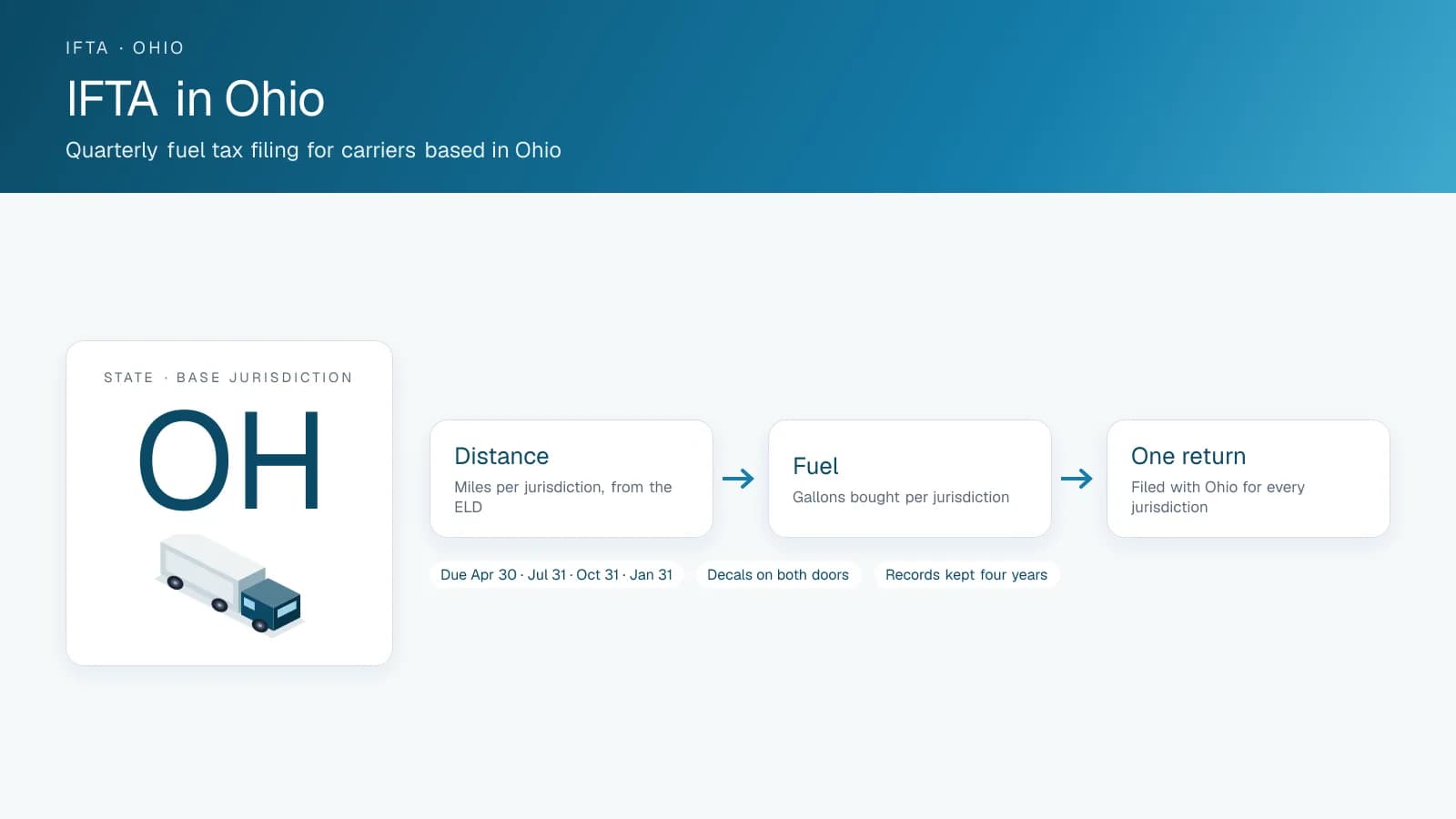
For IFTA in Ohio, the Ohio Department of Taxation administers the program for carriers based in the state, and quarterly returns go through its OH|TAX eServices portal. As in every member jurisdiction, the requirement covers qualified motor vehicles, generally over 26,000 pounds gross vehicle weight or with three or more axles, that operate in Ohio and at least one other IFTA jurisdiction. A fleet that never leaves Ohio doesn't need an IFTA licence.
Ohio charges no fee for IFTA registration, the licence or decals. Once you're registered, a return is due every quarter whether or not the fleet drove any qualifying miles, so a quiet quarter still needs a filed zero return.
First-time registration also happens in OH|TAX eServices, where you register the IFTA account and the Department of Taxation reviews the application before any filing obligation starts. Fleets that register mid-year sometimes miss that the very next quarter, even a partial one, needs a return. The filing calendar runs on fixed calendar-quarter dates, whenever in the quarter the licence was approved.
How to File Through OH|TAX eServices
Ohio carriers file quarterly IFTA returns through OH|TAX eServices with an OHID login. You can enter the data by hand or, if you have a lot of jurisdiction-by-jurisdiction figures, upload an IFTA tax upload template. Due dates follow the standard IFTA schedule: April 30, July 31, October 31 and January 31, moved to the next business day when they fall on a weekend or holiday.
The Ohio IFTA licence renews every year. The renewal window opens October 1, and your renewal must be submitted and approved by December 31 for you to keep filing under a valid licence in the new calendar year. Put that date on the calendar separately from the quarterly deadlines.
Renewal is also when many carriers ask whether they still need an Ohio IFTA licence. A fleet that has moved to purely intrastate routes can't let the licence lapse on its own. It has to cancel it with the Department of Taxation, or the quarterly filing obligation, zero returns included, keeps running against an account that is still open.
Avoiding Late Renewals and Late Returns
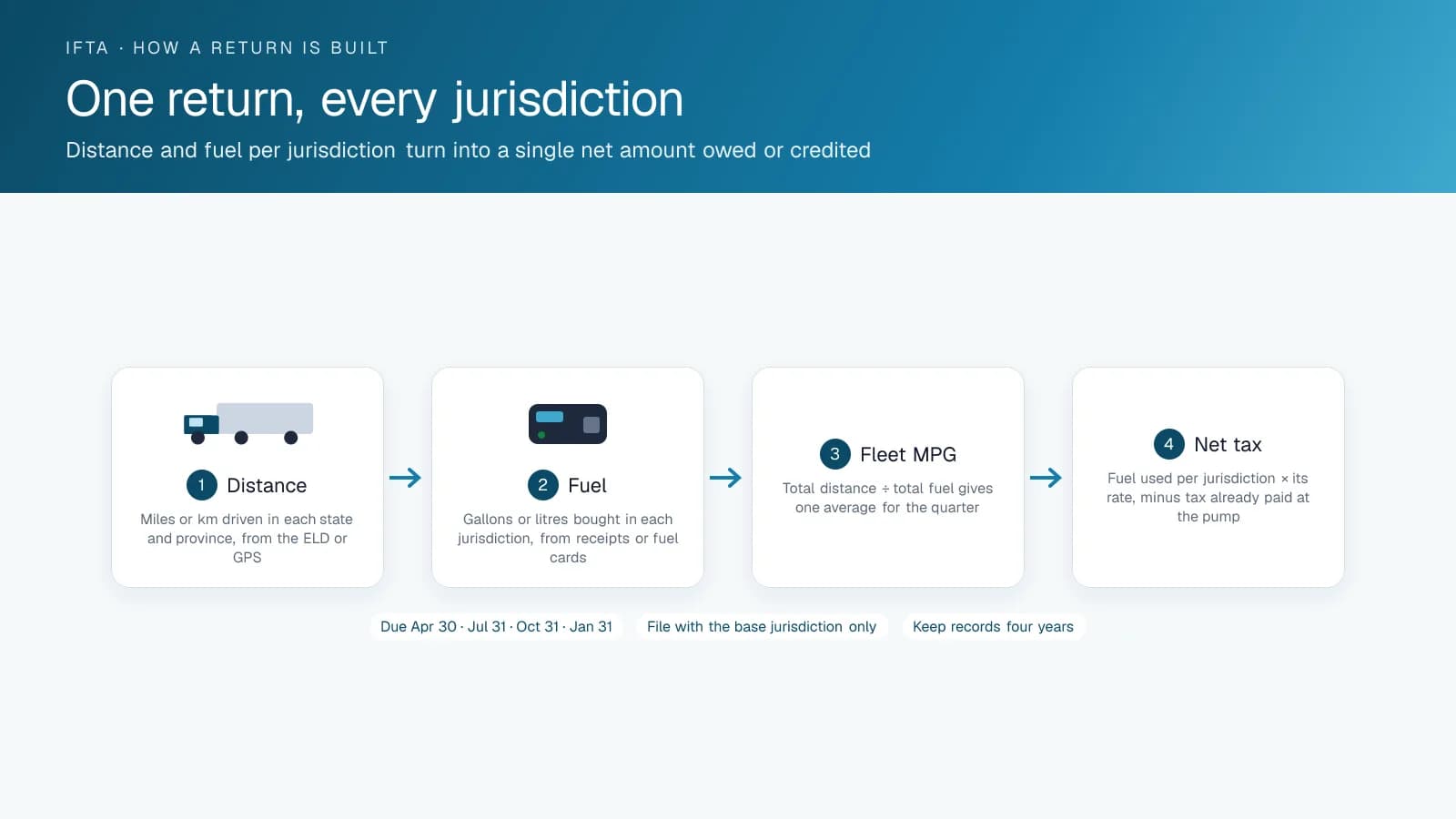
Missing the December 31 renewal cutoff is a separate risk from missing a quarterly return, and because it comes once a year it's easy to overlook. Late or missing quarterly returns carry the standard IFTA penalty most member jurisdictions use: a flat fee or a percentage of the tax due, whichever is greater, plus monthly interest on unpaid amounts.
Cents-per-gallon tax rates change quarterly and are published in the IFTA, Inc. rate matrix, so there is no fixed schedule worth memorizing. GPS mileage by jurisdiction turns the quarterly Ohio return from a manual reconstruction into something closer to a data export. That helps most for fleets whose routes cross in and out of the state regularly.
Ohio IFTA Recordkeeping That Survives an Audit
Ohio carriers follow the same recordkeeping standard as every IFTA jurisdiction: keep the mileage and fuel records behind each quarterly return for four years from the due date or filing date, whichever is later. The shared IFTA Procedures Manual sets that rule, not the Ohio Department of Taxation, so it is the same whichever state is your base jurisdiction.
An auditor checks whether trip-level mileage and fuel receipts tie back to a specific vehicle, date and jurisdiction, beyond whether the quarterly total looks reasonable. Paper trip sheets and a shoebox of receipts cause most of the gaps, because they rely on someone logging every state-line crossing correctly as it happens. A telematics platform that timestamps and logs jurisdiction crossings automatically removes that dependency.
Ohio IFTA at a Glance
The basics for an Ohio-based carrier in one place. Confirm procedures in OH|TAX eServices before each renewal.
| Item | Ohio |
|---|---|
| Administering agency | Ohio Department of Taxation |
| Portal | OH|TAX eServices with an OHID login; manual entry or an upload template |
| Licence and decal fee | None |
| Renewal window | October 1 to December 31 |
| Return due dates | April 30, July 31, October 31, January 31, or the next business day |
| Zero-activity quarter | Return still required |
| No longer interstate | Cancel the licence actively; it does not lapse on its own |
| Record retention | Four years from the due date or filing date, whichever is later |
Frequently asked questions
Who administers IFTA for Ohio-based carriers?
The Ohio Department of Taxation administers IFTA for Ohio-based carriers. Carriers file their quarterly returns through its OH|TAX eServices portal with an OHID login, either by entering the figures by hand or by uploading the IFTA tax upload template, and they handle renewal and cancellation through the same department.
Does Ohio charge a fee for IFTA registration or decals?
No. Ohio doesn't charge for IFTA registration, the licence or decals. The costs that matter are the fuel tax itself, settled on each quarterly return, and the penalties and interest that apply when a return is late or missing, so filing on time is where an Ohio carrier saves money.
When does an Ohio IFTA licence need to be renewed?
Every year. The renewal window opens October 1, and the renewal must be submitted and approved by December 31 for the licence to stay valid into the new year. Track that date separately from the quarterly deadlines, since it comes only once a year and is easy to miss.
Do Ohio carriers still need to file if they didn't drive any qualifying miles that quarter?
Yes. A zero-activity quarter still needs a filed zero return, and skipping the filing is not an option. The obligation continues every quarter for as long as the licence is open, so a fleet that no longer runs interstate should cancel the licence with the Department of Taxation instead of letting it sit.
How long do Ohio carriers need to keep IFTA records?
Four years from the return's due date or filing date, whichever is later. That is the shared IFTA standard used in every member jurisdiction, set by the IFTA Procedures Manual. Keep trip-level mileage and fuel receipts that tie to a specific vehicle, date and jurisdiction, since that is what an auditor checks.
Related solutions & products
Service areas
Related terms
Continue reading
- Compliance (ELD, DVIR, IFTA) overview →
- Ohio IRP: Who Handles Apportioned Registration, Fees and the Distance Schedule →
- How to Calculate Your IFTA Taxes: Formula and Worked Example →
- Who Needs IFTA? The Qualified Motor Vehicle Definition, Axle by Axle →
- IFTA Ontario: Filing and Renewal Through ONT-TAXS Online →
- More in Compliance →
Get a free quote
- Over 500 fleets
- Since 2013
- 4.9 on Google (19 reviews)
What are you looking for?
Prefer to talk?Call 1-800-613-6323[email protected]