
Compliance
How to Calculate Your IFTA Taxes: Formula and Worked Example
How is IFTA calculated? Allocate fuel to each jurisdiction by miles driven, apply its rate, then subtract tax paid at the pump. See the math worked out.

How Is IFTA Calculated? The Formula for IFTA Taxes
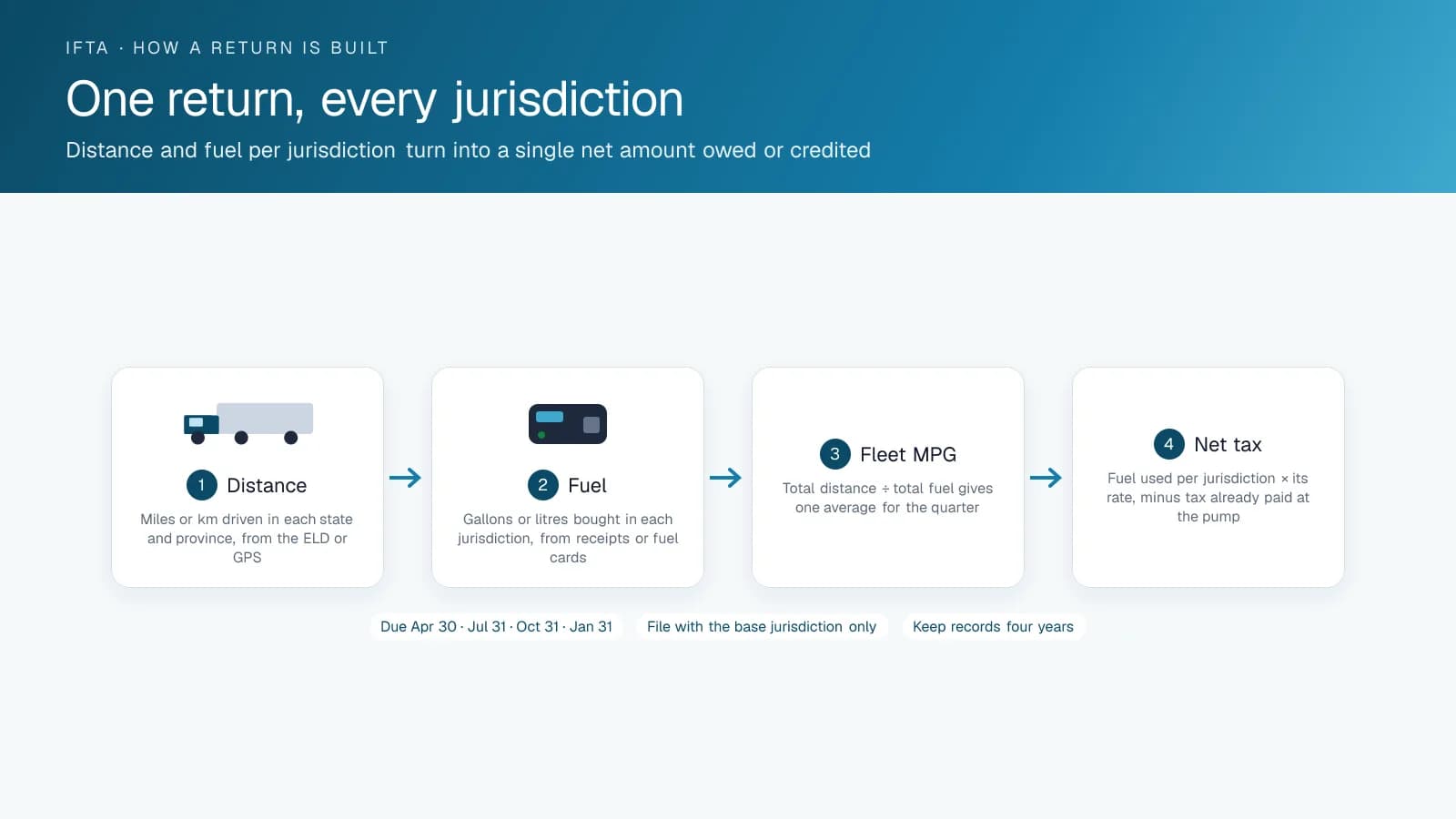
To calculate IFTA taxes, you work out total fuel consumed for the quarter, allocate it to each jurisdiction by the miles driven there, apply that jurisdiction's tax rate, and subtract the tax already paid on fuel bought there. What's left is either a balance owed or a credit. The formula isn't complicated on its own, but it gets tedious by hand across a real fleet, because you repeat it jurisdiction by jurisdiction.
In formula terms: Total Miles ÷ Fleet MPG = Total Gallons Consumed. Then, for each jurisdiction: (Jurisdiction Miles ÷ Total Miles) × Total Gallons Consumed = Gallons Used in That Jurisdiction. Multiply that by the jurisdiction's tax rate for the quarter to get tax owed, then subtract the tax already paid at the pump in that jurisdiction.
You repeat that sequence for every jurisdiction a vehicle touched during the quarter. A fleet running routes through six or eight jurisdictions runs the same set of calculations six or eight times, per vehicle, every quarter.
A Worked IFTA Example (Illustrative Numbers Only)
Say a truck drives 10,000 total miles in a quarter at an average of 6 miles per gallon, with 4,000 of those miles in Jurisdiction A and 6,000 miles in Jurisdiction B. Total fuel consumed: 10,000 ÷ 6 = about 1,666.7 gallons. Jurisdiction A's share: (4,000 ÷ 10,000) × 1,666.7 = about 666.7 gallons. Jurisdiction B's share: (6,000 ÷ 10,000) × 1,666.7 = about 1,000 gallons.
Next, apply tax rates. These are placeholders for illustration, not current published rates: say $0.20 per gallon in Jurisdiction A and $0.25 per gallon in Jurisdiction B. Tax owed in A: 666.7 × $0.20 = about $133.34. Tax owed in B: 1,000 × $0.25 = $250. If the fleet bought 500 gallons in Jurisdiction A and 1,100 gallons in Jurisdiction B at those same rates, it already paid 500 × $0.20 = $100 in A and 1,100 × $0.25 = $275 in B. Net result: the fleet owes Jurisdiction A an additional $33.34, because the truck drove more there than the fuel it bought there covered, and it has a $25 credit in Jurisdiction B, because it bought more fuel there than it burned there.
Look at what pushed each result. The fleet owed more in Jurisdiction A because the truck drove proportionally more miles there than its fuel purchases there would cover, and it earned a credit in B because the opposite was true. Miles driven against fuel bought in the same place is the whole mechanism behind every IFTA outcome, from a five-dollar credit to a five-hundred-dollar bill.
Where Do Fleets Get the IFTA Math Wrong?
The formula itself rarely trips anyone up. The inputs do: an outdated quarterly tax rate, an MPG figure that doesn't reflect the vehicle or its route conditions, or jurisdiction mileage estimated from memory instead of measured. Any one of those errors carries through every jurisdiction in the calculation, because the formula depends on getting miles, fuel and rates right for each jurisdiction the fleet touched that quarter.
A single fleet-wide MPG figure is another common simplification that adds error at scale. A loaded truck climbing mountain routes burns fuel differently from the same truck on flat highway, and averaging very different route types into one MPG number can skew the gallons-consumed figure for fleets with varied route profiles.
Doing IFTA by Hand vs. Letting GPS Data Do It
By hand, the arithmetic is easy; the hard part is knowing exactly how many miles each vehicle drove in each jurisdiction. A GPS platform that logs every jurisdiction boundary crossing removes that step. It measures the mileage inputs automatically instead of leaving you to reconstruct them from route memory, which is where most real-world error in this calculation comes from.
With mileage by jurisdiction measured instead of estimated, the rest of the formula comes down to plugging in the current rate matrix and letting the arithmetic run. That kind of repetitive, error-prone calculation is worth automating across a real fleet every quarter.
The IFTA Example in a Table
The worked example above, laid out the way a return presents it, with the same illustrative rates.
| Line | Jurisdiction A | Jurisdiction B | Total |
|---|---|---|---|
| Miles driven | 4,000 | 6,000 | 10,000 |
| Fleet MPG | 6.0 | ||
| Gallons consumed | 666.7 | 1,000.0 | 1,666.7 |
| Tax rate (illustrative) | $0.20 | $0.25 | |
| Tax on gallons consumed | $133.34 | $250.00 | $383.34 |
| Gallons purchased | 500 | 1,100 | 1,600 |
| Tax paid at the pump | $100.00 | $275.00 | $375.00 |
| Net | Owed $33.34 | Credit $25.00 | Owed $8.34 |
Frequently asked questions
Do I need to know my fleet's exact MPG to calculate IFTA taxes?
Yes, you need a reasonably accurate figure, because MPG drives the total-gallons-consumed calculation that everything else rests on. Using a rough industry-average MPG in place of your fleet's actual average is a common source of error. Fleets with varied routes should also be careful with a single fleet-wide figure, which can skew the result.
What if I don't know exactly how many miles I drove in each jurisdiction?
GPS-based mileage tracking solves that problem. A telematics platform that logs jurisdiction boundary crossings gives you measured mileage for each jurisdiction automatically, so you don't have to reconstruct it from memory or route notes. Measured mileage removes the input that causes most real-world errors in the IFTA calculation.
Are the tax rates used in this example real current IFTA rates?
No. The rates in this example are placeholders, used only to show how the calculation works. For an actual filing, always use the current quarterly tax rate matrix published by IFTA, Inc., since rates are set each quarter and an outdated rate is one of the most common input errors.
Does using one fleet-wide MPG figure cause calculation errors?
It can, especially for fleets that run varied route types. A truck's real fuel consumption differs between mountain and flat-highway driving, so averaging everything into a single MPG figure can skew the gallons-consumed calculation. That error then carries into every jurisdiction's share of fuel and tax for fleets with mixed route profiles.
Sources
Related solutions & products
Related terms
Continue reading
- Compliance (ELD, DVIR, IFTA) overview →
- IFTA Texas: How to Get a Licence and File Your Returns →
- How to File IFTA Online: Step-by-Step for Your First Quarterly Return →
- Florida IFTA: How to Get the Licence and File Your Return →
- When Is IFTA Due? IFTA Filing Deadlines and Late Fees →
- More in Compliance →
Get a free quote
- Over 500 fleets
- Since 2013
- 4.9 on Google (19 reviews)
What are you looking for?
Prefer to talk?Call 1-800-613-6323[email protected]