
Compliance
IFTA Texas: How to Get a Licence and File Your Returns
IFTA Texas: get your licence from the Texas Comptroller, then file every quarter through Webfile. Who needs one, what is free and what brings a penalty.
Who Needs a Texas IFTA Licence?
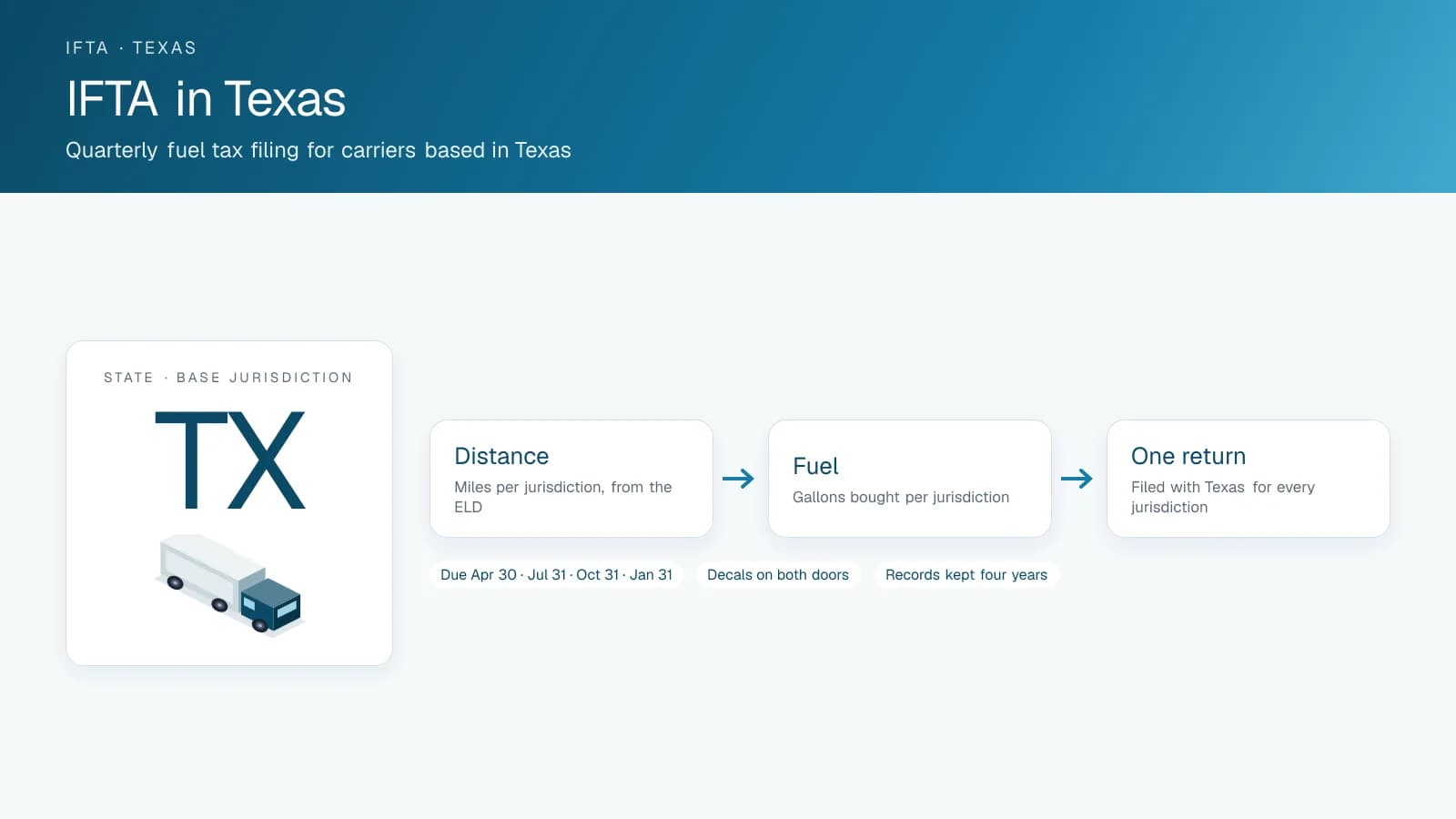
To file IFTA in Texas, you get a Texas IFTA licence from the Texas Comptroller of Public Accounts and then file a fuel tax return every quarter, on time, with records to back it up. You need that licence if your fleet runs even one qualified motor vehicle (two axles with a gross or registered gross vehicle weight over 26,000 pounds, three or more axles regardless of weight, or a combination over 26,000 pounds) in Texas plus at least one other IFTA member jurisdiction. The one Texas licence replaces separate licences in every state you drive through.
Texas can be your base jurisdiction only if you have an established physical place of business in the state. A mailing address or PO box alone doesn't qualify. There is no minimum fleet size: a single qualified vehicle that travels in two or more member jurisdictions needs the licence, or fuel trip permits. If your qualified vehicles stay inside Texas, IFTA doesn't apply, and you pay fuel tax under Texas's regular motor fuels rules instead.
Registration comes first. You apply to the Comptroller and get approved before you file any quarterly return; the two don't happen in one step. Approval brings a Texas IFTA licence and decals for each qualified vehicle, and from then on a return is due every quarter, whether or not that quarter had any qualifying miles outside Texas. New fleets sometimes treat the licence as the finish line, then miss their first quarterly deadline because nobody put the return on the calendar as a recurring job.
How Do You File a Texas IFTA Return?
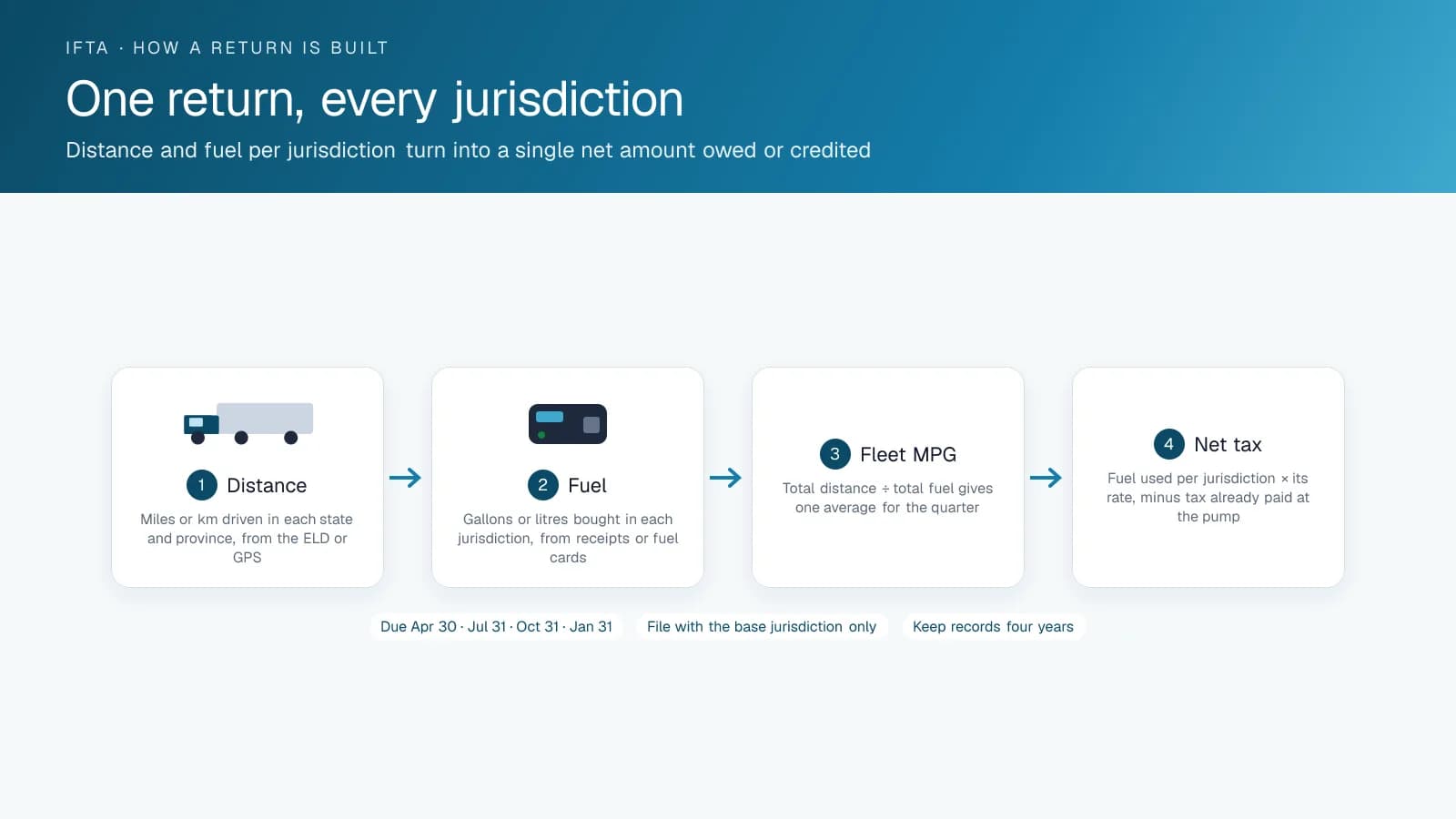
The Comptroller asks carriers to file Texas IFTA returns electronically through Webfile, its eSystems portal, and accepts paper returns in cases of hardship. The quarterly due dates are the same in every IFTA jurisdiction: April 30, July 31, October 31 and January 31. A date that lands on a weekend or holiday moves to the next business day.
Each qualified vehicle displays two IFTA decals, one on each exterior side of the cab, and the Comptroller mails the licence and decals once it approves your application. The Comptroller's IFTA pages don't list a licence or decal fee, so confirm any cost with the Comptroller before you apply. Once licensed, you owe a return every quarter, including zero-mileage quarters, until you formally cancel the licence.
Cancelling is its own step. The licence doesn't lapse because your trucks stopped leaving Texas. If your fleet shrinks back to Texas-only work and you never cancel, the Comptroller still expects a zero return each quarter until it processes the cancellation. That gap is a common and avoidable cause of missed filings on accounts nobody watches anymore.
What Happens When You File Late in Texas?
The Comptroller's published guidance states the penalty plainly: a late, missing or underpaid IFTA return costs $50 or 10 percent of the delinquent tax, whichever is greater. Every IFTA member jurisdiction can assess the same penalty, because it is set in the shared IFTA Articles of Agreement and Texas did not write it.
Tax rates for each jurisdiction change every quarter, so don't memorize them or copy them from an old article. A rate that was right last quarter can be wrong by the time you file. IFTA, Inc. publishes the current rate matrix for every member jurisdiction each quarter, and that matrix is the one to check at filing time.
GPS mileage tracking keeps the Texas quarterly filing manageable for a larger fleet. With an exact record of when each vehicle entered or left Texas, nobody has to match odometer readings and fuel receipts against a route they're trying to remember three months later.
Keeping Records That Hold Up in an IFTA Audit
An on-time return covers half of IFTA compliance. The IFTA Procedures Manual requires you to keep the mileage and fuel records behind each quarterly return for four years from the return's due date or filing date, whichever is later. Texas carriers follow that rule the same way carriers do everywhere else, since it's a shared agreement requirement and the Comptroller doesn't set it independently.
An auditor checks more than the number on the return. They check whether the trip-by-trip mileage and fuel receipts underneath it support that number. The gap auditors find most often is paperwork (trip sheets, odometer readings, fuel receipts) that doesn't tie back to a specific vehicle and date. A telematics platform that logs each jurisdiction crossing automatically, with a timestamp and odometer reading attached, produces the record an IFTA audit looks for, and nobody at your company has to rebuild it after the fact.
Texas IFTA at a Glance
The essentials for a Texas-based carrier in one table. Confirm procedures with the Comptroller before each renewal.
| Item | Texas |
|---|---|
| Administering agency | Texas Comptroller of Public Accounts |
| Portal | Webfile, in the Comptroller's eSystems |
| Decals | Two per qualified vehicle, one on each side of the cab |
| Base jurisdiction test | An established physical place of business in Texas; a PO box does not qualify |
| Return due dates | April 30, July 31, October 31, January 31, or the next business day |
| Zero-activity quarter | Return still required until the licence is cancelled |
| Late or underpaid return | $50 or 10 percent of the delinquent tax, whichever is greater |
| Record retention | Four years from the due date or filing date, whichever is later |
Frequently asked questions
Who has to register for IFTA in Texas?
Texas-based carriers that run even one qualified motor vehicle (over 26,000 lbs GVW on two axles, 3+ axles, or a combination over 26,000 lbs) in Texas and at least one other IFTA member jurisdiction must register with the Texas Comptroller of Public Accounts or buy fuel trip permits. Fleets that operate only within Texas don't need an IFTA licence and pay fuel tax under Texas's regular motor fuels rules instead.
Is there a fee for a Texas IFTA licence or decals?
The Comptroller's IFTA pages don't list a fee for the licence or decals, so confirm with the Comptroller before you apply. Approval brings the licence and two decals per qualified vehicle, one for each side of the cab. Once you hold the licence, you still owe a return every quarter, including quarters with zero miles outside Texas, until you formally cancel the licence with the Comptroller.
What's the penalty for a late IFTA filing in Texas?
The Comptroller's published penalty is $50 or 10 percent of the delinquent tax, whichever is greater, for a late, missing or underpaid return. Every IFTA member jurisdiction can assess the same penalty, because it is set in the shared IFTA Articles of Agreement. Filing every quarter on time, including zero returns, is the simplest way to avoid it.
Where do Texas carriers find current IFTA tax rates?
The Comptroller's IFTA page points filers to IFTA, Inc. for current and prior-period rates, published in the quarterly tax rate matrix, which covers every member jurisdiction and updates each quarter. Check that matrix when you file, since a rate copied from last quarter or from an old article can already be out of date.
How long do Texas carriers need to keep IFTA records?
Four years from the return's due date or filing date, whichever is later. This is a shared IFTA Procedures Manual requirement, not a Texas-specific rule, so it applies the same way in every member jurisdiction. Keep the trip-by-trip mileage and fuel receipts behind each return tied to a specific vehicle and date, because that is what an auditor checks.
Related solutions & products
Service areas
Related terms
Continue reading
- Compliance (ELD, DVIR, IFTA) overview →
- Texas IRP Registration: Apportioned Plates, Fees and the Distance Schedule →
- How to Calculate Your IFTA Taxes: Formula and Worked Example →
- Who Needs IFTA? The Qualified Motor Vehicle Definition, Axle by Axle →
- Tennessee IFTA: How to File TN IFTA Returns in TNTAP →
- More in Compliance →
Get a free quote
- Over 500 fleets
- Since 2013
- 4.9 on Google (19 reviews)
What are you looking for?
Prefer to talk?Call 1-800-613-6323[email protected]