
Compliance
What Is an ELD? Electronic Logging Devices Explained
An ELD (electronic logging device) records driving time from the engine and replaces the paper logbook. What it records, who needs one and who is exempt.
What Is an ELD and How Does It Work?
An ELD (electronic logging device) is a device connected to a commercial vehicle's engine that automatically records engine hours, movement, location and miles driven, then ties that data to the driver's Hours of Service (HOS) log. It replaced the paper logbook drivers used to fill out by hand at the end of a shift. In the US, the FMCSA ELD rule requires most commercial drivers who keep records of duty status to use one, and Canada's ELD mandate does the same. Paper logs and basic logging apps that don't meet the technical standard no longer qualify for those drivers.
The device connects to the engine control module, usually through the OBD-II port or a 9-pin diagnostic port, so it can confirm the vehicle is moving without relying on the driver to start and stop a timer. That was the weakness of paper logs and some older e-log apps: drivers could fudge them, on purpose or by mistake. Data pulled from the engine is much harder to falsify, and from a regulator's point of view that is the reason ELDs exist.
Inside the log, the ELD tracks each driver across four standard duty statuses: off duty, sleeper berth, driving, and on duty not driving. It only knows what the engine tells it (movement, engine on and off), so the driver still has to select a status change, such as going on duty, before pulling out. In the ELD app High Point GPS deploys, Geotab Drive, that change is a tap on the driver's phone or tablet. What the ELD does stop is anyone backdating the driving portion of the record or quietly editing it later.
Who Is Exempt From the ELD Mandate?
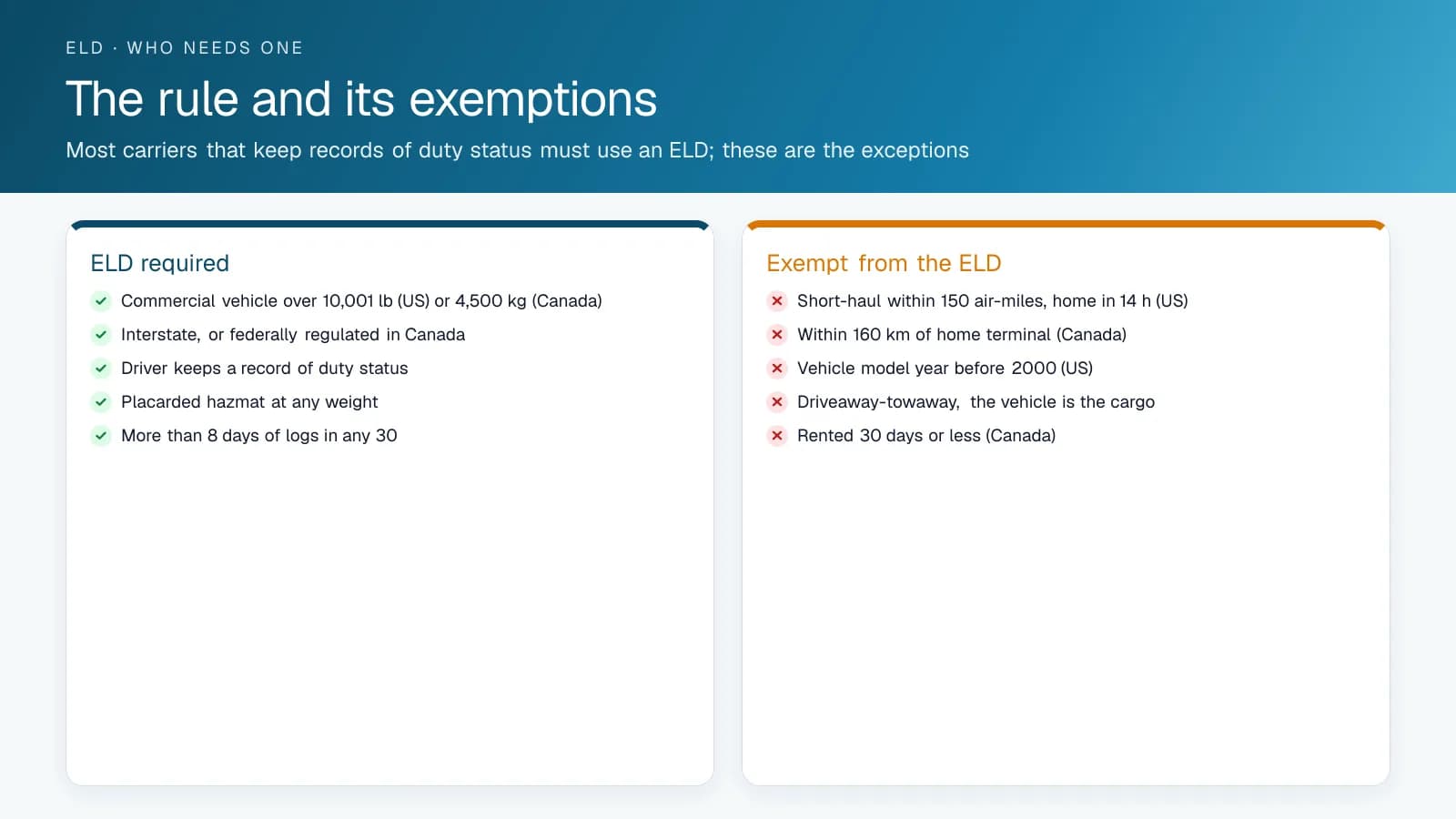
Some commercial drivers don't need an ELD. In the US, the documented FMCSA exemptions cover drivers working under the short-haul exception, drivers who use paper logs eight days or fewer in any 30-day period, driveaway-towaway drivers, and vehicles older than model year 2000, which lack the engine control module an ELD reads. Canada's list is different: vehicles operated under a permit or a federal exemption, rentals of 30 days or less, vehicles built before model year 2000, and drivers who aren't required to keep a record of duty status at all. That last group includes drivers covered by the hours-of-service exemption for work within 160 km of the home terminal, which also requires them to return there each day and the carrier to keep daily time records. A driver who claims an exemption wrongly at a roadside inspection can end up with an out-of-service order fast, so confirm your fleet's status before you assume it either way.
Fleets misread the short-haul exception more often than any other. In the US, it covers drivers who stay within a 150 air-mile radius of their normal work reporting location and return there within 14 hours. Those conditions are narrow and specific, and a driver who mostly works locally doesn't qualify on that basis alone.
What Must Be in the Cab, and What Happens When an ELD Malfunctions?
Every truck that runs an ELD must carry an ELD information packet, and every driver needs to know the malfunction procedure before the screen goes dark. In the US, the packet holds an instruction sheet on transferring logs to an officer, an instruction sheet on malfunctions, and enough blank paper log grids for at least 8 days. Canada asks for the same two sheets plus the ELD user's manual, and blank records of duty status for at least 15 days.
When a US driver's ELD fails, the driver gives the carrier written notice within 24 hours, rebuilds the logs for the current day and the previous 7 consecutive days on paper (unless the ELD can still produce them), and stays on paper until the device is fixed. The carrier has 8 days to repair or replace it. In Canada, the driver tells the carrier as soon as the vehicle is parked, writes the malfunction code and times on each day's log until the repair, and the carrier has 14 days to repair or replace the device.
Retention follows the same pattern on both sides of the border, with different wording.
| Item | United States (FMCSA) | Canada (federal hours of service rules) |
|---|---|---|
| Blank paper logs in the cab | At least 8 days | At least 15 days |
| ELD user's manual in the cab | Not on the required list | Required |
| Driver reports a malfunction | Written notice to the carrier within 24 hours | As soon as the vehicle is parked |
| Carrier fixes or replaces the ELD | Within 8 days; an extension can be requested | Within 14 days, or when the driver returns from a longer planned trip |
| Keeping the records | 6 months, with a backup copy on a separate device | At least 6 months, at the principal place of business |
How Does a Driver Show ELD Logs at a Roadside Inspection?
The driver shows the log on the ELD screen or on a printout, and sends it electronically when the officer asks. In the US, every registered ELD supports one of two transfer options: telematics (wireless web services and email) or local (USB 2.0 and Bluetooth). The officer gives the driver a routing code and the file goes to an FMCSA server, where the officer's software retrieves it. If the electronic transfer fails, FMCSA guidance says the driver is still compliant by showing the display or a printout.
In Canada, the driver produces the display or a printout and, if the inspector asks, transmits the records by the method the inspector names, from those the Technical Standard provides and the ELD supports. In Geotab Drive, the ELD app High Point GPS deploys, a US transfer means entering the officer's transfer code and tapping Email or Web services; a Canadian transfer means entering the email address the officer gives and tapping Transfer (Canada). A compliance print view on the device is the backup, and the officer can page through the days.
Walk drivers through a transfer before their first inspection. The instruction sheet in the cab only helps if someone has read it, and a driver searching through menus while the officer waits turns a short stop into a long one.
Why an ELD Is Usually Part of Your GPS Tracker
Most fleets don't run the ELD as a separate box. The GPS tracking device High Point GPS installs handles ELD and HOS logging, GPS tracking, engine diagnostics and driver behaviour scoring on the same hardware, and reports all of it to the same High Point GPS platform dashboard. You install one device, dispatch and safety check one login, and compliance data sits next to the tracking and safety data your team already looks at every day, instead of in a separate app nobody remembers to open.
When you compare ELD options, look past the log screen to what sits under it. Is the device on the FMCSA registered list and, for Canada, on Transport Canada's list of certified ELDs? That Canadian list shows every device an accredited body has certified for use in Canada, and you can search it by vendor, certification number or ELD identifier. Does it also give you GPS tracking and diagnostics, so you aren't paying for and installing two systems? Will the vendor back you up if a driver gets flagged at a scale house? Most buyers underrate that last question until the day it happens to one of their drivers.
Combined hardware also makes procurement simpler than buying a compliance-only ELD. Two devices mean two installs, two logins and two vendor relationships to manage when either one has a problem. With one device doing both jobs, you have one less thing that can go wrong and one less bill to reconcile each month.
What Happens If You Don't Comply With the ELD Rule?
Skipping or mishandling ELD compliance can cost you more than a single ticket. A driver caught at a roadside inspection without a compliant ELD, or using one improperly, can be placed out of service on the spot. The violation typically counts toward the carrier's CSA (Compliance, Safety, Accountability) score, and insurers, brokers and some shippers check that score when they decide who to work with.
For that reason, fleets tend to treat ELD compliance as a baseline operating requirement instead of a box to tick once and forget. Staying compliant keeps you clear of fines. It also protects your safety score, and through it your insurance costs and your standing with the brokers and customers who read that record before they do business with you.
What Does an ELD Record, and What Does It Miss?
The device captures some data on its own and leaves the rest for the driver to declare. Most misunderstandings about ELDs come from mixing up the two.
| Recorded automatically | Declared by the driver | Not recorded at all |
|---|---|---|
| Engine on and off | On duty, not driving | Audio or video (unless a separate camera is installed) |
| Vehicle moving, and driving status once it moves | Off duty and sleeper berth | The driver's phone activity |
| Distance and engine hours | Personal conveyance and yard moves, before moving | Location when the driver is not in the vehicle |
| Location, at reduced precision during personal conveyance | Annotations and certification of the day's log | Anything on a vehicle the driver is not logged into |
| Malfunctions and data diagnostics | Edits, which never overwrite the original | |
| Unassigned driving when nobody is logged in | Acceptance or rejection of carrier-suggested edits |
Frequently asked questions
Is an ELD the same thing as a GPS tracker?
No, although the two are related. An ELD logs Hours of Service and engine data for compliance, while a GPS tracker records location and trip history. The GPS tracking device High Point GPS installs does both jobs on one piece of hardware, which is why most fleets end up treating ELD logging and GPS tracking as a single system.
What happens if my ELD isn't on the FMCSA registered list?
At a roadside inspection, a device that isn't FMCSA-registered counts the same as having no ELD at all. That can lead to violations and an out-of-service order for the driver. Before you deploy an ELD across your whole fleet, confirm that the device appears on the current FMCSA registered list.
Do owner-operators need an ELD?
Yes, in most cases. An owner-operator who is required to keep records of duty status needs an ELD unless a documented FMCSA exemption applies. The main exemptions are the short-haul exception, drivers using paper logs 8 days or fewer in 30, driveaway-towaway operations, and vehicles older than model year 2000.
Does an ELD violation affect a carrier's safety score?
Yes. ELD-related violations found during a roadside inspection typically count toward the carrier's CSA score, and the driver can also be placed out of service on the spot. Insurers, brokers and some shippers check CSA scores when they decide whether to do business with a carrier.
What should a driver do if the ELD stops working?
Switch to paper and tell the carrier. In the US, the driver gives written notice within 24 hours, rebuilds the current day and previous 7 days on paper logs, and the carrier has 8 days to fix the device. In Canada, the driver notifies the carrier once parked, records the malfunction code on each log, and the carrier has 14 days.
How long must ELD records be kept?
At least six months in both countries. In the US, the carrier keeps ELD records for 6 months, with a backup copy on a device separate from the original. In Canada, the carrier keeps records of duty status and supporting documents for at least 6 months at its principal place of business, in order for each driver.
Sources
- FMCSA: Electronic Logging Devices
- FMCSA: Hours of Service
- eCFR, 49 CFR 395.22, Motor carrier responsibilities (ELD information packet, record backup)
- eCFR, 49 CFR 395.34, ELD malfunctions and data diagnostic events
- FMCSA, ELD Data Transfer
- Justice Laws, Commercial Vehicle Drivers Hours of Service Regulations (SOR/2005-313), sections 77, 78, 85 and 98
- Geotab support, Roadside checks in Geotab Drive
- Transport Canada, List of electronic logging devices
Related solutions & products
Related terms
Continue reading
- Compliance (ELD, DVIR, IFTA) overview →
- ELD Info: The Documents a Driver Must Show at an ELD Roadside Inspection →
- ELD and Telematics: Do You Need Both? →
- ELD Settings Validator: Catching ELD Setup Errors Before the Officer Does →
- ELD Compliance Guide: What the ELD Enforces and What Fleets Still Do →
- More in Compliance →
Get a free quote
- Over 500 fleets
- Since 2013
- 4.9 on Google (19 reviews)
What are you looking for?
Prefer to talk?Call 1-800-613-6323[email protected]