
Compliance
FMCSA ELD Exemptions: Does Your Fleet Need One?
ELD exemptions under FMCSA rules cover short-haul and local drivers, occasional paper loggers, driveaway-towaway and older vehicles. See which applies.
Do FMCSA ELD Exemptions Apply to Your Fleet?
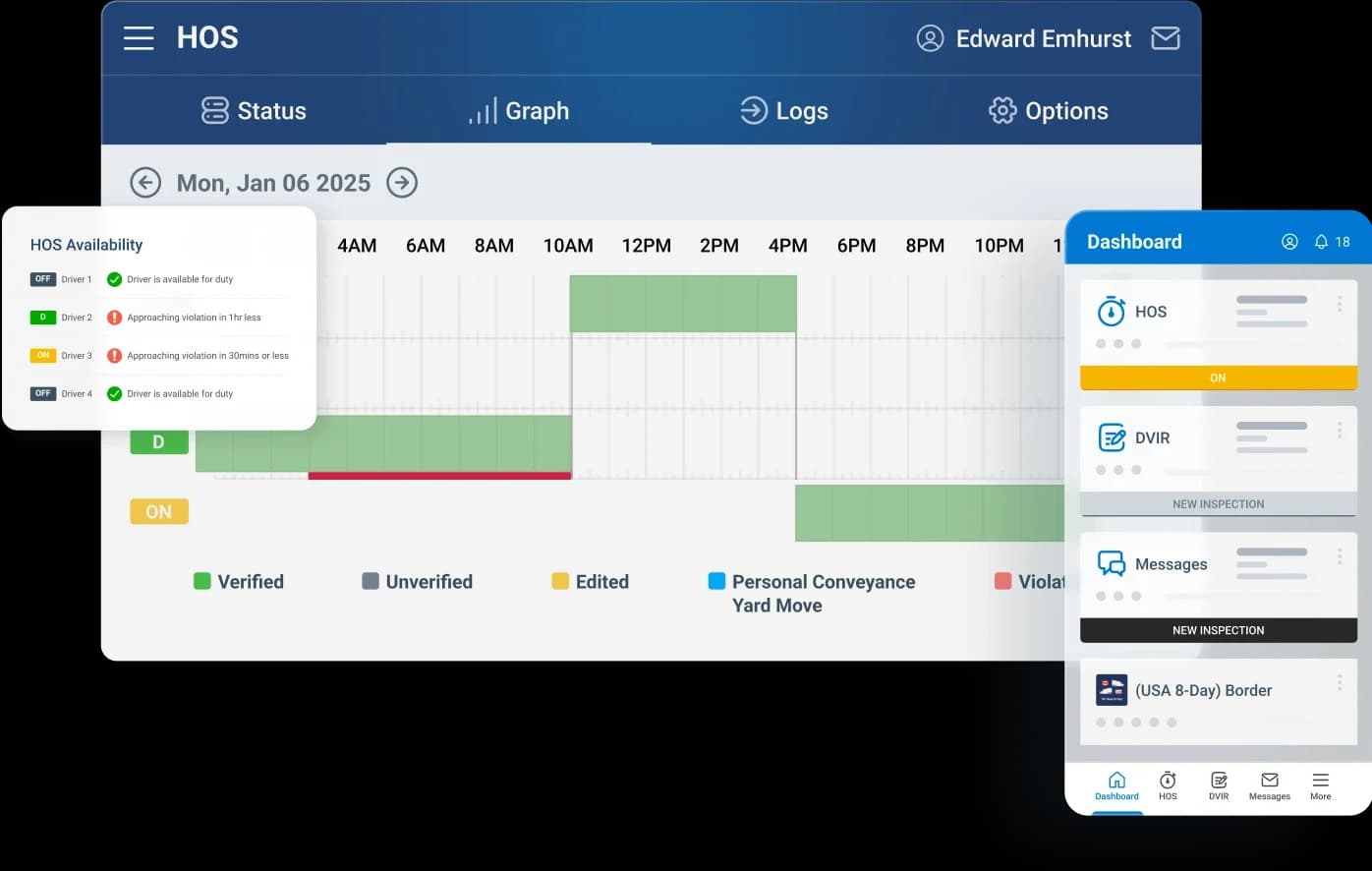
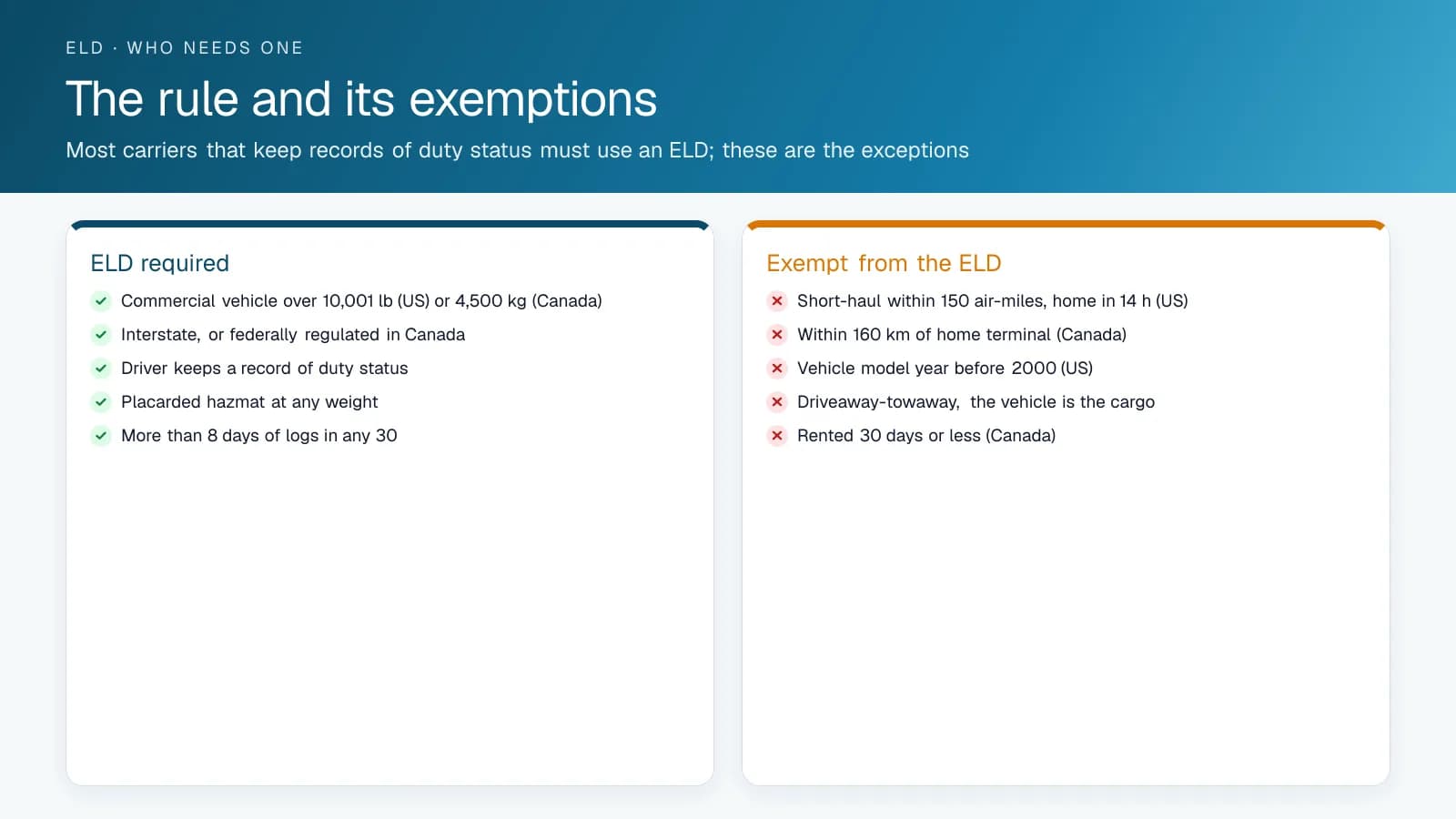
Most commercial drivers who keep records of duty status need an ELD, but the FMCSA rule has several documented ELD exemptions, and some fleets qualify for one. Many fleet managers assume ELDs are mandatory across the board, and for most drivers that holds. Know which exemption applies to your operation, if any, before you rely on it, because a wrong guess at a roadside inspection goes badly. These are US rules: Canadian federally regulated carriers follow Transport Canada's ELD rules, which have their own exemptions, such as the 160 km radius for drivers who return to their home terminal each day.
The exemptions exist for operational reasons and were not written as loopholes. A local trades van that never leaves a 20-mile radius has different oversight needs from a long-haul sleeper cab crossing three states, and the exemption structure accounts for that instead of treating every commercial vehicle the same way regardless of how it's used.
Which FMCSA ELD Exemptions Exist?
The short-haul exception is the one fleets use most. Drivers who operate within a 150 air-mile radius of their normal work reporting location and return to that location within 14 hours generally don't need to keep RODS at all, on an ELD or on paper, as long as they meet the specific time and distance conditions. The exception is narrow. Driving locally doesn't qualify a driver on its own, so confirm your routes meet the conditions before you assume they do.
A second exemption covers drivers who use paper logs eight days or fewer in any rolling 30-day period. It suits fleets where most drivers are exempt or off the ELD most of the time and only log hours now and then. Driveaway-towaway operations, where the vehicle being driven is the commodity being delivered, have their own exemption. Vehicles with an engine older than model year 2000 are also exempt, because those engines generally lack the electronic control module an ELD reads engine data from. FMCSA goes by the engine's model year, not the vehicle's.
Check these conditions driver by driver, not fleet-wide. One company can have some drivers who qualify for the short-haul exception on most days and others who sometimes run a longer route that takes them outside the 150 air-mile radius. That specific trip has to be logged, even if the driver is exempt on a normal day.
What Happens If You Claim an Exemption Incorrectly?
Claiming an exemption you don't qualify for counts the same as running without a required ELD, and this is where fleets get caught. You face violations, possible fines and, in some cases, an out-of-service order that strands a load. If your fleet does qualify, write down why, keep that documentation with the driver, and make sure the driver can explain it clearly at an inspection.
Keep two decisions separate. An exemption from ELD and HOS logging says nothing about your need for GPS tracking or video safety. Plenty of exempt fleets, local trades and field service vehicles among them, still want real-time location, driver behaviour data and dash cam footage for productivity and liability reasons that have nothing to do with the ELD mandate.
So for an exempt fleet, the technology question shifts from "do we need an ELD?" to "which of the other capabilities do we still want?" Most exempt fleets end up running GPS tracking anyway with the HOS logging module switched off, since the dispatch and safety value has no connection to exemption status.
The Exemptions, Listed
Each FMCSA exemption appears below with the condition that most often disqualifies a driver who assumed it applied. Rulemaking can change these rules, so confirm with the FMCSA before you rely on one.
| Exemption | Conditions | Where fleets get caught |
|---|---|---|
| Short-haul, 150 air-miles | Start and end at the same work reporting location; released within 14 hours; no RODS required | A long day goes on RODS; more than 8 RODS days in 30 means an ELD |
| 8 days in 30 | RODS required on no more than 8 days in any 30-day period | A driver who keeps paper logs on a ninth day needs an ELD from then |
| Driveaway-towaway | The vehicle driven is the commodity being delivered | Does not cover the return trip in a different vehicle |
| Pre-2000 engine | Engine model year before 2000, by the engine plate, not the VIN | A glider or re-powered truck with a newer engine is not exempt |
| Intrastate only | Outside the federal rule, but many states apply their own ELD rules to intrastate carriers | Freight that is part of an interstate move makes the trip interstate |
| Any of the above | Documented, with the driver, and explainable at roadside | Claiming one that does not apply is treated as having no ELD |
Frequently asked questions
What is the 150 air-mile short-haul exemption?
The short-haul exemption frees drivers from keeping records of duty status, and so from needing an ELD, if they operate within a 150 air-mile radius of their normal work reporting location and return there within 14 hours. The specific conditions in the FMCSA rule still apply, and the exemption covers each qualifying trip, not the driver permanently.
Do vehicles older than model year 2000 need an ELD?
Not if the engine is older than model year 2000. FMCSA applies this exemption by engine model year, because older engines generally lack the electronic control module that an ELD reads engine and movement data from. A truck with a newer replacement engine is not exempt, so check the engine plate before claiming the exemption.
Can a fleet switch between paper logs and an ELD depending on the driver?
Only within the documented exemptions, such as the paper log exception for drivers who keep RODS 8 days or fewer in a rolling 30-day period. Outside a real exemption, every driver required to keep RODS has to use a compliant ELD consistently. Check each driver's situation separately, since one fleet can mix exempt and non-exempt drivers.
Can one driver qualify for an exemption on some days but not others?
Yes. The short-haul exception applies trip by trip, not permanently. A driver who normally stays within the 150 air-mile radius still has to log hours on any day they run a longer route outside it. That one trip goes on RODS, even if the same driver is exempt for the rest of the week.
Related solutions & products
Service areas
Continue reading
- Compliance (ELD, DVIR, IFTA) overview →
- IRP Registration in New York: Apportioned Plates, Fees and the Distance Schedule →
- IFTA New York Guide: OSCAR Filing and the NY HUT Tax →
- How to File IFTA Online: Step-by-Step for Your First Quarterly Return →
- How to Pass a DOT Inspection: Checklist and Inspection Levels →
- More in Compliance →
Get a free quote
- Over 500 fleets
- Since 2013
- 4.9 on Google (19 reviews)
What are you looking for?
Prefer to talk?Call 1-800-613-6323[email protected]