
Compliance
How to Pass a DOT Inspection: Checklist and Inspection Levels
To pass a DOT roadside inspection, have credentials, ELD logs and a DVIR ready. This DOT inspection checklist covers brakes, tires, lights and the levels.

What Does Passing a DOT Roadside Inspection Require?
You pass a DOT roadside inspection when the inspector finds no out-of-service condition on the driver or the vehicle. Your DOT inspection checklist has two sides that must be in order at the same time. On the paperwork side, you need a valid licence and proof of medical certification, current insurance and registration, and a clean, up-to-date ELD log the driver can transfer or display on request. On the mechanical side, brakes, tires, lights, steering and load securement must be within limits, backed by a current DVIR. If both hold up, the truck rolls; if either fails at an out-of-service level, it stays.
The inspector is checking a defined list and is not hunting for reasons to fail you. Know what is on that list and have it ready before you are pulled in, and you have done most of the job. A driver who produces documents quickly and calmly, with logs already current, sets the tone for the whole stop.
Which DOT Inspection Levels Are You Most Likely to See?
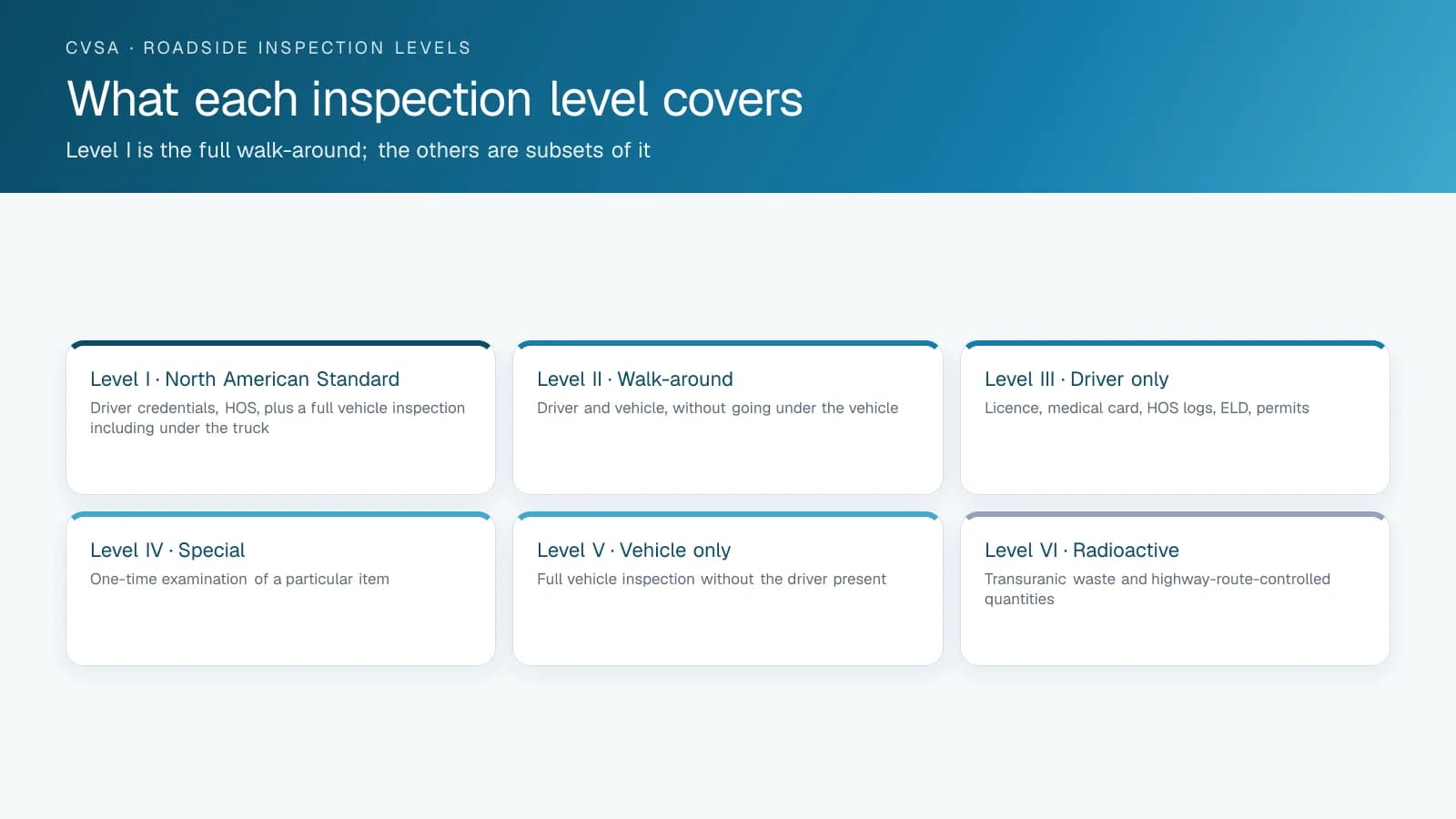
Inspectors grade roadside inspections by level. A Level I is the full North American Standard inspection, covering the driver and a walk-around of the vehicle, including underneath. A Level II is a walk-around driver-and-vehicle inspection that skips the underside. A Level III is driver-only: credentials, medical certification, hours of service, ELD and required paperwork, with no mechanical component. Higher-numbered levels exist for specific purposes, but most commercial drivers encounter Levels I through III.
Even a driver-only Level III can put a truck out of service on hours-of-service or ELD grounds alone, with no mechanical fault at all. A clean log and ready credentials are often the entire inspection, so give them the same attention as the brakes.
What Credentials, HOS and ELD Records Do Inspectors Check?
Keep the documents an inspector will ask for within arm's reach: driver's licence, proof of medical certification (for CDL holders, it now goes electronically to the state driving record under FMCSA's National Registry II, though a paper certificate can still apply in some cases), and the vehicle's registration and proof of insurance. On the hours side, the driver has to be inside the daily and cycle limits and able to produce the ELD record, by electronic transfer or on the display, without fumbling the transfer. Keep three things in the cab: an instruction sheet for transferring ELD data, an instruction sheet for reporting ELD malfunctions, and at least eight days of blank paper logs. Those are required backups in the US, and the inspector may ask to see them. Since July 22, 2026, FMCSA no longer requires the ELD user manual in the truck; Canada still does.
A clean ELD log needs more than hours remaining. It should have no unassigned driving time hanging on the account, no string of unexplained edits, and no misused special-driving-category flags. An experienced inspector reads those details quickly, and a fleet can keep them tidy year-round instead of scrambling to explain them at the scale house.
What Puts a Truck Out of Service on the Mechanical Side?
The vehicle side centres on the systems most likely to cause a crash: brakes (adjustment and function), tires (tread depth, inflation, no exposed cord or flats), lights and reflectors, steering and suspension, coupling devices, and load securement. A current DVIR that matches the vehicle's actual condition ties this together by showing that defects get found and fixed. Load securement comes up often, because inspectors check it against specific working-load-limit and tie-down rules that are easy to underestimate.
An out-of-service order is the outcome you are trying to avoid. It means the inspector found a condition serious enough that the driver or vehicle cannot legally continue until it is corrected: a defective brake, a flat or badly worn tire, an HOS violation, an unsecured load. The North American Standard Out-of-Service Criteria define where that line sits, so the target is 'within the published limits', and 'looks fine' won't hold up.
You can't get there in a day. Fleets that pass consistently treat the walk-around, the DVIR and the ELD log as a daily habit, so any truck pulled in on any day is already in order and nobody has to prepare after the fact.
A DOT Inspection Checklist for the Pre-Trip Walk-Around
Here is a driver walk-around in the order inspectors follow, with the out-of-service conditions most often found at each stop. Fleets load this list into the driver app as the DVIR.
| Stop | Check | Out-of-service condition often found |
|---|---|---|
| Cab | Licence, medical certification, registration, insurance, cab card, ELD documents, logs current | Over hours; missing ELD documents; unassigned driving |
| Front | Headlights, signals, windshield, wipers, mirrors | Inoperative headlight or signal |
| Steer axle | Tire tread and inflation, wheel nuts, hub leaks, steering play | Steer tire tread under 2/32 (under 4/32 is a violation); loose nuts |
| Under the cab | Brake chambers, slack adjusters, air leaks, hoses | Brake out of adjustment; audible air leak |
| Drive axles | Tires, brakes, suspension, exhaust | Flat or exposed cord; broken spring |
| Coupling | Fifth wheel lock, glad hands, electrical line | Fifth wheel not locked |
| Trailer | Lights, tires, brakes, doors, placards | Inoperative brake lights; ABS fault |
| Load | Tie-downs, working load limit, edge protection, tarps | Insufficient tie-downs for the load |
| Rear | Lights, reflectors, underride guard, mudflaps | Missing rear lights |
Frequently asked questions
What is the difference between a Level I, II, and III inspection?
Level I is the full driver-and-vehicle inspection, including under the vehicle. Level II is a walk-around driver-and-vehicle inspection without going underneath. Level III is driver-only, covering credentials, medical certification, hours of service, ELD and paperwork, with no mechanical component, and it can still end in an out-of-service order.
What puts a truck out of service at a roadside inspection?
Any condition that meets the North American Standard Out-of-Service Criteria. Examples include defective brakes, a flat or badly worn tire, an hours-of-service violation, a missing or non-functioning required ELD, and an unsecured load. The driver or vehicle cannot continue until the condition is corrected.
Can I be put out of service on ELD or hours-of-service grounds alone?
Yes. A driver-only Level III inspection can end in an out-of-service order based on hours-of-service or ELD problems, with no mechanical fault involved. That is why a clean, current log and ready credentials matter as much as the vehicle's condition.
What documents should a driver have ready for a DOT inspection?
Have a valid driver's licence, proof of medical certification, vehicle registration, proof of insurance and a current DVIR ready, and be able to produce the ELD record. Keep the ELD data-transfer and malfunction instruction sheets and eight days of blank paper logs in the cab; FMCSA no longer requires the ELD manual there.
Related solutions & products
Related terms
Continue reading
- Compliance (ELD, DVIR, IFTA) overview →
- Alberta Safety Fitness Certificate Explained: Provincial and Federal Certificates, Ratings and Audits →
- Manitoba Safety Fitness Certificate: Who Needs One, How to Apply and How the Carrier Profile Works →
- HOS Driver Summary: The Weekly HOS Violations Report That Runs Itself →
- Quebec's Heavy Vehicle Registry and PEVL Explained: The NIR, the Safety Rating and the Commission des transports →
- More in Compliance →
Get a free quote
- Over 500 fleets
- Since 2013
- 4.9 on Google (19 reviews)
What are you looking for?
Prefer to talk?Call 1-800-613-6323[email protected]