
Compliance
NY OSCAR Login: IFTA Credentials and the HUT Tax in New York
NYS OSCAR is where New York carriers get IFTA credentials and HUT certificates. How IFTA and HUT returns are filed, for New York and Quebec fleets.
What Is NY OSCAR, and Who Administers IFTA in New York?
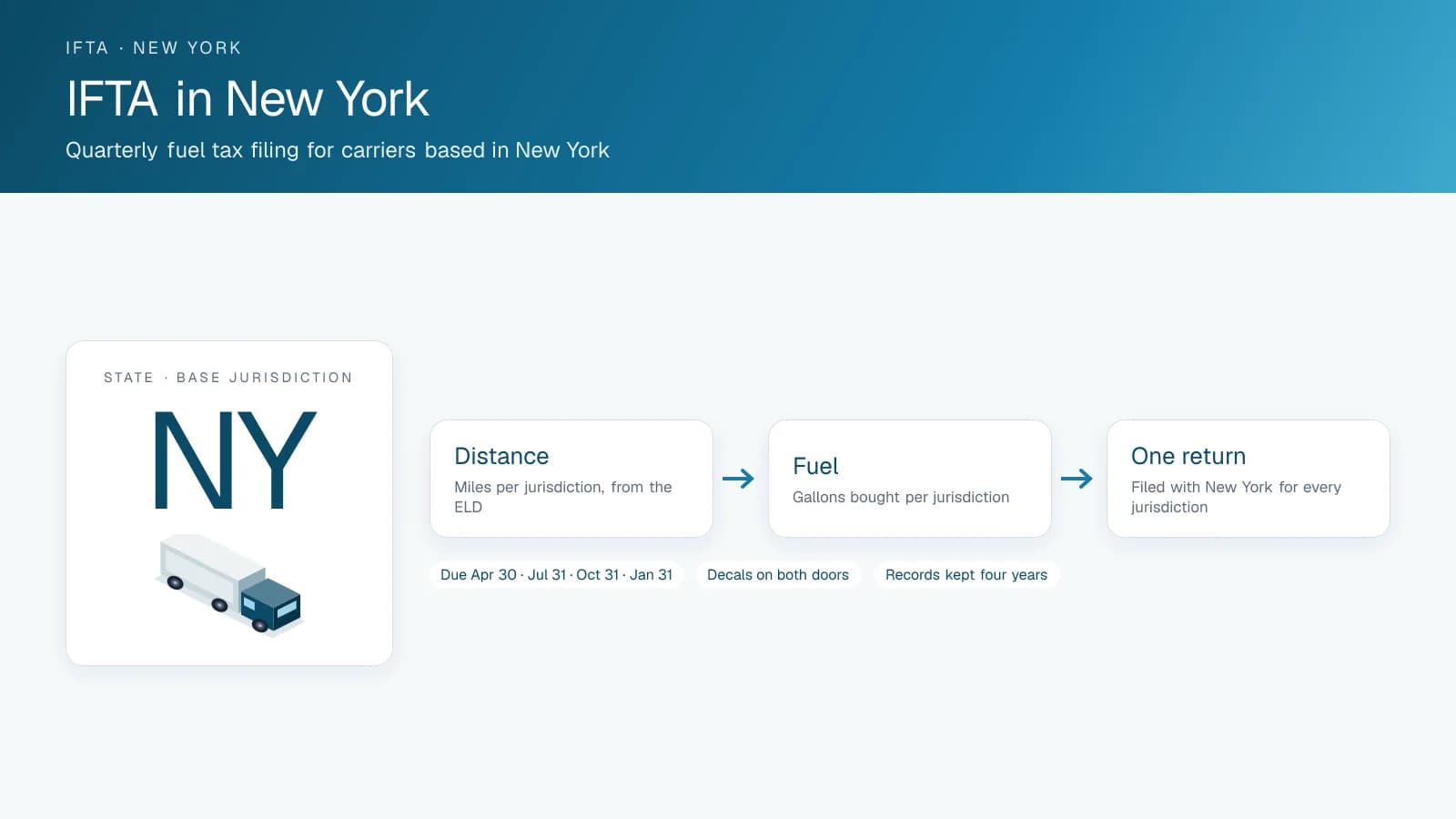
NY OSCAR, the One Stop Credentialing and Registration system, is where the New York State Department of Taxation and Finance issues your IFTA credential and your Highway Use Tax certificates. You log in there for the credentials, while the IFTA return is filed online with the same department and HUT returns follow their own schedule. OSCAR is a shared portal run by several New York State agencies, and New York plans to move it in 2027, so recheck the login path before then. The IFTA requirement is the standard one: qualified motor vehicles, generally over 26,000 pounds or with three or more axles, operating in New York and at least one other member jurisdiction.
Is the NY HUT Tax (Highway Use Tax) Part of IFTA?
No, and carriers new to New York often miss it. HUT is a weight-distance tax on miles travelled on New York public highways by vehicles over 18,000 pounds, and it sits alongside IFTA, outside it. A truck based in New York, or a Quebec or Ontario carrier heading south through Champlain or the Thousand Islands, needs a HUT certificate and decal on top of its IFTA credential. HUT returns follow their own schedule, separate from the IFTA quarterly return.
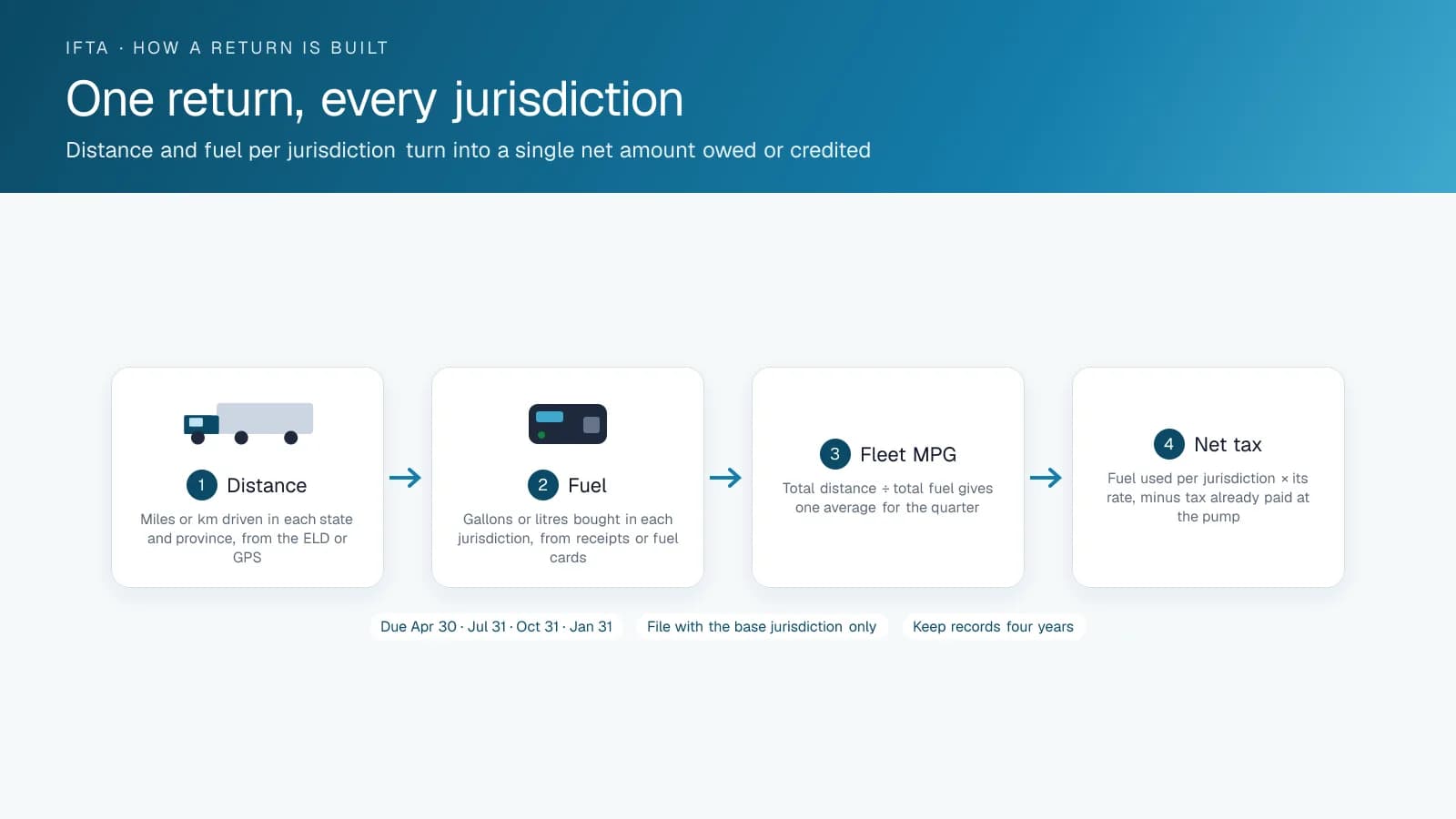
Both programs read the same odometer. IFTA wants distance by jurisdiction to settle fuel tax, and HUT wants New York miles by weight class to charge for road use. A mileage record that produces one produces the other, which is why telematics pays off more in New York than in a state with a single program.
How Is the New York HUT Tax Calculated?
HUT is the miles a vehicle travels on New York public highways multiplied by a rate set by the vehicle's weight and the reporting method you choose. Miles on the toll-paid portions of the New York State Thruway are excluded. On the first return of each calendar year you pick either the gross weight method or the unloaded weight method, and you then use it for every vehicle and every return that year; you can switch only the following year.
The gross weight method covers every truck and tractor with a gross weight over 18,000 pounds. It taxes laden miles at the loaded weight and unladen miles at the unloaded weight, with a straight line option (each vehicle's own weights) or a heaviest weight option for carriers running more than one truck. The unloaded weight method covers trucks with an unloaded weight over 8,000 pounds and tractors over 4,000 pounds. Under either method the return needs New York miles by vehicle, and the gross weight method also needs them split into laden and unladen, which is more detail than an IFTA return asks for.
Trip-level GPS records show when a truck was on the toll-paid Thruway and when it was on other New York roads, which is the first split the return needs. Load status has to come from dispatch or the driver, since a position on the map does not show whether a trailer is loaded.
How Often Do You File New York HUT Returns?
Quarterly to start, then according to how much tax you owe. A new HUT carrier files Form MT-903 every quarter, by the last day of the month after the quarter ends. After a full calendar year, the Tax Department reviews the year's total HUT and tells you if your schedule changes: more than $12,000 makes you a monthly filer, and $1,200 or less, for a carrier subject to HUT the whole year, makes you an annual filer with one return due January 31. Anything in between stays quarterly.
Every holder of a HUT certificate of registration files, even when no tax is due, through Web File or on paper. A carrier that only runs New York now and then can ask for a trip certificate of registration instead, and a trip certificate carries no return. The HUT account is opened with Form TMT-39 and certificates and decals are requested with Form TMT-1; the IFTA licence application is Form IFTA-21, which replaced Forms IFTA-1 and IFTA-9.
How Do You File the New York IFTA Quarterly Return?
You file IFTA returns online with the Department of Taxation and Finance, due April 30, July 31, October 31 and January 31, or the next business day. A quarter with no interjurisdictional travel still needs a zero return. The licence is annual, and decals for the new year must be on the vehicles when the old ones expire.
For a Quebec fleet making day trips into New York, the base jurisdiction stays Quebec: the IFTA return is filed in Quebec and includes the New York miles. The HUT obligation belongs to New York, and you file it with New York directly. That means two programs and two filings, fed by one set of distance data.
Which Records Survive an Audit?
Keep IFTA records four years from the return's due date or filing date, whichever is later. HUT has its own retention rule. An audit under either program asks for trip-level miles tied to a vehicle, a date and a jurisdiction. GPS distance reports backed by trip logs, produced by the same device that runs the ELD, answer both programs from one source.
IFTA New York at a Glance
Here are the essentials for a New York-based carrier, or any carrier that runs New York. Check fees and procedures in OSCAR before each renewal.
| Item | New York |
|---|---|
| Administering agency | New York State Department of Taxation and Finance |
| Portal | OSCAR (One Stop Credentialing and Registration) |
| Also issued there | Highway Use Tax certificates and decals |
| Return due dates | April 30, July 31, October 31, January 31, or the next business day |
| Zero-activity quarter | Return still required |
| Related tax | HUT on New York public-highway miles for vehicles over 18,000 lb, filed separately |
| Out-of-state carriers | IFTA filed with their own base; HUT filed with New York directly |
| Record retention | Four years for IFTA; HUT has its own rule |
Frequently asked questions
What is NY OSCAR, and who administers IFTA in New York?
The New York State Department of Taxation and Finance administers IFTA and issues the credential through OSCAR, the One Stop Credentialing and Registration system. OSCAR is the same portal that issues Highway Use Tax certificates, so a New York carrier handles both credentials in one place, even though the filings stay separate.
What is the NY HUT tax, and is it part of IFTA?
The Highway Use Tax is a separate weight-distance tax on New York highway miles for vehicles over 18,000 pounds. It runs alongside IFTA, so a carrier needs both credentials and files both returns. One distance record can feed both returns.
Does a Quebec carrier crossing into New York need HUT?
Yes. A Quebec carrier files IFTA in Quebec as its base jurisdiction, and that return includes the New York miles. The HUT certificate and HUT returns, though, are New York's own obligation and are filed with New York directly. That means two filings drawn from one set of distance records.
When are New York IFTA returns due?
New York IFTA returns are due April 30, July 31, October 31 and January 31, or the next business day. You still have to file a zero return for any quarter with no interjurisdictional travel, and you file online with the Department of Taxation and Finance.
How long must records be kept?
Keep IFTA records for four years from the return's due date or filing date, whichever is later. HUT has its own retention rule. An auditor under either program asks for trip-level miles tied to a vehicle, a date and a jurisdiction, which GPS distance reports and trip logs supply.
Do Thruway miles count for New York HUT?
Not the toll-paid ones. HUT is calculated on miles travelled on New York public highways, and the toll-paid portions of the New York State Thruway are excluded. Miles on the state's other public roads count. Trip-level GPS records let you separate toll-paid Thruway miles from the rest of your New York miles when you prepare the return.
How often do New York HUT returns have to be filed?
New carriers file quarterly. After a full calendar year, the Tax Department sets the schedule from that year's total HUT: more than $12,000 means monthly returns, $1,200 or less means one annual return due January 31, and anything in between stays quarterly. Every certificate holder files, even when no tax is due, except holders of a trip certificate.
Sources
Related solutions & products
Service areas
Related terms
Continue reading
- Compliance (ELD, DVIR, IFTA) overview →
- IRP Registration in New York: Apportioned Plates, Fees and the Distance Schedule →
- How to File IFTA Online: Step-by-Step for Your First Quarterly Return →
- FMCSA ELD Exemptions: Does Your Fleet Need One? →
- New Jersey IFTA: Filing, Decals, Deadlines and Renewal →
- More in Compliance →
Get a free quote
- Over 500 fleets
- Since 2013
- 4.9 on Google (19 reviews)
What are you looking for?
Prefer to talk?Call 1-800-613-6323[email protected]