
Compliance
IRP in Saskatchewan: Apportioned Registration, Fees and the Distance Schedule
IRP in Saskatchewan runs through SGI: qualified vehicles crossing into other provinces or states get apportioned plates, with fees split by distance.
Who Administers IRP in Saskatchewan?
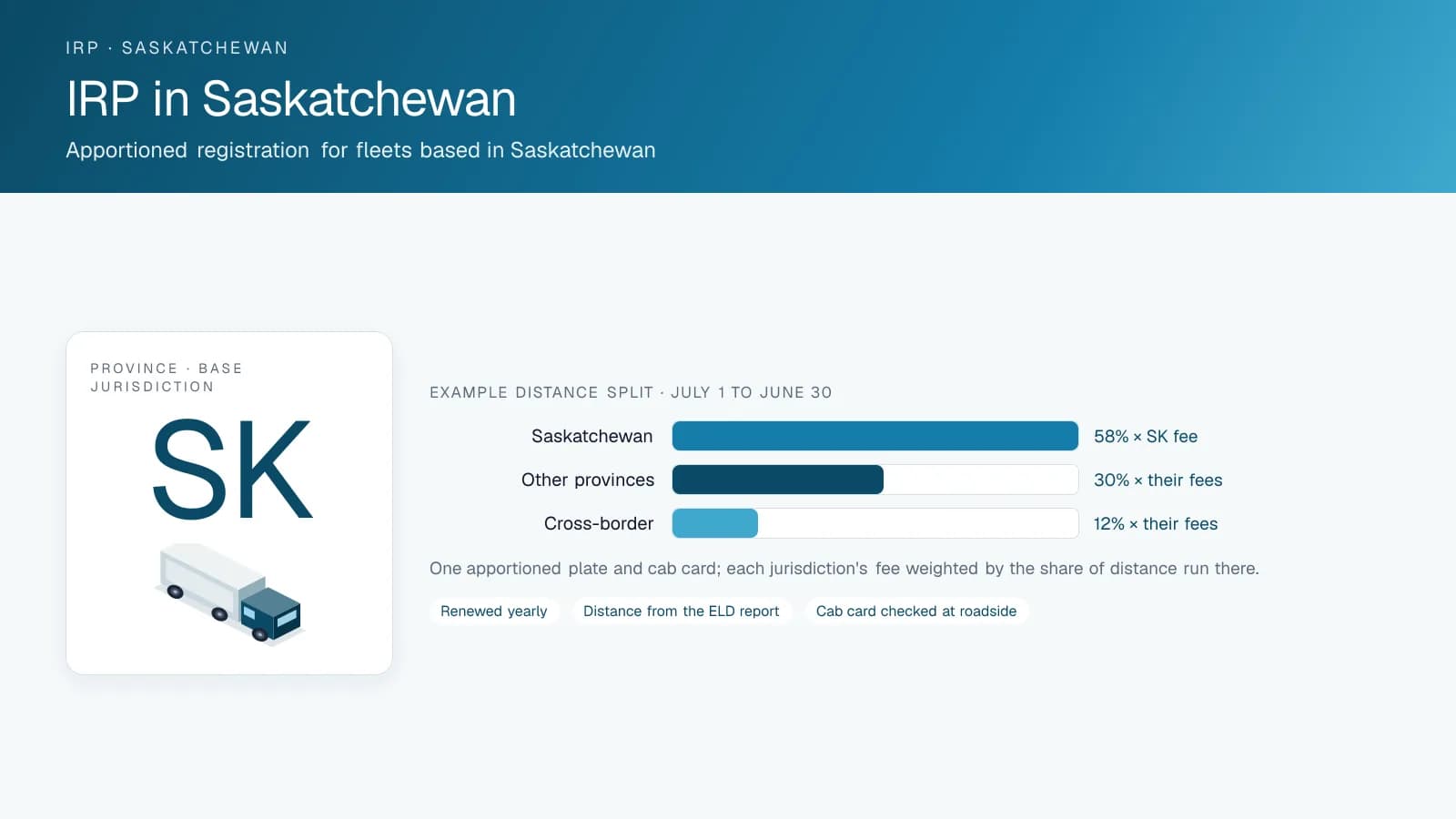
For IRP in Saskatchewan, SGI (Saskatchewan Government Insurance) administers apportioned registration, issuing apportioned plates and cab cards to carriers based in the province, while the Ministry of Finance handles IFTA through SETS. Like Manitoba and British Columbia, Saskatchewan runs IRP through its provincial public insurer. A Regina or Saskatoon grain, energy or general-freight carrier that runs into Alberta or Manitoba, or south through North Portal into North Dakota, registers under IRP with SGI as its base jurisdiction.
What Drives the Saskatchewan Apportioned Fee?
Saskatchewan fleets cover long rural highways with few borders in a day's run, so the distance schedule is short but each line carries a lot of kilometres. Heavy agricultural and energy loads also often mean high registered weights, which sit near the top of each jurisdiction's fee schedule. That makes getting the Alberta and Manitoba percentages right more important here than for a fleet with a dozen small entries. Telematics logs position continuously and reports distance by jurisdiction, per unit, for the July-to-June year, and the same data feeds the IFTA quarter filed in SETS.
Roadside Checks and Audits
Saskatchewan Highway Patrol officers check cab cards and weights at the province's permanent weigh scales and with mobile inspection units, and the province's carrier safety rating runs alongside. A fleet that runs IRP, IFTA and a Canadian-certified ELD from one GPS tracking device keeps its credentials current through the winter without rebuilding the records separately for each one.
IRP in Saskatchewan at a Glance
The essentials for a fleet based in Saskatchewan, in one place. Confirm current procedures and fee schedules with SGI before renewing.
| Item | Saskatchewan |
|---|---|
| IRP administered by | SGI (Saskatchewan Government Insurance) |
| Threshold | Power unit over 26,000 lb, or three or more axles, or a combination over 26,000 lb, in two or more jurisdictions |
| Credential | Apportioned plate and cab card per power unit; trailers not apportioned |
| Distance reporting period | July 1 to June 30 before the registration year |
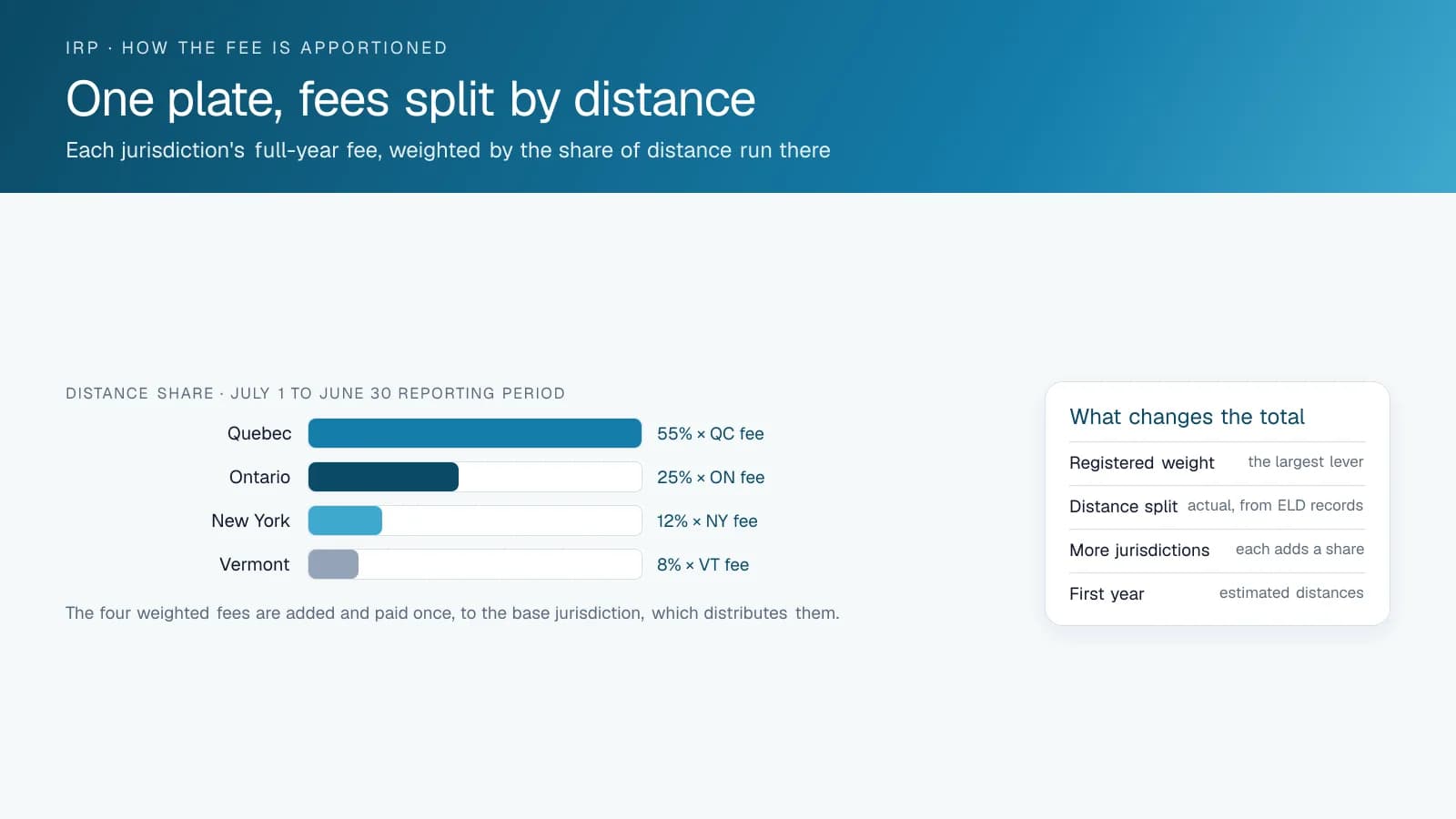
| Fee basis | Each jurisdiction's fee at the registered weight, weighted by distance share |
| First-year fleet | Estimated distance chart until a full year of actual distance exists |
| Audit window | Three years after the registration year closes |
| Distance source | ELD or GPS jurisdiction report, per unit |
Frequently asked questions
Who handles IRP registration in Saskatchewan?
SGI (Saskatchewan Government Insurance) handles IRP for carriers based in the province. Applications, renewals and supplements for the apportioned plate and cab card all go through SGI, while IFTA is a separate account with the Ministry of Finance, filed through SETS.
If our Saskatchewan trucks stay local, do we still register under IRP?
No. IRP splits one registration fee among the jurisdictions a vehicle operates in, so a Saskatchewan truck that never leaves the province has nothing to split and stays on an ordinary SGI plate. Once it starts scheduled runs to Alberta, it needs the apportioned plate, or a trip permit for a single trip.
What distance does the Saskatchewan IRP renewal use?
The renewal uses actual kilometres in each jurisdiction, per vehicle, for the twelve months ending June 30 before the registration year, reported to SGI. A fleet in its first year has no history, so it uses the average per-vehicle distance chart published by IRP, Inc. until it has a full year of actual distance.
Do IRP and IFTA cover the same thing for a Saskatchewan carrier?
No, they cover different money. IRP splits one year's registration fee among the jurisdictions the truck runs in and is paid through SGI. IFTA reconciles the fuel tax owed to each of them every quarter. One set of distance records feeds both, but each is its own filing.
How long should a Saskatchewan carrier keep IRP distance records?
Keep them for the full audit window: three years after the registration year closes. A carrier that keeps its GPS distance reports for that period can answer an SGI audit in an afternoon, because the reports show distance by jurisdiction for each unit.
Related solutions & products
Service areas
Related terms
Continue reading
- Compliance (ELD, DVIR, IFTA) overview →
- IFTA Saskatchewan Fuel Tax: How to File and Stay Compliant →
- How to File IFTA Online: Step-by-Step for Your First Quarterly Return →
- Who Needs IRP? Apportioned Registration Requirements and How to Apply →
- Alberta IRP: Apportioned (Prorate) Registration, Fees and the Distance Schedule →
- More in Compliance →
Get a free quote
What are you looking for?