
Compliance
Cross-Border Trucking Checklist: Every Credential a Canadian Carrier Needs to Run Into the US
Cross-border trucking from Canada to the US takes a USDOT number, IRP plates, IFTA, a customs broker and carrier bond, and ACE eManifest. The full list.
Cross-Border Trucking Checklist: Authority and Registration
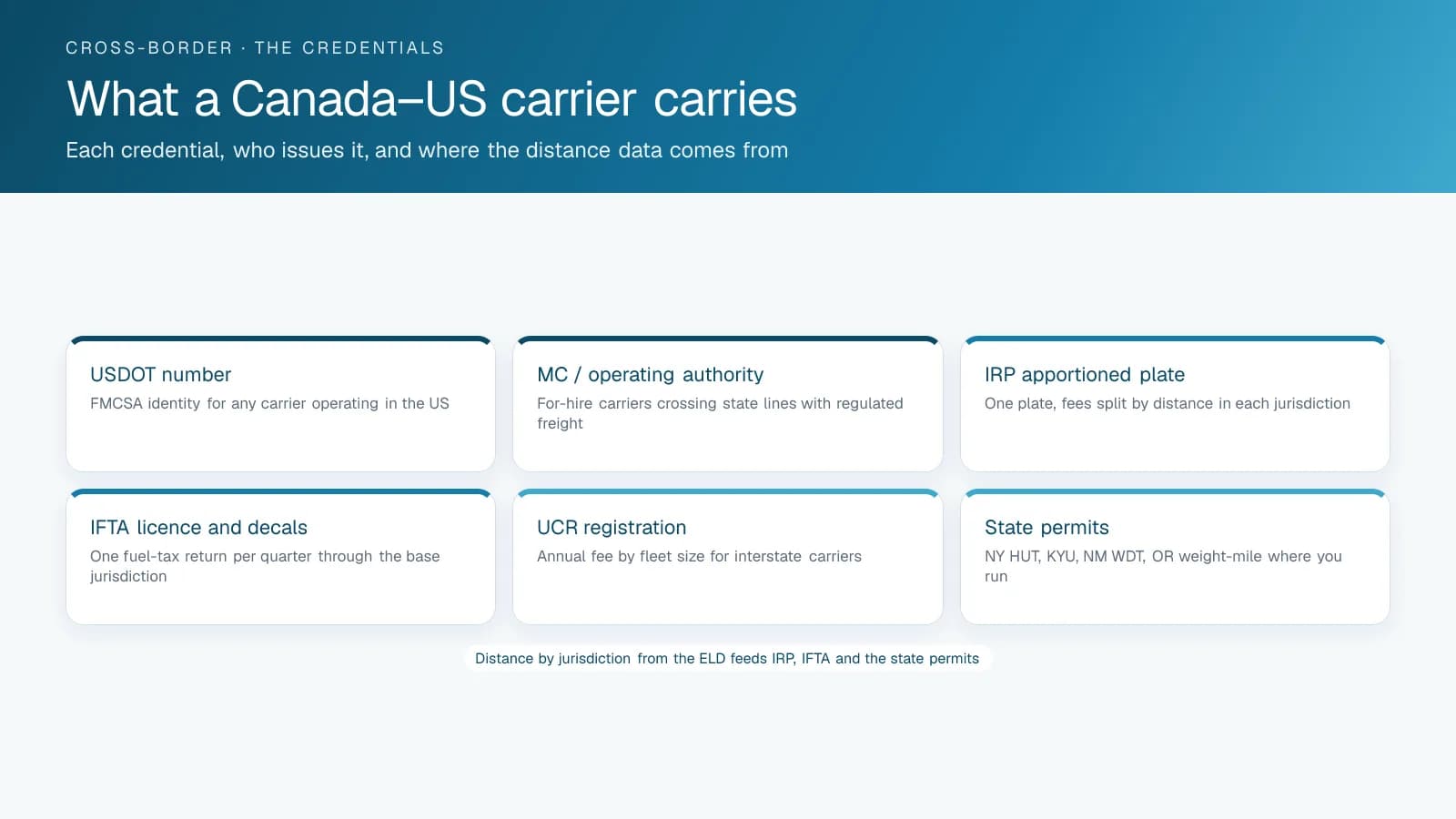
Cross-border trucking from Canada to the US requires a carrier to have authority, registration, tax accounts, customs, driver documents and a dual-certified ELD in place before its first US trip. Start with a USDOT number from the FMCSA, which identifies the carrier and which every other US system references. A for-hire carrier also needs operating authority (an MC number); a private carrier hauling its own goods does not. File a process agent designation (BOC-3) with the FMCSA and pay Unified Carrier Registration for the year. Each power unit needs IRP apportioned plates from the SAAQ in Quebec or the MTO in Ontario, and the IRP office requires the IRS Form 2290 Schedule 1 for vehicles at 55,000 pounds and over. Then, for a for-hire carrier, the FMCSA insurance filing: a $750,000 liability minimum for general freight, more for hazardous materials, with the MCS-90 endorsement.
Which Fuel and Road Tax Accounts Apply?
Your base province issues the IFTA licence and decals, which cover fuel tax in the 48 contiguous states and the ten provinces (not Alaska, Hawaii or the District of Columbia). Any truck over 18,000 pounds that will touch New York roads needs New York's Highway Use Tax certificate and decal, which for a Quebec carrier means nearly every truck. Lanes into Connecticut, Kentucky, New Mexico or Oregon add Connecticut's Highway Use Fee, Kentucky's KYU and the New Mexico and Oregon weight-distance accounts. Each is a separate account with its own return and mileage figure, all pulled from the same telematics jurisdiction report.
Which Customs Registrations and Carrier Bond Do You Need?
You need a customs broker on the US side and a carrier bond to clear shipments. Register for ACE, the US eManifest, which you must transmit before the truck reaches the border, and for ACI on the way back into Canada. PARS and PAPS labels on the paperwork keep the broker's entry and the carrier's manifest matched. C-TPAT and PIP membership are optional and open faster lanes: a FAST lane requires a driver holding a FAST card, hauling for a carrier and importer certified in those programs. Drivers need a passport or equivalent, and officers enforce the immigration rules on what a Canadian driver may do in the US: a point-to-point US move is cabotage and is generally not permitted, with only narrow exceptions for carriage incidental to an international trip.
How Does eManifest Work in Each Direction?
Both countries want the truck and its freight reported electronically before the truck reaches the border, and in both directions the carrier sends the report. Southbound, the carrier transmits an ACE eManifest to U.S. Customs and Border Protection (CBP), identified by its Standard Carrier Alpha Code (SCAC), which the National Motor Freight Traffic Association issues and the carrier renews every year. Northbound, the carrier sends ACI eManifest data on the conveyance and the cargo to the Canada Border Services Agency (CBSA) through the eManifest Portal or EDI, either itself or through a service provider it authorizes, under its own CBSA carrier code.
The deadlines are close but not identical, and the table sets them side by side. Penalties fall on the carrier: CBSA can issue administrative monetary penalties (AMPS) for goods that arrive unreported, and CBP lists penalties, liquidated damages, examination holds and seizure for manifest violations. Dispatch can time each transmission from the truck's live GPS position instead of a guessed arrival time.
| Direction | Agency and system | Carrier identifier | Deadline |
|---|---|---|---|
| Canada to the US | CBP, ACE eManifest | SCAC | 1 hour before reaching the first port of arrival; 30 minutes for shipments that qualify for CTPAT |
| US to Canada | CBSA, ACI eManifest | CBSA carrier code | No later than 1 hour before arrival at the first port of arrival; accepted up to 30 days ahead |
FAST Card, CTPAT, PIP and the Carrier Bond: What Do You Need?
FAST (Free and Secure Trade) is a joint CBSA and CBP program for low-risk commercial shipments. The driver applies online through CBP's Trusted Traveler Programs system and, if eligible, finishes the process at an enrolment centre. Canadian and US citizens and permanent residents, and Mexican nationals, can apply if they are 18 or older and hold a valid driver's licence, and membership lasts five years. The card alone does not open the FAST lane: southbound, the truck must run for a CTPAT FAST-approved carrier; northbound, the carrier and the importer must be authorized under Partners in Protection (PIP).
PIP is CBSA's voluntary trusted trader program, with no membership fee, and CBSA lists lower examination rates and access to FAST lanes among its benefits. CBSA has a mutual recognition arrangement with CTPAT, so each country recognizes the security standards behind the other's members.
A carrier bringing trucks into the US needs an international carrier bond (activity code 3 under 19 CFR 113.64), which secures the entry of vehicles arriving from outside the US. A carrier that moves goods in bond, such as Canadian freight crossing the US to another Canadian point, also needs a basic custodial bond (activity code 2 under 19 CFR 113.63). A customs broker or surety arranges both, and CBP sets the bond amount.
What Do Drivers and Trucks Need?
Each driver needs a licence class valid for the vehicle, a medical certificate and, for the US, enrolment in the FMCSA Drug and Alcohol Clearinghouse with the testing program that implies. The ELD must be certified under both regimes, on Transport Canada's list for the Canadian side and self-certified with the FMCSA for the US side, and the driver switches rulesets at the border. Transport Canada's List of electronic logging devices can be searched by vendor, certification number or ELD identifier, and each entry shows a status of certified or revoked. The truck carries the cab card, the IFTA licence copy, the HUT certificate, the ELD documents and the inspection decal. For cross-border carriers in Canada and the United States, High Point GPS sets up the ELD, ruleset switching, jurisdiction reporting and document add-ins, and reviews this list with new carriers before the first trip.
The Cross-Border Checklist in One Table
Each credential above appears here with its issuer and renewal cycle. Requirements change, so confirm each one with the issuing body before the first trip.
| Credential | Issued by | Renewal |
|---|---|---|
| USDOT number | FMCSA | Biennial update of the MCS-150 |
| MC operating authority (for hire) | FMCSA | Kept active with insurance and BOC-3 on file |
| BOC-3 process agent | Filed with FMCSA by a process agent | Kept current |
| UCR | State UCR program | Annual |
| IRP apportioned plates and cab card | SAAQ in Quebec, MTO in Ontario | Annual |
| Form 2290 Schedule 1 (55,000 lb and over) | IRS | Annual, July to June tax year |
| IFTA licence and decals | Revenu Québec or Ontario Ministry of Finance | Annual; quarterly returns |
| New York HUT certificate and decal | New York Department of Taxation and Finance | Per renewal period; periodic returns |
| Connecticut HUF, KYU, New Mexico WDT, Oregon weight-mile | Each state | Annual accounts; quarterly or monthly returns |
| Customs bond, ACE and ACI registration | CBP and CBSA, through a broker | Bond renewed annually |
| Drug and Alcohol Clearinghouse | FMCSA | Annual query per driver |
| ELD certified in both countries | Transport Canada list and FMCSA registration | Check the list when the standard changes |
Frequently asked questions
What does a Canadian carrier need to haul into the US?
A Canadian carrier needs a USDOT number, BOC-3, UCR, IRP plates with Form 2290 Schedule 1, and, if for hire, operating authority and the FMCSA insurance filing. Add IFTA, state weight-distance accounts where they apply, a customs broker and bond, ACE and ACI eManifest registration, and drivers with valid documents and a dual-certified ELD.
Does a private carrier need an MC number?
No. Operating authority, the MC number, applies only to for-hire carriage. A private carrier hauling its own goods into the US skips the MC number and the for-hire insurance filing, but still needs the USDOT number, IRP plates, IFTA and customs registration. Check with the FMCSA which other filings apply.
Is a Canadian ELD accepted in the US?
Only if it is also self-certified with the FMCSA. A cross-border ELD has to be on Transport Canada's list for Canadian driving and self-certified with the FMCSA for US driving. The platform's devices are certified under both regimes, and the driver switches rulesets at the border.
Can a Canadian driver haul between two US points?
Generally no. A Canadian driver hauling a load between two US points is doing cabotage, which is not permitted outside narrow exceptions for carriage incidental to an international trip. Canadian drivers move international freight, and border officers enforce the immigration rules on what they may do while working in the US.
What is the FMCSA Drug and Alcohol Clearinghouse?
It is a US database of drug and alcohol testing results. Carriers operating in the US, including Canadian carriers running into the US, must enrol and query it for their CDL-equivalent drivers and run the testing program that enrolment implies.
How far ahead must a truck send its eManifest?
In both directions, the deadline is one hour before the truck reaches the first port of arrival. CBP must receive the ACE eManifest 1 hour ahead, or 30 minutes ahead for shipments that qualify for CTPAT. CBSA accepts ACI eManifest data up to 30 days early and needs it no later than one hour before arrival in Canada.
Does a FAST card let any truck use the FAST lane?
No. The driver's FAST card is one condition out of several. Heading into the US, the carrier must be CTPAT FAST-approved; heading into Canada, the carrier and the importer must be authorized under Partners in Protection. A driver's FAST membership lasts five years and starts with an online application through CBP's Trusted Traveler Programs system.
Sources
- FMCSA: Registration
- US Customs and Border Protection: ACE
- Canada Border Services Agency: Carriers
- CBSA, Memorandum D3-4-2: Highway pre-arrival and reporting requirements
- CBP, Trading Partner: Commercial Truck Manifest
- CBP, Truck mode FAQ (SCAC and advance cargo information)
- CBSA, About the FAST program
- CBSA, FAST drivers: how to apply
- CBP, FAST eligibility
- CBSA, Partners in Protection: what the program offers
- CBP, A Guide for the Public: How CBP Sets Bond Amounts
- Transport Canada, List of electronic logging devices
Related solutions & products
Related terms
Continue reading
- Compliance (ELD, DVIR, IFTA) overview →
- UCR Registration Explained: The Unified Carrier Registration Fee for Interstate and Cross-Border Carriers →
- Who Needs IRP? Apportioned Registration Requirements and How to Apply →
- Form 2290 and the Heavy Vehicle Use Tax for Canadian Carriers Running Into the US →
- IFTA and IRP in Canada: The Base Jurisdiction Office for Every Province and Territory →
- More in Compliance →
Get a free quote
- Over 500 fleets
- Since 2013
- 4.9 on Google (19 reviews)
What are you looking for?
Prefer to talk?Call 1-800-613-6323[email protected]