
Dispatch & Routing
Deadhead Miles: What They Are and How to Reduce Them
Deadhead miles are empty, non-revenue miles. Measure them with GPS trip data, then cut the worst legs with backhauls, job matching and tighter stop order.

What Are Deadhead Miles and How Do You Reduce Them?
Deadhead miles are the empty, non-revenue miles a vehicle drives when it isn't carrying a load or heading to a paying job, the classic case being the run back after a delivery with nothing on board. You reduce them by matching return trips to nearby work, sequencing jobs so vehicles finish closer to their next task, and using GPS data to see where the empty running happens. A deadhead mile burns the same fuel, wear and driver time as a loaded mile and earns nothing, so it eats margin inside routes that otherwise look normal.
Deadhead deserves its own attention because the usual ways of looking at a fleet hide it. A truck that is busy all day can still run a large share of empty miles between productive stops. Unless you measure loaded against empty distance, those miles blend into total mileage and nobody questions them.
How Do You Measure Deadhead Miles?
Start by making empty miles visible. GPS trip data shows the path each vehicle took, and comparing it with where the jobs and loads were shows the gap: miles driven that weren't tied to a delivery or a service call. Once you can see which routes, days or drivers generate the most deadhead, you can go after those patterns instead of guessing. A recurring empty leg between two regular locations is a routing problem you can fix as soon as you can point at it.
Dispatch and tracking data work together here. Geofences around your yards, customer sites and job locations separate productive stops from empty transit without anyone sorting trips by hand, and historical trip data shows whether the empty running is a one-off or a standing inefficiency. With that measurement in place, deadhead reduction turns into a list of specific route changes, ranked by how many empty miles each one removes.
Which Changes Reduce Deadhead in Trucking the Most?
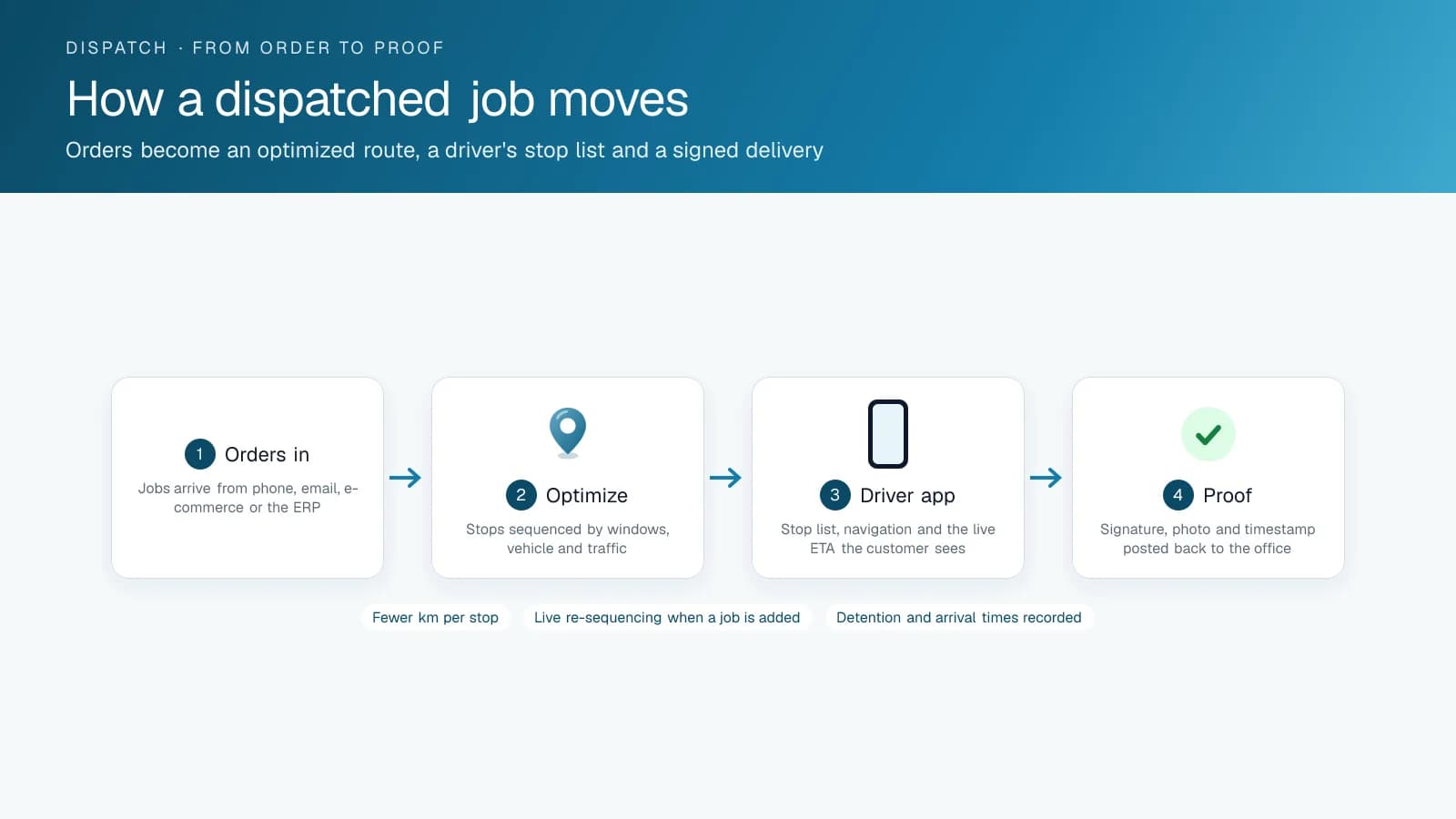
Backhaul and job matching come first: filling the return leg or the gap between jobs with work that is already near the vehicle's path. For a freight fleet, that means finding a load for the trip home so the truck doesn't come back empty. For a service or delivery fleet, it means giving the next stop to whichever vehicle is closest instead of dispatching from a fixed home base. Real-time location makes this possible, since you can only match a job to the nearest vehicle if you know where every vehicle is right now.
Tighter stop sequencing and zone-based territories help as well, by cutting the empty distance between consecutive jobs so vehicles don't crisscross the service area. You don't have to overhaul your dispatch process overnight. Start with the worst recurring empty legs your trip data turns up, fix those, and let the measured drop in non-revenue miles justify the next round. Fewer empty miles means lower fuel cost, less wear and more capacity from the same fleet.
How Do You Read a Deadhead Report?
This report comes from the platform once geofences mark the loaded and unloaded legs. It covers one regional truck over a month, with what each line points to.
| Leg pattern | Empty km in the month | What it suggests |
|---|---|---|
| Return from customer A to the yard, every Tuesday and Thursday | 1,120 | A standing backhaul from that area; the highest-value fix |
| Yard to first pickup each morning | 640 | Stage the truck at the pickup the night before, or move the first stop |
| Between consecutive jobs across town | 410 | Territory assignment or stop sequencing |
| Trip to the shop and back | 180 | Bundle service with a job nearby, or use a closer shop |
| Unexplained after-hours | 95 | A policy question, not a routing one |
| Total empty | 2,445 of 9,800 km | 25% deadhead; set your target from this baseline and track it monthly |
How Do You Calculate Your Deadhead Percentage?
Your deadhead percentage is your empty distance divided by your total distance, expressed as a percentage. Work it out per truck and per month from the same geofenced trip data that produces the report above, so the empty legs are measured the same way every time and you can see whether a change in dispatch actually moved the number.
The percentage tells you how much running is unpaid. To judge a single load, look at what it pays per mile driven in total. A load's rate per loaded mile ignores the empty run to the shipper and the empty run out of the receiver's area. Divide what the load pays by every mile it takes, both empty legs included, and a high-paying load at the end of a long empty run can come out behind a lower-paying load that starts close by. Do this comparison before you accept the load, while the empty leg is still a choice.
Set your target from your own baseline. Published deadhead benchmarks mostly come from load boards, dispatch services and software vendors, and they mix long-haul, regional and local work that run very differently. Your trailing three months of trip data, split by lane and by customer, is a fairer starting point than any industry average.
Do Deadhead Miles Count Against Hours of Service?
Yes. Hours-of-service limits make no distinction between loaded and empty driving, and the ELD records an empty leg as driving time like any other. In the United States, a property-carrying driver may drive a maximum of 11 hours after 10 consecutive hours off duty and may not drive beyond the 14th hour after coming on duty. In Canada, south of latitude 60°N, the federal regulations stop a driver at 13 hours of driving or 14 hours on duty in a day. Every hour spent running empty comes out of the same allowance the next paying load needs.
Drivers sometimes ask whether an empty run can be logged as personal conveyance. Under FMCSA guidance, it cannot when it serves the business: bobtailing or pulling an empty trailer to retrieve another load, repositioning a truck at the carrier's direction, or driving past available rest locations to get closer to the next pickup are all listed as uses that do not qualify. Canada's personal use allowance is narrower still: the vehicle must not be used in the course of the carrier's business, it must be unloaded with any trailers unhitched, and the distance cannot exceed 75 km in a day.
For dispatch, this means a backhaul that looks good on price can fail on hours. Before you send a truck on a long empty leg to a pickup, check the driver's remaining driving time and duty window in the ELD, not only the distance on the map.
Frequently asked questions
What are deadhead miles?
Deadhead miles are the empty, non-revenue miles a vehicle drives when it is not carrying a load or heading to a paying job, most often the return trip after a delivery. They cost the same fuel, wear and driver time as loaded miles and earn nothing, which is why they cut into margin.
How do I measure deadhead miles?
Compare GPS trip data with where your jobs and loads were. Geofences around yards, customer sites and job locations let the system separate productive stops from empty transit, so you can see which routes, days and drivers generate the most non-revenue distance and which empty legs repeat.
What is the most effective way to reduce deadhead miles?
Backhaul and job matching. Fill the return leg or the gap between jobs with work already near the vehicle's path, and assign each new stop to the closest available vehicle instead of dispatching from a fixed base. Real-time location data is what makes that matching possible.
Do I need route optimization software to cut deadhead miles?
It helps at scale, but you can start without it. With real-time GPS visibility and historical trip data, a dispatcher can spot the worst recurring empty legs and reassign work to nearer vehicles by hand. That captures much of the benefit before you put any dedicated optimization engine in place.
How do you calculate deadhead percentage?
Divide the empty distance a truck ran by its total distance over the same period, and express the result as a percentage. Use geofenced GPS trip data so loaded and empty legs are split the same way every month. Track it per truck, per lane and per customer, and set your target from your own baseline instead of a published industry average.
Can deadhead miles be logged as personal conveyance?
No, not when the empty run serves the business. FMCSA guidance says bobtailing or pulling an empty trailer to retrieve another load, or repositioning a truck at the carrier's direction, does not qualify as personal conveyance. In Canada, personal use requires an unloaded vehicle with trailers unhitched, not used for the carrier's business, and is capped at a daily distance.
Sources
Related solutions & products
Related terms
Continue reading
- Dispatch & Routing overview →
- AI Dispatch Software: How AI Dispatching and Automated Routing Change Fleet Dispatch →
- Truck Driver Shortage 2026: Why Retention Matters More →
- The Questions Worth Asking a Fleet Tracking Vendor Before You Sign →
- Dispatch Software for Security Guard and Patrol Companies →
- More in Dispatch & Routing →
Get a free quote
- Over 500 fleets
- Since 2013
- 4.9 on Google (19 reviews)
What are you looking for?
Prefer to talk?Call 1-800-613-6323[email protected]