
Compliance
IFTA in Quebec: Licence, Decals and Filing With Revenu Québec
IFTA in Quebec runs through Revenu Québec, not the SAAQ, and Quebec charges for both the licence and the decals. See how filing and renewal work.
Who Administers IFTA in Quebec?
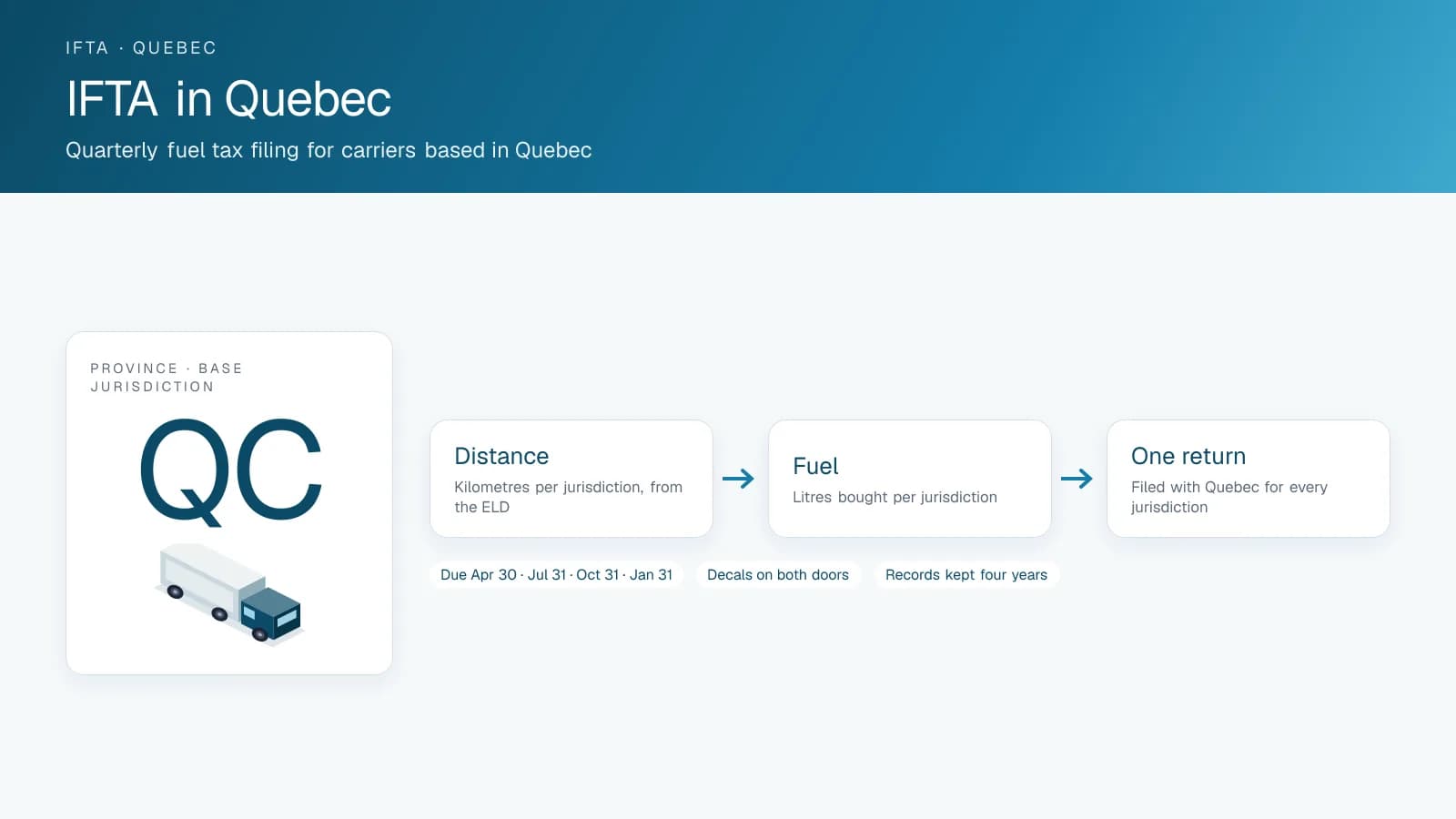
IFTA in Quebec is administered by Revenu Québec, the province's tax authority, which handles licensing, decals and quarterly filing for Quebec-based carriers. The SAAQ (Société de l'assurance automobile du Québec) does not. Carriers who assume every vehicle obligation in Quebec goes through the SAAQ get caught here, partly because the SAAQ keeps its own information page on fuel tax for carriers operating outside Quebec.
A Quebec-based carrier running qualified motor vehicles outside the province, into other Canadian provinces or into the US, needs a Quebec IFTA licence in place of separate permits for each jurisdiction it crosses. If a vehicle operates only within Quebec, you don't need an IFTA licence for it.
How Do You File IFTA Returns in Quebec?
Quebec carriers file the quarterly IFTA return on Revenu Québec's Quarterly Fuel Tax Return form, either the paper copy Revenu Québec mails out or the fillable PDF from its website, which is printed and mailed back, or with authorized tax software. Revenu Québec's IFTA page does not list an online filing service in My Account for Businesses. Due dates follow the standard IFTA quarterly schedule shared by every member jurisdiction: April 30, July 31, October 31, and January 31, moved to the following Monday when the date falls on a weekend. The form is CAZ-510-V. From the first quarter of 2027 (January 1 to March 31, 2027), Revenu Québec will stop mailing it, and it will only be available on its website as a fillable PDF.
You must file a return every quarter while the licence is valid, including a quarter with no travel outside Quebec and no tax owed. The Quebec IFTA licence runs on the calendar year, valid January 1 through December 31, so you renew it each year on top of the quarterly filings.
Which GPS Records Does Revenu Québec Accept for IFTA?
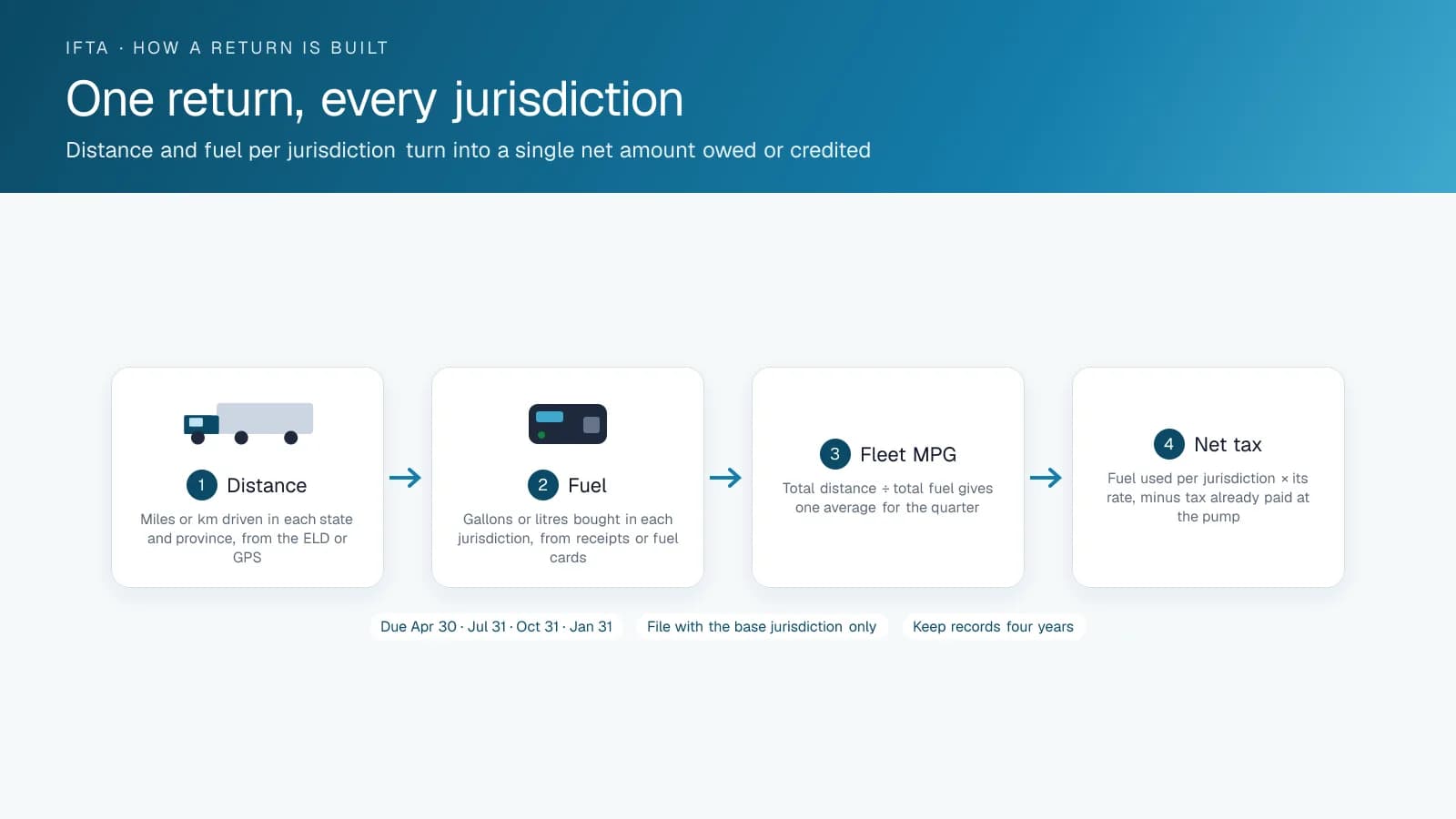
Revenu Québec accepts distance records produced by a vehicle-tracking system, including GPS, when each trip record holds a defined set of data. The list is longer than for paper trip sheets: the original GPS or other location data; the date and time of each reading, at intervals frequent enough to validate the distance in each jurisdiction; the location of each reading; the odometer, hubodometer or engine control module reading at the start and end of the quarter; the distance calculated between readings; the route; the total distance; the distance in each jurisdiction; and the vehicle identification or unit number.
Fuel records have their own list. Each purchase needs the date, the quantity and type of fuel, the price per litre or total price, the seller's name and address, the purchaser's name and the vehicle the fuel went into. A fleet with its own bulk tanks also keeps delivery receipts, a quarterly inventory reconciliation for each tank and a record of every withdrawal.
Revenu Québec asks for all of it to be kept for six years and made available to any member jurisdiction on request; Ontario, for comparison, asks for four years from the due date or filing date. Revenu Québec can audit on behalf of the other jurisdictions, and records it finds inadequate can lead to an additional assessment. A summary report alone does not meet the list: keep the underlying GPS readings the totals were calculated from.
Which Vehicles and Trips Does Quebec IFTA Cover?
A qualified motor vehicle has two axles and a gross weight or registered gross weight over 11,797 kg (26,000 lb), or three or more axles at any weight, or is used in a combination whose total gross weight or registered gross weight is over 11,797 kg. Revenu Québec notes that a pickup truck towing a trailer can qualify, which catches out service fleets that think of IFTA as a tractor-trailer rule. The vehicle must also be used at least partly for commercial purposes and be designed, used or maintained to carry passengers or freight.
Quebec is your base jurisdiction if your main establishment is in the province, or if the vehicle is most often assigned, stored, repaired or otherwise checked here. The licence covers every Canadian province and every US state except Alaska and Hawaii; the District of Columbia, the three territories and Mexico are not members, so trips there follow their own fuel tax rules.
What Does a Quebec IFTA Licence Cost?
Quebec charges for both the licence and the decals, which not every jurisdiction does: Ohio, for example, charges for neither. For 2026, the annual IFTA licence costs $70, and decals cost $14.10 per pair. One licence covers the whole fleet, but you need a pair of decals for every qualified vehicle operated outside Quebec, so the decal cost grows with fleet size while the licence fee stays flat.
Budget for this if your fleet is used to filing in a jurisdiction that charges for neither the licence nor the decals. When a Quebec-based carrier adds qualified vehicles, the per-pair decal cost grows with it, so IFTA credentials are not a fixed, one-time expense.
Do Occasional Cross-Border Trips Need a Full IFTA Licence?
A Quebec carrier that sends a vehicle outside the province only now and then, without running regular interjurisdictional routes, may not need a full IFTA licence for that vehicle. A certificate for occasional trips covers that narrower case. It is a Revenu Québec document, obtained before each trip from an authorized organization such as the Commission des transports du Québec, and it stays in the vehicle.
Before you assume every vehicle that ever crosses the Quebec border needs full IFTA credentials, check which case applies: regular cross-border operation, which needs the full licence, or infrequent trips, which can run on a trip certificate. GPS trip history shows which category each vehicle falls into, based on how you use it.
Quebec at a Glance
The basics for a Quebec-based carrier in one table. Fees are those in effect at the time of writing; confirm them with Revenu Québec before each renewal.
| Item | Quebec |
|---|---|
| Administering agency | Revenu Québec (not the SAAQ) |
| Filing method | Form CAZ-510-V (mailed paper copy or fillable PDF, returned by mail) or authorized software |
| Licence fee | $70 per year |
| Decal fee | $14.10 per pair, one pair per qualified vehicle operated outside Quebec |
| Credential period | January 1 to December 31 |
| Return due dates | April 30, July 31, October 31, January 31 |
| Zero-activity quarter | Return still required while the licence is valid |
| Occasional trips | Certificate for occasional trips, obtained before each trip from an authorized organization such as the Commission des transports du Québec |
| IRP | Separate, through the SAAQ |
Frequently asked questions
Does the SAAQ or Revenu Québec administer IFTA in Quebec?
Revenu Québec administers IFTA in Quebec, including the licence, the decals and the quarterly returns. The SAAQ publishes information for carriers operating outside Quebec, but it does not issue IFTA credentials. IRP, a separate credential, goes through the SAAQ, which is one reason carriers mix the two up.
How do Quebec carriers file IFTA returns?
Quebec carriers file on Revenu Québec's Quarterly Fuel Tax Return form, using the mailed paper copy or the fillable PDF, then mail it in, or they file with authorized tax software. A return is due every quarter while the licence is valid, even when the fleet did not travel outside Quebec and owes no tax for that quarter.
Does Quebec charge for an IFTA licence and decals?
Yes. For 2026, the annual licence costs $70 and decals cost $14.10 per pair, while some jurisdictions, such as Ohio, charge for neither. One licence covers the fleet, but each qualified vehicle operated outside Quebec needs its own pair of decals, so the cost grows with the fleet.
When does a Quebec IFTA licence expire?
A Quebec IFTA licence runs on the calendar year, valid January 1 through December 31, so it expires at year end and you renew it annually. The quarterly returns continue alongside the renewal, and you still file a return for any quarter with no travel outside Quebec while the licence is valid.
Does an occasional cross-border trip require a full Quebec IFTA licence?
Not necessarily. A carrier that only occasionally operates outside Quebec can use a certificate for occasional trips in place of a full IFTA licence, obtained before each trip from an authorized organization such as the Commission des transports du Québec. Vehicles on regular interjurisdictional routes still need the full licence and decals.
How long must a Quebec IFTA carrier keep its records?
Six years. Revenu Québec requires IFTA licensees to keep distance and fuel records, with their supporting documents, for six years and to make them available to any member jurisdiction on request. GPS distance records are accepted when they include the original location data, the time and place of each reading, and odometer or engine readings for the quarter.
Does a pickup towing a trailer need IFTA decals in Quebec?
It can. A vehicle used in combination counts as a qualified motor vehicle when the combined gross weight or registered gross weight exceeds 11,797 kg (26,000 lb), and Revenu Québec states that a pickup towing a trailer can qualify. If it also travels outside Quebec for business, it needs a licence and decals, or an occasional trip certificate.
Sources
Related solutions & products
Service areas
Related terms
Continue reading
- Compliance (ELD, DVIR, IFTA) overview →
- IFTA and IRP in Canada: The Base Jurisdiction Office for Every Province and Territory →
- IRP Registration in Quebec: Apportioned Plates, Fees and the Distance Schedule →
- Quebec's Heavy Vehicle Registry and PEVL Explained: The NIR, the Safety Rating and the Commission des transports →
- Canada Hours of Service Rules: Cycles and the 13-Hour Limit →
- More in Compliance →
Get a free quote
- Over 500 fleets
- Since 2013
- 4.9 on Google (19 reviews)
What are you looking for?
Prefer to talk?Call 1-800-613-6323[email protected]