
Compliance
Canada Hours of Service Rules: Cycles and the 13-Hour Limit
Canadian HOS rules allow 13 hours of driving and 14 on duty a day after 10 off, under Cycle 1 (70 hours in 7 days) or Cycle 2 (120 in 14).

What Are Canada's Daily Limits? 13 Hours Driving, 14 On Duty, 10 Off
Under Canada's federal hours of service rules (Canadian HOS), a commercial driver south of the 60th parallel can drive up to 13 hours and be on duty up to 14 hours in a day, and must take at least 10 hours off duty in that same day. At least 8 of those 10 off-duty hours have to be consecutive. Once a driver reaches 13 hours of driving or 14 hours on duty, or once 16 hours have passed since the end of their last 8 consecutive hours off duty, they cannot drive again until they have taken the required rest. That gives Canadian drivers more driving time per day than the US rule most cross-border carriers know.
The rules define the 'day' around a 24-hour period, and drivers can split the daily off-duty time, but most plan around the 8 consecutive hours. Your ELD works all of this out from engine and movement data, so the fleet's job is to set the device to the correct ruleset and make sure each driver selects the right duty status.
Cycle 1 vs. Cycle 2: 70 Hours in 7 Days or 120 in 14?
Beyond the daily limits, every federally regulated Canadian driver works under a cycle that caps total on-duty time over a rolling window. Cycle 1 allows up to 70 hours of on-duty time in any 7 consecutive days. Cycle 2 allows up to 120 hours of on-duty time in any 14 consecutive days and suits longer trips, with one extra condition: a driver on Cycle 2 cannot drive after accumulating 70 on-duty hours until they take at least 24 consecutive hours off duty.
A driver can't switch cycles mid-week on a whim. To reset and start a new cycle, the driver ends Cycle 1 with at least 36 consecutive hours off duty, or ends Cycle 2 with at least 72 consecutive hours off duty. Until that reset happens, accumulated on-duty hours carry forward across the rolling window, so fleets running close to the limit rely on the ELD's live cycle counter instead of a driver's memory.
| Rule | Cycle 1 | Cycle 2 |
|---|---|---|
| On-duty cap | 70 hours / 7 days | 120 hours / 14 days |
| Mid-cycle rule | None beyond daily limits | 24 consecutive hours off before driving past 70 on-duty hours |
| Reset requirement | 36 consecutive hours off duty | 72 consecutive hours off duty |
How Do Canada's Rules Differ From the US Rules?
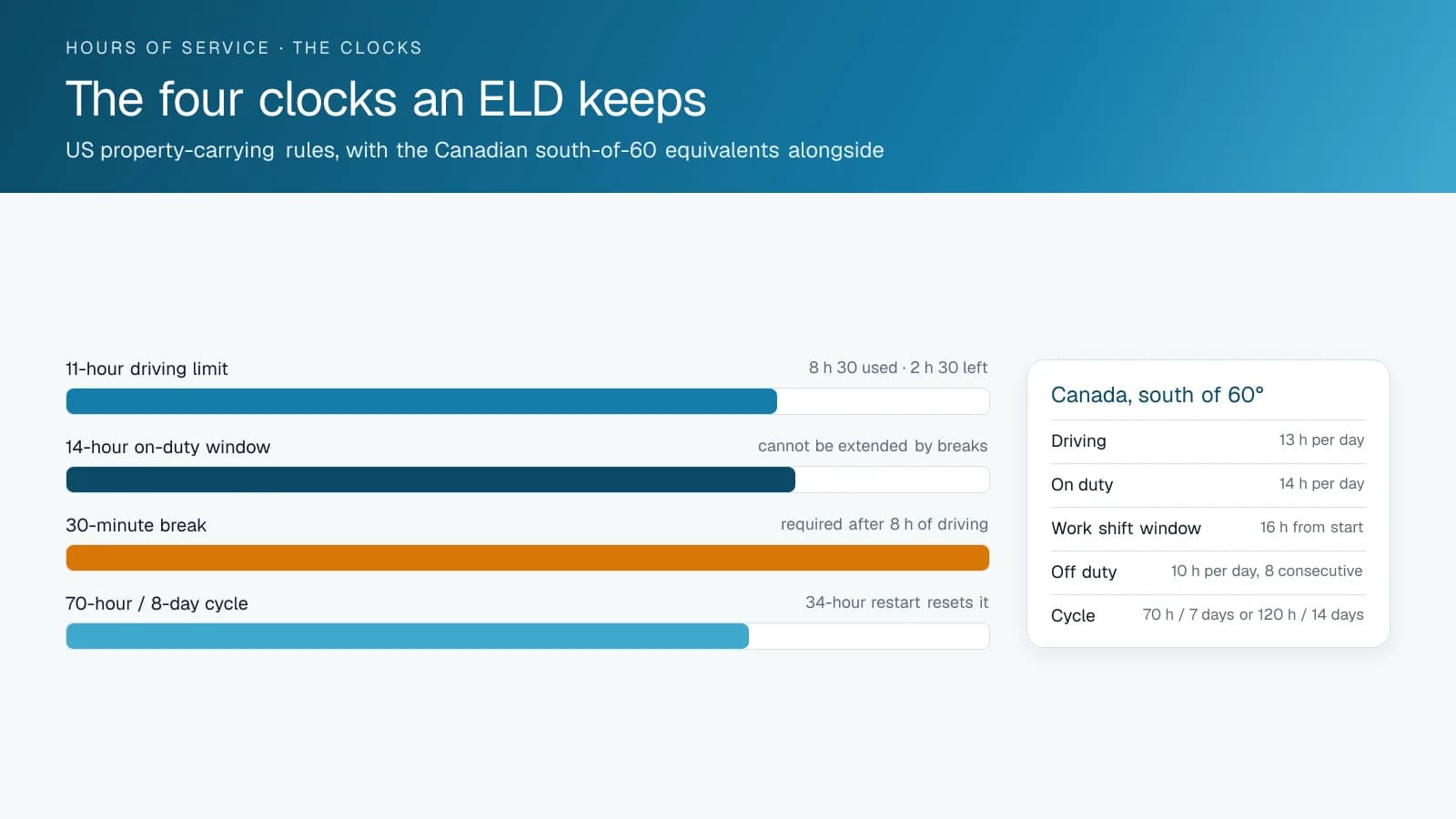
If you run both sides of the border, you have to keep two rulebooks straight. The US allows 11 hours of driving inside a 14-hour on-duty window after 10 consecutive hours off, requires a 30-minute break after 8 hours of driving, and uses a 60-hour-in-7-days or 70-hour-in-8-days cycle. Canada allows 13 hours of driving and 14 hours on duty in a day, with no driving once 16 hours have passed since the last 8 consecutive hours off, does not impose the same fixed 30-minute driving break, and uses the 70-in-7 or 120-in-14 cycle structure.
Those differences change what a driver can legally do. A load a driver can finish under Canadian rules might put that same driver in violation the moment the rule set changes, so the daily and cycle math depends on which country the driving happened in.
How Does an ELD Switch Rulesets at the Border?
An ELD used by a cross-border fleet has to support both the US and Canadian rulesets and apply the correct one for where the driving takes place. In practice, the driver indicates the change at the border: under Canada's ELD technical standard, the device prompts the driver to confirm the new operating zone and its limits, then applies them, so the daily limits and cycle counters follow the right jurisdiction and Canadian limits don't get applied to US miles, or the reverse.
Before you run cross-border, confirm two things. The ELD must be certified for Canada, which keeps its own list of certified devices separate from the US FMCSA registration process. That list, Transport Canada's List of electronic logging devices, can be searched by vendor, certification number or ELD identifier, and each entry shows whether the device is certified or revoked. Geotab Drive, the ELD app High Point GPS installs, appears there under Geotab, Inc. with the status Active, and it carries both the Canadian cycle rulesets and the US federal rulesets. Your drivers also need to understand that their remaining hours can shift the moment the ruleset changes. That part is driver training as much as hardware: the device does the calculation, but the driver still plans the trip around it.
A Cross-Border Day Under Both Rulesets
Here is one driver's day from Montreal to Albany and back, showing how the ELD applies each ruleset and where the limits bind. The times are illustrative.
| Time | Event | Ruleset in force | Clock that matters |
|---|---|---|---|
| 05:00 | On duty at the Montreal terminal; pre-trip | Canada cycle 1 | 14-hour on-duty and 16-hour elapsed limits start counting |
| 05:30 | Driving south on the 15 | Canada cycle 1 | 13-hour driving limit |
| 06:20 | Crosses at Champlain; switches ruleset in the app | US 70-hour/8-day | 11-hour driving, 14-hour window from 05:00, 30-minute break due by 8 h of driving |
| 09:45 | Unloads in Albany; 50 minutes on duty not driving | US | Counts against the 14-hour window, not driving |
| 12:10 | 30-minute break at a truck stop | US | Satisfies the break rule |
| 14:40 | Crosses back at Champlain; switches ruleset | Canada cycle 1 | 13-hour driving and 14-hour on-duty limits resume |
| 16:30 | Back at the terminal; post-trip; off duty | Canada cycle 1 | 10 hours off before the next day, 8 consecutive |
| Totals | 8.9 h driving, 11.5 h on duty | Legal under both; the app counted both |
Frequently asked questions
How many hours can a truck driver drive in Canada?
Under federal Canadian HOS rules, a driver can drive up to 13 hours and be on duty up to 14 hours in a day. The driver must also take at least 10 hours off duty, with 8 of them consecutive, before driving again. A cycle limit on total on-duty time applies on top.
What is the difference between Cycle 1 and Cycle 2?
Cycle 1 caps on-duty time at 70 hours over 7 days and resets with 36 consecutive hours off. Cycle 2 caps it at 120 hours over 14 days, resets with 72 consecutive hours off, and requires 24 consecutive hours off before the driver can drive past 70 accumulated on-duty hours.
Are Canadian and US hours-of-service rules the same?
No. Canada allows up to 13 hours of driving and 14 hours on duty in a day, within 16 hours of the last 8 consecutive hours off. The US allows 11 hours of driving in a 14-hour window and requires a 30-minute break. The cycle structures differ too, so cross-border carriers follow whichever rule applies where the driving happens.
Does an ELD switch rules automatically at the border?
Not entirely on its own. Under Canada's ELD technical standard, the driver confirms the operating zone change in the ELD, and the device then applies that jurisdiction's daily limits and cycle counters. Before you rely on it, confirm the device is certified for Canada, which keeps its own certified-device list separate from US registration.
Sources
Related solutions & products
Service areas
Continue reading
- Compliance (ELD, DVIR, IFTA) overview →
- Canada's ELD Mandate: Dates and How It Differs From the US →
- Quebec's Heavy Vehicle Registry and PEVL Explained: The NIR, the Safety Rating and the Commission des transports →
- How Does a Digital DVIR Work? Inspections, Defects and Repairs →
- IFTA and IRP in Canada: The Base Jurisdiction Office for Every Province and Territory →
- More in Compliance →
Get a free quote
- Over 500 fleets
- Since 2013
- 4.9 on Google (19 reviews)
What are you looking for?
Prefer to talk?Call 1-800-613-6323[email protected]