
Compliance
Canada's ELD Mandate: Dates and How It Differs From the US
Canada's ELD mandate requires third-party certification, while the US lets makers self-certify. The key mandate dates and how the two rules differ.

How Does Canada's ELD Mandate Differ From the US Rule?
Canada's ELD mandate differs from the US rule mainly in how a device gets certified: Canada requires independent third-party certification, while the US lets manufacturers self-certify. Both rules cover similar ground, replacing paper hours-of-service logs with electronic records, but certification is where a cross-border fleet picks up real operational risk. In the US, an ELD maker certifies that its device meets the technical standard and registers it with FMCSA. Canada does not accept self-certification at all. Each device must be certified by an independent third-party body against the Technical Standard for Electronic Logging Devices published by the Canadian Council of Motor Transport Administrators (CCMTA).
That bar is higher, and it has a direct consequence: a device that is legal and registered in the US is not automatically legal in Canada. If you run cross-border, you need hardware certified against the Canadian standard specifically. FMCSA registration alone leaves you exposed to a device that is fully compliant south of the border and fails a roadside inspection north of it.
When Did the Canadian ELD Mandate Take Effect?
Canada's ELD mandate took effect June 12, 2021, for federally regulated motor carriers. Jurisdictions did not enforce it in full right away. They ran a progressive enforcement period of education and warnings, extended out to January 1, 2023, and after that date drivers face real penalties for not using a certified device when one is required.
Enforcement itself is a provincial and territorial responsibility. Transport Canada tells carriers to check the requirements of each jurisdiction where they operate, and a carrier that stays within one province follows that province's rules, which can differ from the federal ones. A carrier running across several provinces has more than one set of rules to follow, a detail you miss unless you go looking for it.
Is a Certified ELD Compliant for Good?
The CCMTA Technical Standard changes over time. Version 1.3 was published September 29, 2025, and version 1.3.1 replaced it in July 2026. Transport Canada leads the coming into force of the revised standard, with a transition period for ELD providers and certification bodies, so re-check the certification status of the device your fleet adopted in 2021 instead of assuming it never changes.
Transport Canada keeps the official list of certified devices, and entries are added, and certificates revoked, over time. Inspectors no longer accept uncertified devices at roadside inspections. Before you rely on a device, look it up on the current official list yourself instead of taking the vendor's compliance claim on trust.
Canada and the US, Side by Side
Where the two regimes differ. A cross-border fleet checks both its devices and its drivers against this list.
| Canada | United States | |
|---|---|---|
| Certification | Third-party certification against the CCMTA standard; Transport Canada list | Manufacturer self-certification; FMCSA registered list |
| Effective date | June 12, 2021; full enforcement from January 1, 2023 | December 18, 2017; AOBRD phase-out December 16, 2019 |
| Applies to | Federally regulated carriers; provincial rules for intraprovincial carriers vary | Interstate carriers under FMCSA hours-of-service rules |
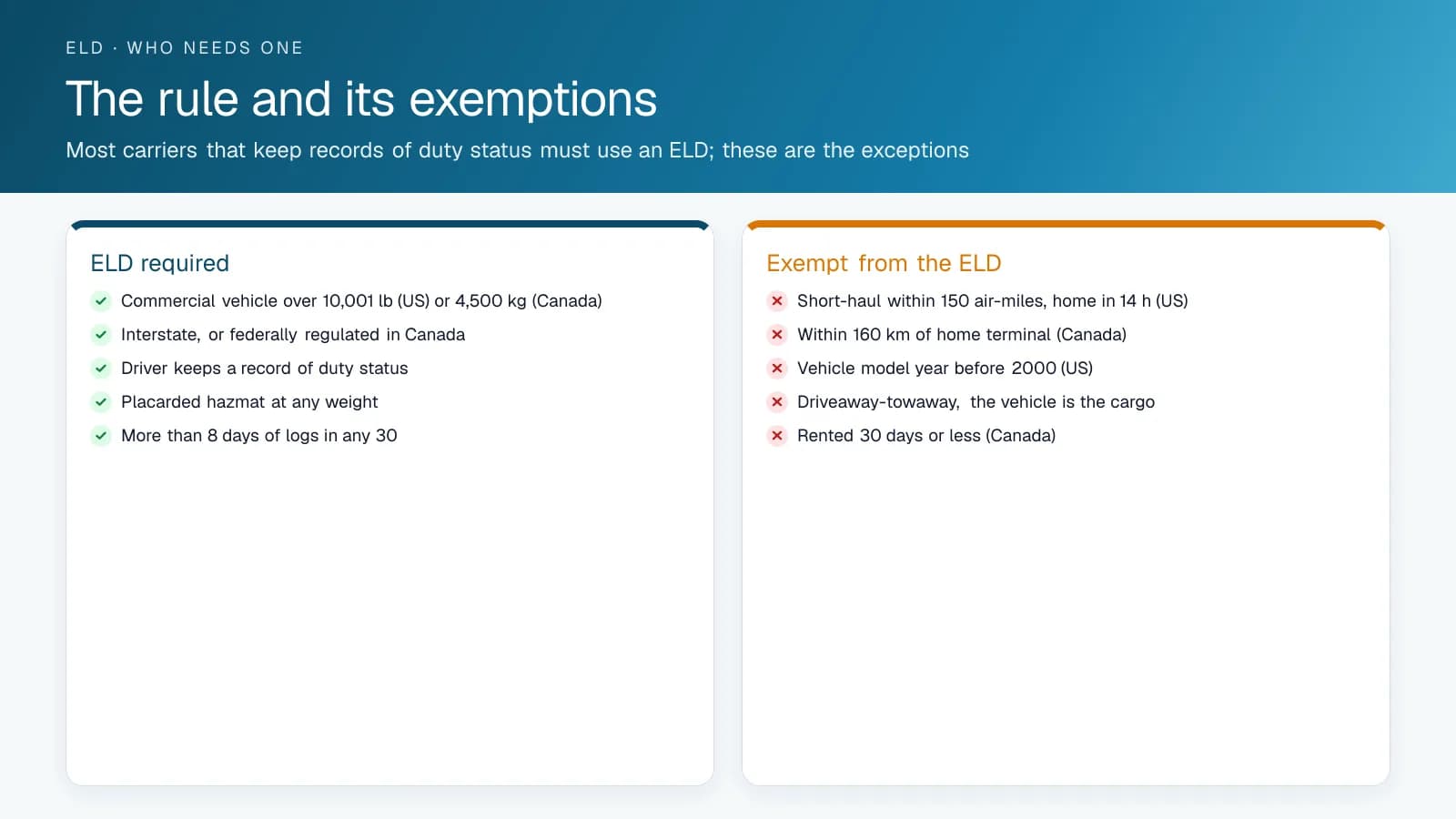
| Short-haul exemption | Within 160 km of the home terminal, conditions apply | Within 150 air-miles, released within 14 hours |
| Older vehicles | Vehicles manufactured before model year 2000 exempt | Model year before 2000 exempt |
| Rental vehicles | Rented 30 days or less exempt | Rented 8 days or less exempt |
| Records the driver must have | Current day and the previous 14 days | Current day and the previous 7 days |
| Standard version | Version 1.3 published September 2025; version 1.3.1 in July 2026 | Technical specifications in the rule, amended by rulemaking |
Frequently asked questions
Can a US-certified ELD be used legally in Canada?
Not automatically. Canada requires independent third-party certification against the CCMTA Technical Standard, a separate process from FMCSA self-certification in the US. To be legal in Canada, a device must be certified against the Canadian standard specifically, so check that it appears on Transport Canada's official list of certified devices before you rely on it.
When did Canada's ELD mandate take effect?
Canada's ELD mandate took effect June 12, 2021, for federally regulated motor carriers. Enforcement started with a progressive period of education and warnings instead of penalties, which jurisdictions extended until January 1, 2023. After that date, drivers who must use a certified ELD and don't can be penalized.
Does every Canadian province enforce the ELD mandate the same way?
Not entirely. Provinces and territories ran one progressive enforcement period, without penalties, until January 1, 2023, but enforcement is their responsibility, and rules for carriers that stay within one province vary. A carrier working in several provinces should check the requirements of each jurisdiction where it operates.
Does an ELD certified under an older version of the Canadian standard stay compliant indefinitely?
Not necessarily. The CCMTA Technical Standard has been updated, with version 1.3 published September 29, 2025 and version 1.3.1 in July 2026, and Transport Canada leads the coming into force of the revised standard. Confirm your specific device against Transport Canada's current official certified list instead of assuming a past certification still applies.
Related solutions & products
Service areas
Continue reading
- Compliance (ELD, DVIR, IFTA) overview →
- How to File IFTA Online: Step-by-Step for Your First Quarterly Return →
- Canada Hours of Service Rules: Cycles and the 13-Hour Limit →
- AOBRD vs ELD: What Changed in the Transition and Why It Matters →
- Quebec's Heavy Vehicle Registry and PEVL Explained: The NIR, the Safety Rating and the Commission des transports →
- More in Compliance →
Get a free quote
What are you looking for?