
Compliance
Georgia IRP: Apportioned Registration, Fees and the Distance Schedule
Georgia IRP plates come from the Department of Revenue's Motor Vehicle Division. See who registers, what sets the fee and where distance comes from.
Who Administers Georgia IRP?
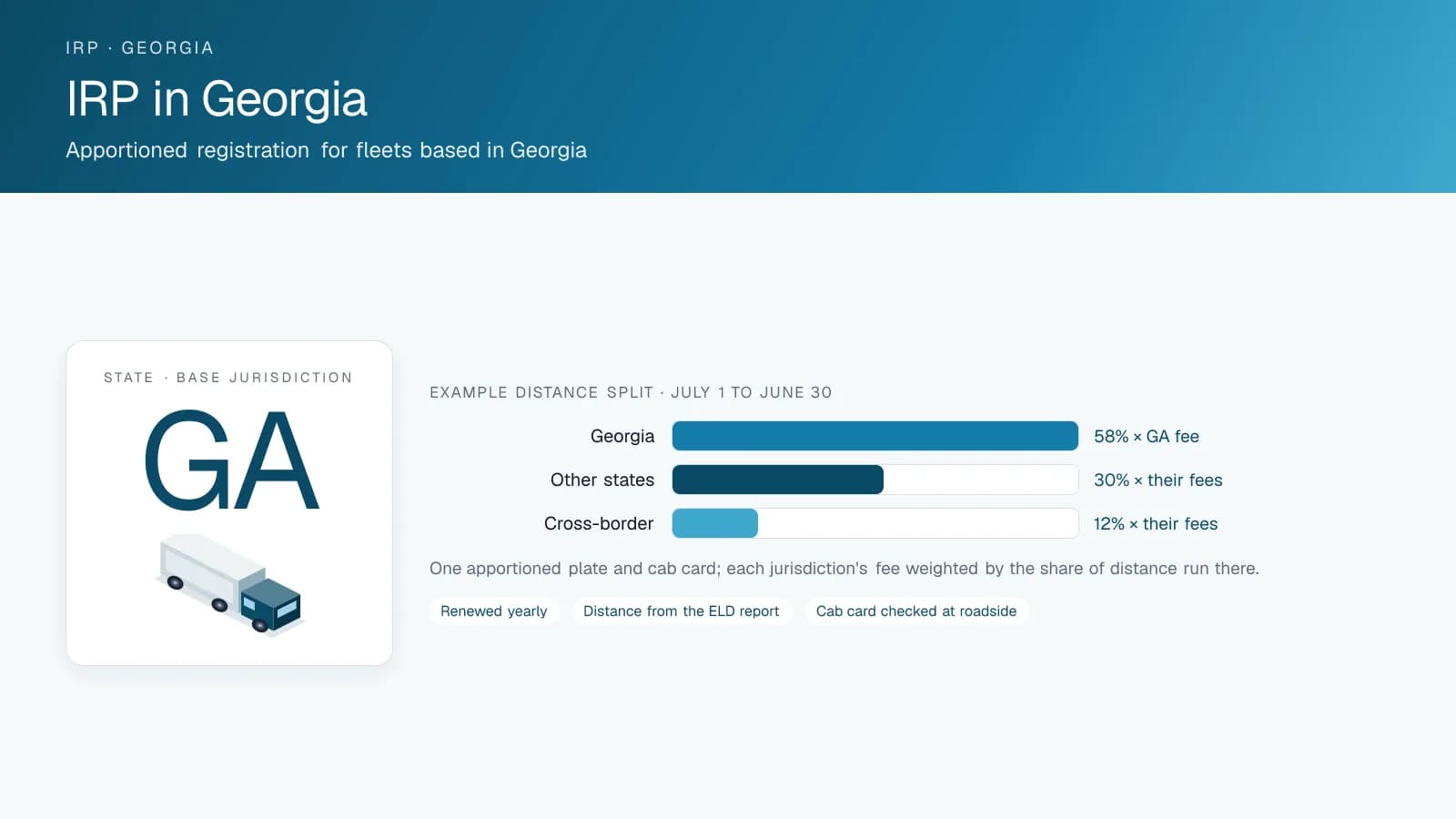
Georgia IRP apportioned registration is issued by the Department of Revenue's Motor Vehicle Division to carriers that run qualified vehicles into other states or provinces, and the fee is split by where the fleet drives. The Department of Revenue also runs the state's IFTA program, so one department handles both: IRP applications and renewals go through the Georgia Trucking Portal, and IFTA through the Georgia Tax Center. Atlanta is a major freight hub in the Southeast, and the Port of Savannah is one of the busiest container ports in the country. A Georgia-based fleet runs into Florida, Alabama, Tennessee and the Carolinas as routine work, and registers with Georgia as its base jurisdiction.
How Do You Open a New Georgia IRP Account?
You open a new Georgia IRP account through EZ IRP, the Department of Revenue's online request tool, by sending the Schedule G new account application, the Schedule A vehicle form and your supporting documents. Login credentials come only after the Motor Vehicle Division reviews and approves the file. County tag offices and the Southmeadow MVD office cannot process IRP registrations, so the whole process runs online.
To name Georgia as your base jurisdiction, you prove an established place of business with five documents from the Department of Revenue's list, or Georgia residency with three, and you cannot mix the two lists. Every proof must show the same address, and post office boxes and virtual offices are refused. The fleet also has to produce Georgia miles, and its records must be kept in Georgia or be available there.
Expect to send a copy of the applicant's driver's licence, proof of liability insurance (a card, binder or certificate; declarations pages are not accepted), a Georgia title receipt, any equipment or employment lease, and IRS Schedule 1 of Form 2290 for every VIN registered over 54,999 pounds. The department asks you to allow five business days for a reply. Once approved, you receive your login credentials and an invoice, and payment generates a Temporary Apportioned Permit so the truck can run while the plate and cab card arrive by mail.
What Drives the Georgia Apportioned Fee?
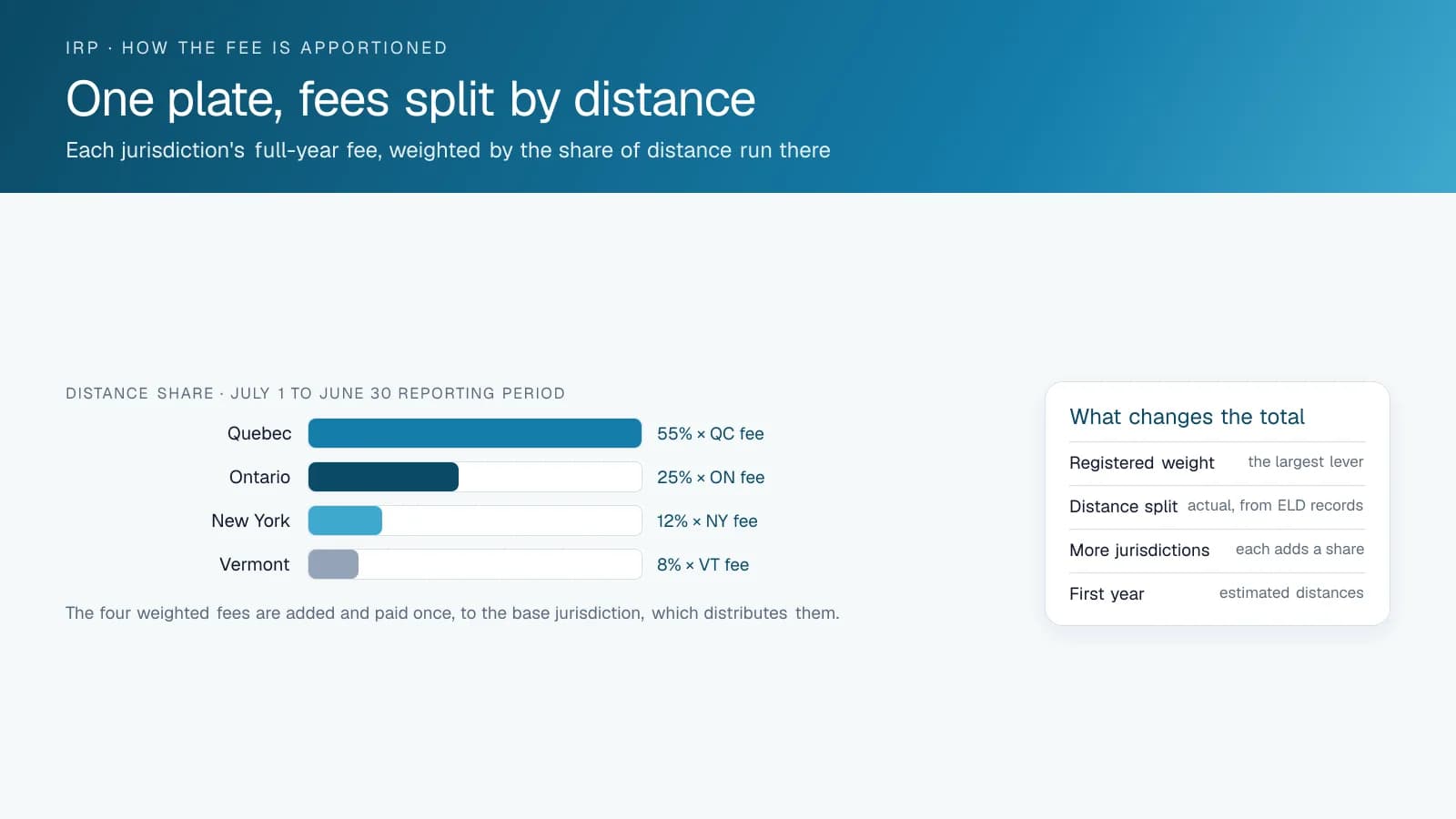
For a Southeast regional fleet, the Georgia schedule shows meaningful percentages in Florida, Alabama, Tennessee, South Carolina and North Carolina. Long-haul operations on the I-75 and I-85 corridors add the Midwest and the Northeast. Savannah drayage adds short runs across the line into South Carolina, and trip sheets tend to miss those. Telematics reports distance by jurisdiction from continuously logged position, which gives you the July-to-June schedule for each unit and the IFTA quarter from the same data, both filed with the same agency.
Roadside Checks and Audits in Georgia
Georgia's Department of Public Safety Motor Carrier Compliance Division runs inspections at the weigh stations on I-75, I-85, I-20 and I-95, and checks cab cards, IFTA decals and ELD records together. If you keep all of them current from one telematics dataset, your trucks spend the least time at the scale.
Georgia IRP at a Glance
The essentials for a Georgia-based fleet. Confirm current procedures and fee schedules with the agency before you renew.
| Item | Georgia |
|---|---|
| IRP administered by | Georgia Department of Revenue's Motor Vehicle Division |
| Threshold | Power unit over 26,000 lb, or three or more axles, or a combination over 26,000 lb, in two or more jurisdictions |
| Credential | Apportioned plate and cab card per power unit; trailers not apportioned |
| Distance reporting period | July 1 to June 30 before the registration year |
| Fee basis | Each jurisdiction's fee at the registered weight, weighted by distance share |
| First-year fleet | Estimated distance chart until a full year of actual distance exists |
| Audit window | Three years after the registration year closes |
| Distance source | ELD or GPS jurisdiction report, per unit |
Frequently asked questions
Who handles Georgia IRP registration?
The Georgia Department of Revenue's Motor Vehicle Division handles IRP registration. Applications, renewals and supplements for the apportioned plate and cab card all go through that office, on the Georgia Trucking Portal. The Department of Revenue also runs Georgia's IFTA program, through the Georgia Tax Center, so a carrier deals with one department for its registration and its fuel tax filings.
If our Georgia trucks stay local, do we still register under IRP?
No. IRP splits one registration fee among the jurisdictions a vehicle operates in, so a Georgia truck that never leaves the state has nothing to split. It stays on an ordinary plate from the Motor Vehicle Division. Once it starts scheduled runs to Florida, it needs the apportioned plate, or a trip permit for a single trip.
What distance does the Georgia IRP renewal use?
The renewal uses actual miles in each jurisdiction for the twelve months ending June 30 before the registration year, per vehicle, reported to the Georgia Department of Revenue's Motor Vehicle Division. A fleet in its first year has no history, so it uses the average per-vehicle distance chart published by IRP, Inc. until it has a full year of actual distance.
Do IRP and IFTA cover the same thing for a Georgia carrier?
No, they cover different money. IRP splits one year's registration fee among the jurisdictions the truck runs in, paid through the Georgia Department of Revenue's Motor Vehicle Division. IFTA reconciles the fuel tax owed to each of those jurisdictions every quarter. One set of distance records feeds both, but each is its own filing.
How long should a Georgia carrier keep IRP distance records?
Keep them for the full audit window: three years after the registration year closes. A carrier that keeps its GPS distance reports for that period can answer an audit from the Georgia Department of Revenue's Motor Vehicle Division in an afternoon, because the per-unit distance by jurisdiction is already on file.
What documents does Georgia need to open a new IRP account?
Georgia asks for the Schedule G new account application, a Schedule A vehicle form, five proofs of an established place of business or three proofs of Georgia residency at one matching address, a Georgia title receipt, proof of liability insurance, the applicant's driver's licence and IRS Schedule 1 of Form 2290 for vehicles registered over 54,999 pounds. Add any lease that applies.
Can a Georgia truck run before the apportioned plate arrives?
Yes, once the Department of Revenue approves the new account and you pay the invoice. Payment generates a Temporary Apportioned Permit, which covers the truck while the plate and cab card are mailed. The department says to allow five business days for credentials to arrive by mail after payment, and the plate goes on the front of the truck.
Sources
Related solutions & products
Service areas
Related terms
Continue reading
- Compliance (ELD, DVIR, IFTA) overview →
- Georgia IFTA: How to File the GA IFTA Tax and Order Decals →
- How to File IFTA Online: Step-by-Step for Your First Quarterly Return →
- Who Needs IRP? Apportioned Registration Requirements and How to Apply →
- New Jersey IRP: Apportioned Registration, Plates, Fees and the Distance Schedule →
- More in Compliance →
Get a free quote
- Over 500 fleets
- Since 2013
- 4.9 on Google (19 reviews)
What are you looking for?
Prefer to talk?Call 1-800-613-6323[email protected]