
Compliance
IRP Registration Fees by State and Province: How the Apportioned Fee Is Built
IRP fees by state and province differ: each sets its own fee by weight, and you pay each in proportion to your distance there. See a worked example.
Why Are IRP Fees Different in Every State and Province?
IRP fees differ by state and province because each of the 59 IRP member jurisdictions sets its own fee schedule by registered gross weight, through its own legislature and on its own update cycle, and you pay each one in proportion to your distance there. Some schedules climb steeply at the top weights, some stay flat, and some add surcharges or highway-fund levies on the apportioned portion. Canadian provinces set their weight classes in kilograms, while US states use pounds. IRP leaves the schedules as they are. It lets the base jurisdiction collect your share of every one of them on a single invoice and pass the money on.
How Is the Apportioned Fee Calculated? A Worked Example
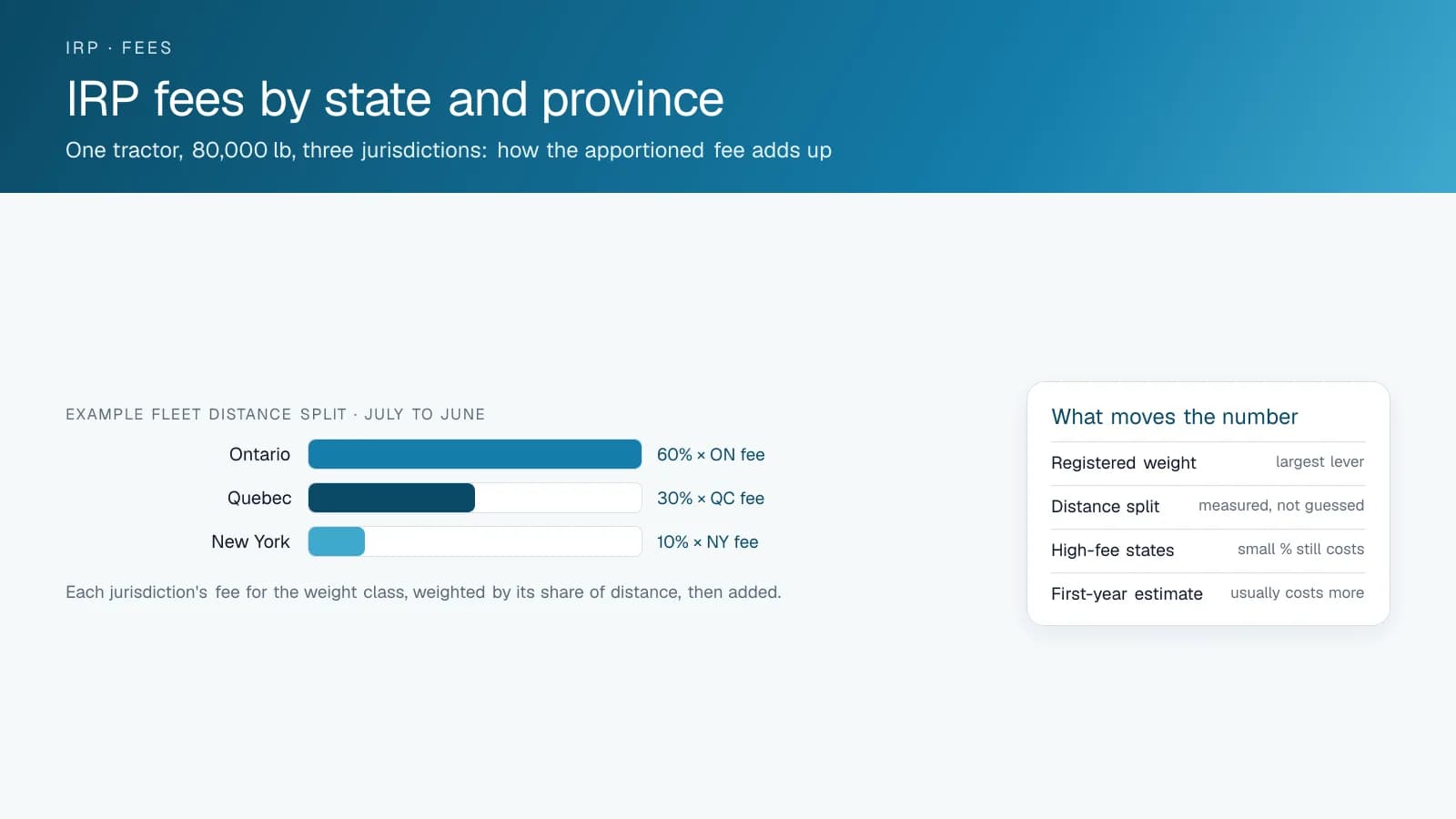
Take a tractor registered at 80,000 pounds combined, based in Ontario, with a July-to-June distance split of 60% Ontario, 30% Quebec and 10% New York. The base jurisdiction looks up Ontario's annual fee for that weight and takes 60% of it, takes 30% of Quebec's fee and 10% of New York's, then adds the three. Suppose Ontario's fee for the class were $2,900, Quebec's $2,600 and New York's $1,900 (illustrative figures, since each one changes). The apportioned fee would be $1,740 plus $780 plus $190, about $2,710 for the year, before the base jurisdiction's administrative and plate fees. Shift ten points of distance from Ontario to New York and the total falls; shift them to a high-fee state and it rises.
What Moves Your IRP Total Up or Down?
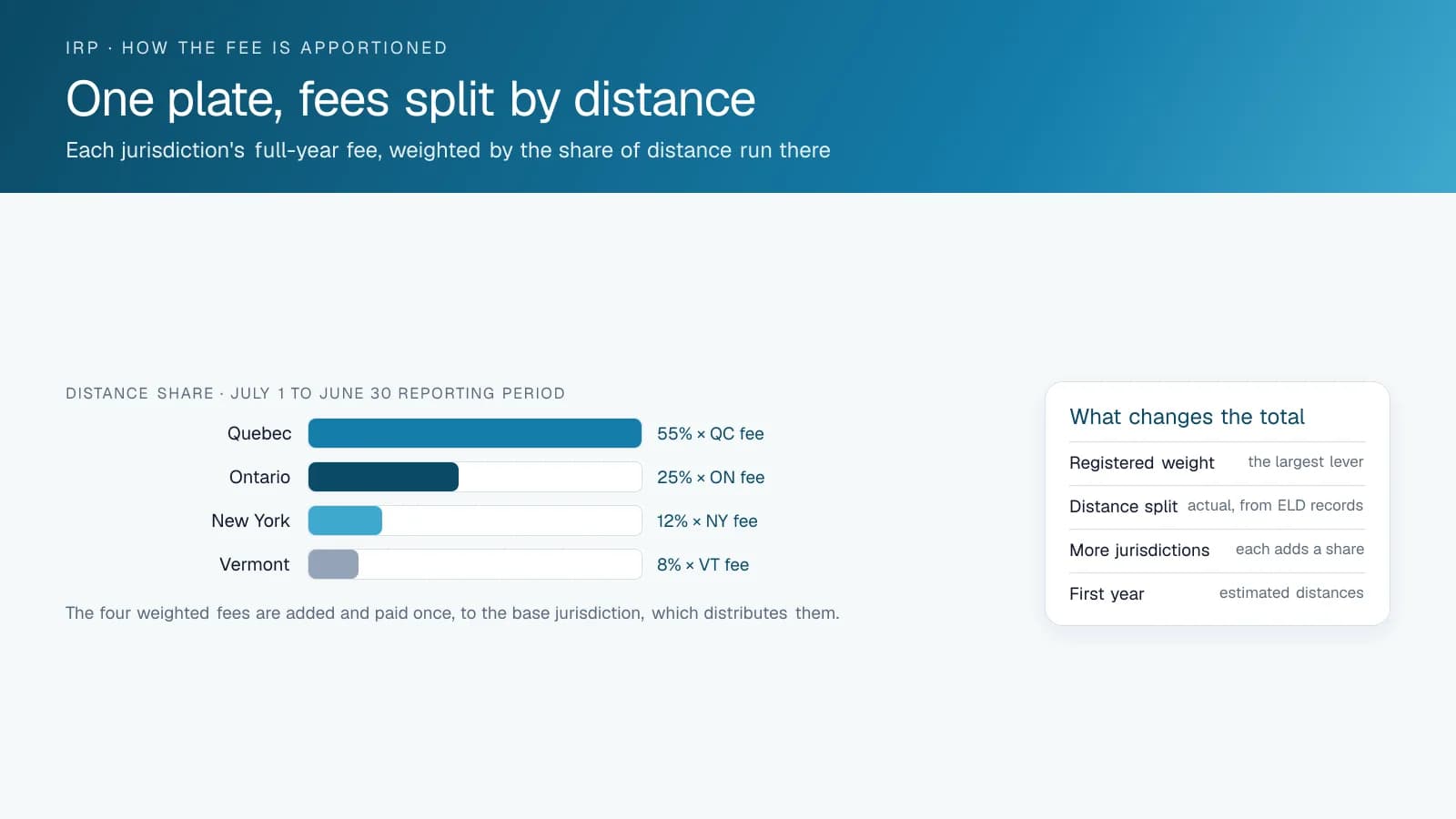
Registered weight is the biggest lever, since every schedule climbs with it. A truck registered above the weight it runs pays the difference in every jurisdiction, every year. The distance split comes second, and measured data beats estimates in both directions here: over-reporting a high-fee jurisdiction means you overpay, and under-reporting invites an audit recalculation. A first-year fleet with no history uses the base jurisdiction's average per-vehicle distance chart, which spreads distance across many jurisdictions and usually costs more than the fleet's real pattern would. Vehicles added mid-year are often charged only for the months remaining, but proration rules vary, so check with your base jurisdiction.
How Do You Get the Distance Split Right?
The distance figures come from your fleet's own records, and telematics turns them into a report: distance by jurisdiction for any date range, per unit, from continuously logged position. Run it July to June and you have the IRP schedule; run it by quarter and you have the IFTA return. Fleets that file both from one dataset give both agencies consistent numbers, and consistency is the first thing an auditor from either one checks. High Point GPS configures jurisdiction reporting for carriers across Canada and the United States.
The Example, Line by Line
The worked example as a table, with the same illustrative fees. The fees will change, but the arithmetic stays the same.
| Jurisdiction | Distance share | Full-year fee (illustrative) | Apportioned share |
|---|---|---|---|
| Ontario (base) | 60% | $2,900 | $1,740 |
| Quebec | 30% | $2,600 | $780 |
| New York | 10% | $1,900 | $190 |
| Total apportioned fee | 100% | $2,710 | |
| Plus base jurisdiction admin and plate fees | Varies |
Frequently asked questions
Is there an IRP fee table by state?
No single IRP fee table exists. Each state and province publishes its own registration fee schedule by weight, and IRP does not set a common fee. Instead, IRP apportions each jurisdiction's own fee by your share of distance there, and your base jurisdiction collects the total on one invoice.
How is the IRP fee calculated?
Take each jurisdiction's annual fee for the vehicle's weight class and multiply it by your fleet's percentage of distance in that jurisdiction. Add those amounts across all jurisdictions, then add the base jurisdiction's administrative and plate fees to get your apportioned IRP fee.
Which is more expensive, US or Canadian IRP fees?
Neither side is consistently more expensive; it depends on the jurisdiction and the weight class. Some states and provinces charge a lot at the top weights and some charge little. The mix of jurisdictions on your fleet's schedule, weighted by distance, decides the total you pay.
Why did my IRP fee go up when my trucks did not change?
Usually because your distance split moved toward higher-fee jurisdictions, a jurisdiction raised its fee schedule, or someone increased a registered weight. Compare this year's distance report with last year's first, since a shift toward a high-fee state raises the total.
Can I lower my IRP fee?
Yes. Register each truck at the weight it runs, report measured distance instead of estimates, and avoid the first-year average distance chart once you have a real distance history. Measured distance by jurisdiction from telematics also keeps your IRP and IFTA numbers consistent for auditors.
Related solutions & products
Related terms
Continue reading
- Compliance (ELD, DVIR, IFTA) overview →
- Who Needs IRP? Apportioned Registration Requirements and How to Apply →
- How Much Do Apportioned Plates Cost? IRP Registration Fees Explained →
- UCR Registration Explained: The Unified Carrier Registration Fee for Interstate and Cross-Border Carriers →
- IRP in North Carolina: NC IRP Registration, Apportioned Fees and the Distance Schedule →
- More in Compliance →
Get a free quote
- Over 500 fleets
- Since 2013
- 4.9 on Google (19 reviews)
What are you looking for?
Prefer to talk?Call 1-800-613-6323[email protected]