
Compliance
What Is IFTA? IFTA Fuel Tax Reporting Explained for Fleets
IFTA lets fleets that cross state and provincial lines file one quarterly fuel tax report. See who has to file for IFTA and how the reporting math works.

What Is IFTA, and What Did It Replace?
IFTA, the International Fuel Tax Agreement, is a fuel tax collection and sharing agreement between the lower 48 US states and the ten Canadian provinces. It lets a fleet file one quarterly report in its base jurisdiction, which then distributes the tax owed to every other jurisdiction the fleet drove in. Before IFTA, a fleet running through several states or provinces had to file a separate fuel tax report in each one.
Registration is generally required for qualified motor vehicles, typically those over 26,000 pounds gross vehicle weight or with three or more axles, that operate in two or more IFTA member jurisdictions. If your fleet stays inside one state or province, IFTA usually doesn't apply. Cross a border regularly and it almost certainly does. For an occasional trip, a fuel trip permit can stand in for the licence.
Alaska, Hawaii and the Canadian territories are not IFTA member jurisdictions, which surprises fleets that assume the agreement covers all of North America. A trip into one of them falls under that jurisdiction's own fuel tax rules, outside IFTA.
How Does the IFTA Calculation Work?
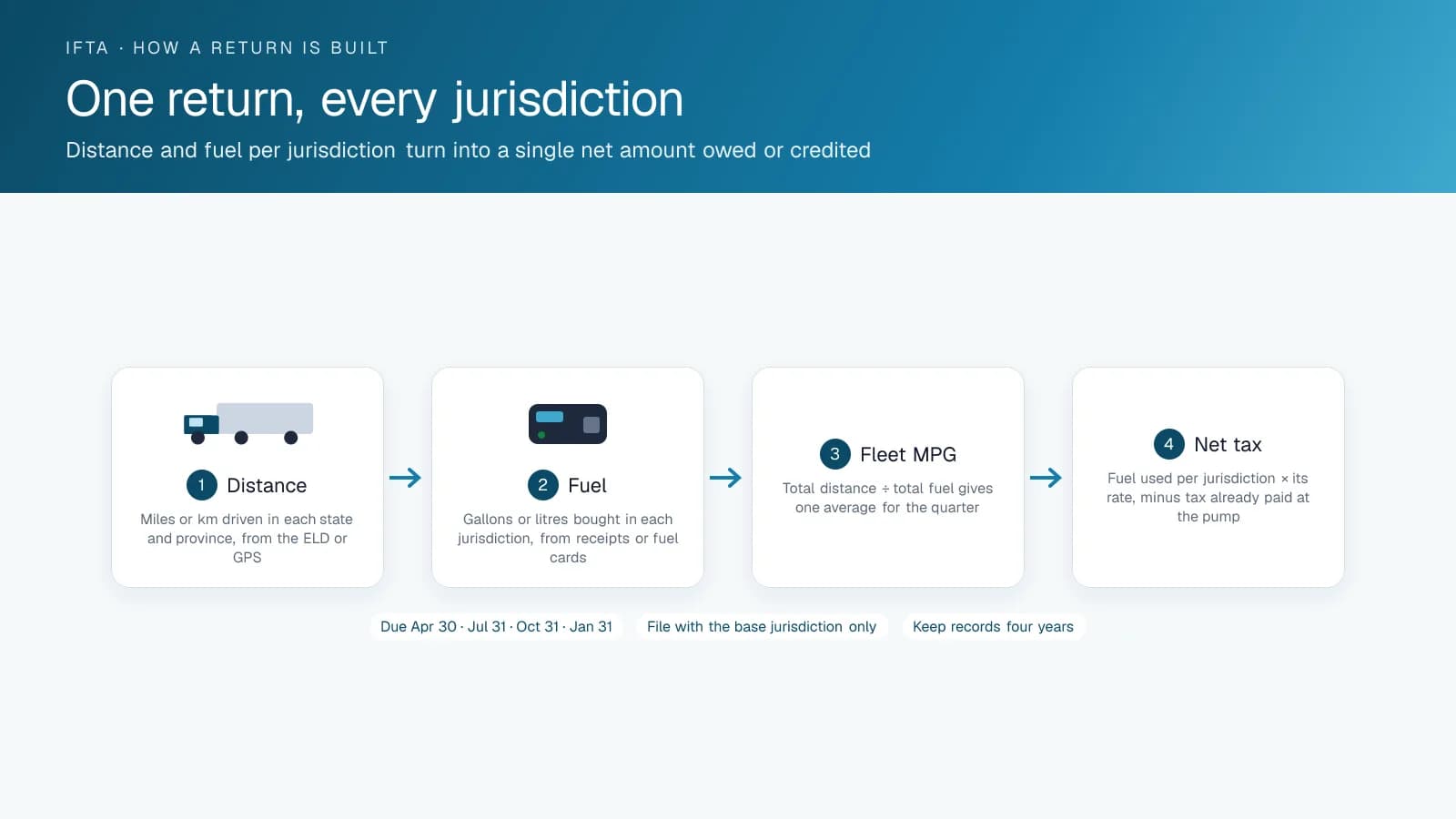
It comes down to two numbers per jurisdiction, per quarter: miles driven and fuel purchased. Fuel tax rates differ by state and province, and you don't always buy fuel where you drive the most, so the report works out, for each jurisdiction, whether you owe more tax or have a credit coming, based on where you drove compared with where you fuelled up.
That one-report, one-jurisdiction structure is the whole point of IFTA. Your base jurisdiction processes a single filing and moves the money to every other jurisdiction behind the scenes, so you never file twenty state-level fuel tax returns because your trucks touched twenty states in a quarter.
How Do You Get an IFTA Licence and Decals?
You apply to your base jurisdiction, which issues one IFTA licence for the whole fleet and a pair of decals for each qualified motor vehicle. The IFTA Articles of Agreement require a copy of the licence, on paper or as an electronic image, in every vehicle, and the decals on the outside of both sides of the cab. A vehicle without a copy of the licence is not considered to be operating under IFTA.
In Quebec, the licence and decals come from Revenu Québec. Québec is your base jurisdiction if your main establishment is in the province, or if your qualified vehicles are most often assigned, stored or repaired there. The licence is valid from January 1 to December 31, and the licence and decals are renewed every year. If you renew by December 31, a grace period lets your trucks run on the old decals until the last day of February. Miss the deadline and you need certificates for occasional trips until the new decals are on the trucks.
When Are IFTA Returns Due, and What Records Must You Keep?
An IFTA return, with full payment, is due on the last day of the month after each calendar quarter. You file it even for a quarter in which the fleet did no IFTA travel or used no taxable fuel. When the due date falls on a Saturday, Sunday or legal holiday, the next business day counts.
A late or missing return, or an underpayment, can cost you a penalty of $50 or 10% of the delinquent tax, whichever is greater, and the base jurisdiction also charges interest on the tax owed.
Records matter as much as deadlines. The IFTA Procedures Manual requires a licensee to keep its distance and fuel records for four years from the date each return was due or filed, whichever is later, and to make them available for audit to any member jurisdiction. In an IFTA audit the burden of proof is on the licensee, and the records must let the auditor verify the distance travelled and the fuel bought. GPS records of distance by jurisdiction, trip by trip and kept for the full four years, are built for that check.
| Quarter | Months covered | Return due |
|---|---|---|
| First | January to March | April 30 |
| Second | April to June | July 31 |
| Third | July to September | October 31 |
| Fourth | October to December | January 31 |
How Does GPS Take the Manual Work Out of IFTA Reporting?
Manual IFTA prep is where the pain sits. Rebuilding mileage by jurisdiction from odometer readings and route memory, then matching it against a shoebox of fuel receipts, is slow and error-prone even for a small fleet. It gets worse as the fleet grows, and it's a common reason fleets either overpay out of caution or underpay and get flagged in an audit.
GPS-based mileage tracking removes most of that reconstruction. When your telematics platform already knows the moment a vehicle crossed into a new state or province, the mileage by jurisdiction for the IFTA report is a query instead of a research project. Whoever owns quarterly filing at your company gets real time back, and those are rarely their favourite two hours of the quarter.
GPS also settles a kind of dispute that's hard to win with manual records: an auditor questioning whether a trip crossed into a jurisdiction you reported mileage for, or one you left off. A GPS boundary-crossing log answers that question definitively, which a driver's route notes generally can't.
A Worked IFTA Quarter
One truck, one quarter, two jurisdictions, with illustrative tax rates. The arithmetic is the same at any scale, and the platform runs it for every truck in every jurisdiction.
| Step | Ontario | New York | Total |
|---|---|---|---|
| Distance driven | 12,000 km | 8,000 km | 20,000 km |
| Fuel purchased | 4,200 L | 1,800 L | 6,000 L |
| Fleet consumption | 20,000 km ÷ 6,000 L = 3.33 km/L | ||
| Fuel used per jurisdiction | 12,000 ÷ 3.33 = 3,600 L | 8,000 ÷ 3.33 = 2,400 L | |
| Tax on fuel used (illustrative rate) | 3,600 × $0.15 = $540 | 2,400 × $0.12 = $288 | |
| Tax already paid at the pump | 4,200 × $0.15 = $630 | 1,800 × $0.12 = $216 | |
| Net | Credit $90 | Owed $72 | Credit $18, settled through Ontario |
Frequently asked questions
Who has to file IFTA reports?
Fleets that operate qualified motor vehicles in two or more IFTA member jurisdictions generally have to register and file quarterly. A qualified vehicle is typically over 26,000 lbs GVW or has 3+ axles. Fleets that operate entirely within one state or province usually don't need to register, so check the requirement again before your trucks start crossing borders.
Does IFTA apply to Canadian carriers?
Yes. All ten Canadian provinces are IFTA member jurisdictions alongside the lower 48 US states, so a cross-border carrier files one quarterly IFTA report that covers driving on both sides of the border. The report goes to the carrier's base jurisdiction, which distributes the tax owed to every other member jurisdiction the fleet drove in.
What's the difference between IFTA and IRP?
IFTA covers fuel tax, based on where you drove and where you bought fuel. IRP, the International Registration Plan, is a separate agreement that apportions vehicle registration fees across jurisdictions according to the distance travelled in each. Many fleets deal with both, but they are separate filings, even though both depend on distance by jurisdiction.
Are Alaska, Hawaii, or Canadian territories covered by IFTA?
No. Alaska, Hawaii and the Canadian territories are not IFTA member jurisdictions. Travel into those areas falls under each jurisdiction's own fuel tax rules, outside the standard IFTA quarterly report, which surprises fleets that assume the agreement covers all of North America. Check that jurisdiction's requirements before the trip.
When are IFTA quarterly returns due?
IFTA returns are due on the last day of the month after each quarter: April 30, July 31, October 31 and January 31. You file even if the fleet had no IFTA travel that quarter. When the date falls on a weekend or legal holiday, the next business day counts, and a late return can bring a penalty plus interest.
How long do you have to keep IFTA records?
Keep your IFTA distance and fuel records for four years from the date each quarterly return was due or filed, whichever is later. Any member jurisdiction can ask to audit them, and the burden of proof sits with the carrier. Records that show distance by jurisdiction, trip by trip, are the easiest kind to defend in an audit.
Sources
Related solutions & products
Related terms
Continue reading
- Compliance (ELD, DVIR, IFTA) overview →
- Who Needs IRP? Apportioned Registration Requirements and How to Apply →
- IFTA Indiana: Licence Fee, Decals and Quarterly Returns →
- IFTA Massachusetts: MassTaxConnect Filing, Decals and Deadlines →
- IFTA New York Guide: OSCAR Filing and the NY HUT Tax →
- More in Compliance →
Get a free quote
- Over 500 fleets
- Since 2013
- 4.9 on Google (19 reviews)
What are you looking for?
Prefer to talk?Call 1-800-613-6323[email protected]