
Industry
GPS Fleet Tracking for Mobile Clinics & Health Units
GPS fleet tracking for mobile clinics and health units: arrival at every site, generator and vaccine refrigerator status, and site hours for funders.
Updated September 21, 2026
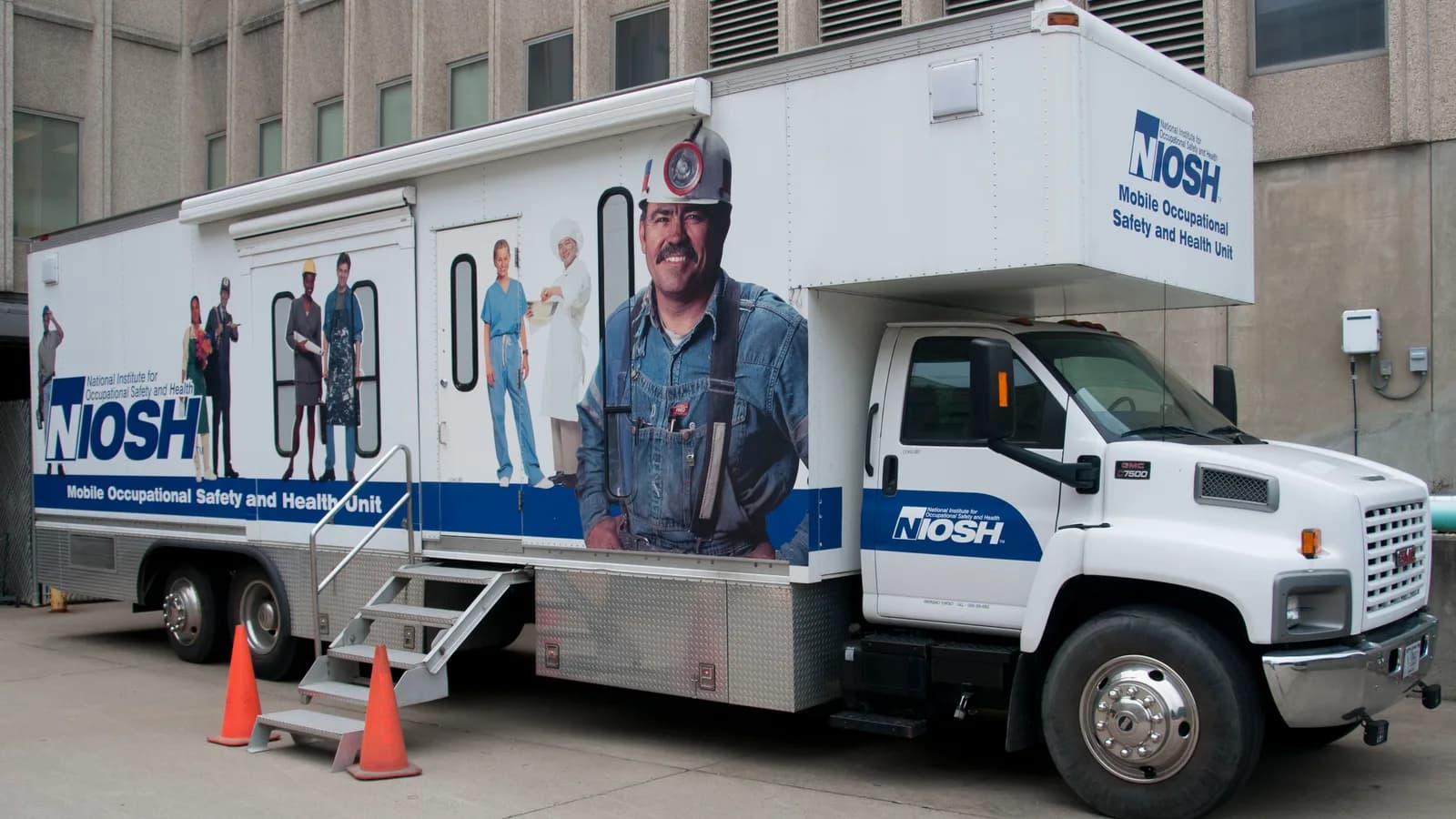
A mobile clinic is a health facility that happens to have wheels, and everything a fixed clinic takes for granted becomes a fleet problem on the road. The unit has to be at the community centre by 9:00 because patients were told it would be, the vaccine refrigerator has to stay cold on the drive and the generator has to power the exam room. At the end of the quarter the funder wants to know how many sites were served and for how many hours. High Point GPS puts each unit on one live map in the High Point GPS platform with the day's scheduled sites beside it. A geofence around every site records the arrival time, the departure time and the hours on location without anyone filling in a log. An IOX-AUXM module reads the unit's own circuits, so the generator, the lift and the shore-power connection each show up as timed events in the trip record. A Bluetooth temperature sensor in the vaccine refrigerator reports on the road and raises an alert when the reading drifts. Engine-hours and generator-hours maintenance, electronic pre-trip inspections in the driver app, and driver ID for the shared units complete a record a program director can hand to a health authority or a funder as it stands. Trips are stored on the device when a rural site has no coverage and uploaded when it returns.
Common challenges
- Patients and site coordinators calling to ask when the unit will arrive, with no better answer than a phone call to the driver
- Site-hours reporting to funders built from paper logs that do not match the mileage claims
- Vaccine and specimen refrigeration that is checked at departure and at arrival, with nothing in between
- Generator hours nobody tracks until the generator fails at a site with a full waiting room
- Units shared by rotating clinical staff, with no record of who drove on which day
- Rural routes where the unit goes out of cell coverage and the office loses sight of it for hours
How High Point GPS helps
- Live location of every unit on one map for the program office, with the scheduled site list beside it and an ETA for the next stop
- Geofences around each clinic site that record arrival, departure and hours on location automatically
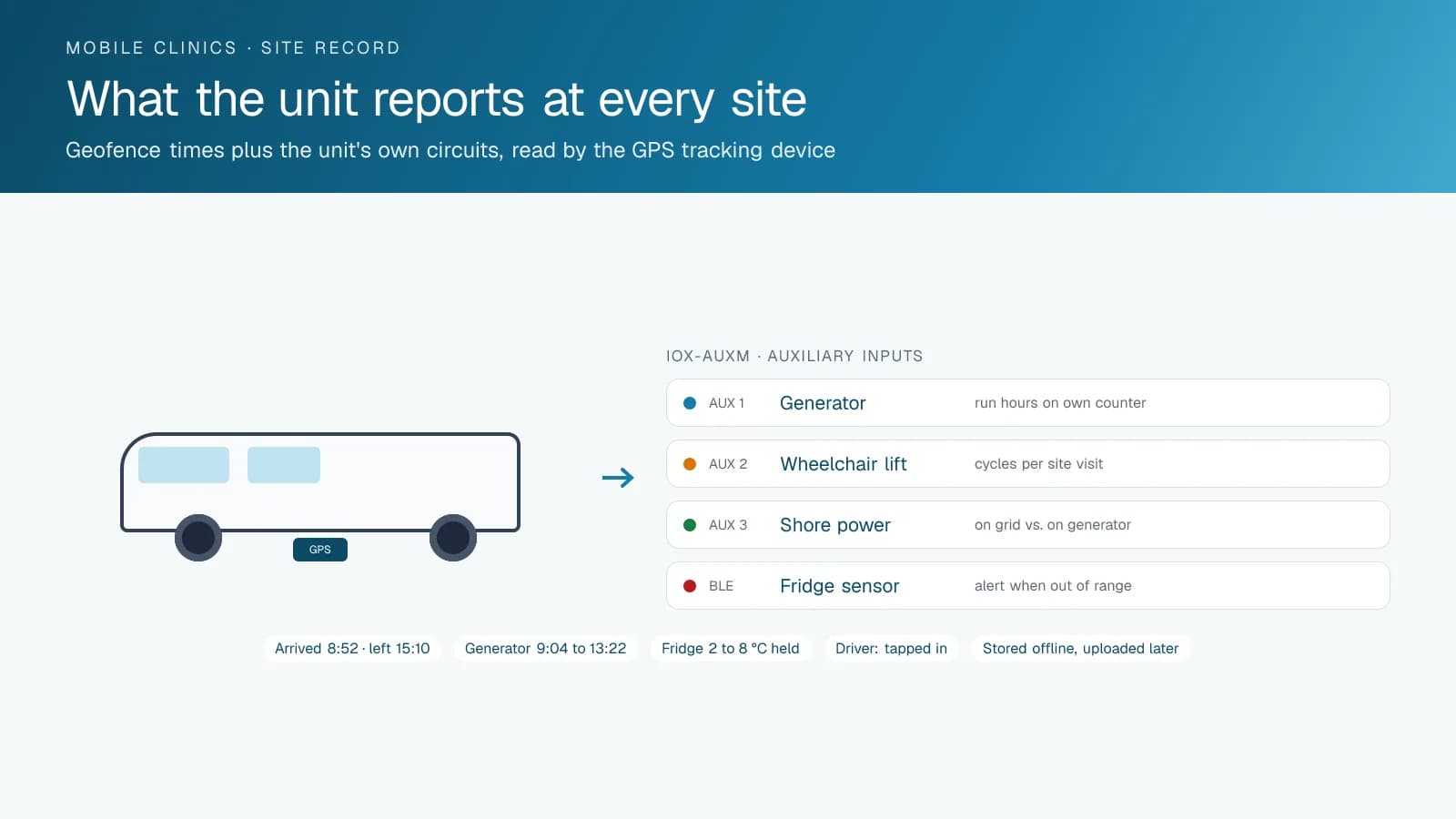
- Generator, wheelchair lift and shore-power status read from the unit's circuits through IOX-AUXM auxiliary inputs
- Bluetooth temperature sensors in the vaccine refrigerator, with alerts when a reading leaves the set range
- Site-hours and mileage reports by program and by funder, exported from the High Point GPS platform or through the API
- Driver ID with an IOX-NFCREADERA reader that attributes each trip on a shared unit to the person who drove
- Maintenance reminders on engine hours and generator hours, with fault codes sent to the fleet coordinator as they appear
- Trips stored on the GPS tracking device out of coverage and uploaded when the unit returns, which keeps rural days complete
Being where the patients were told you would be
A mobile health program lives on trust with the communities it visits. A unit that arrives forty minutes late at a seniors' residence loses patients who went home. High Point GPS sets up each unit in the High Point GPS platform with its scheduled sites for the day, and the program office watches the unit against that schedule on a live map. When traffic or a late departure puts a stop at risk, the coordinator sees it in time to call the site rather than learning about it from the site. The same view lets the office answer a patient who calls, because the coordinator can see the unit is three kilometres away and say so.
The record behind that map is what settles the schedule questions that come later. A site coordinator says the unit left early; the geofence record shows it arrived at 8:52, departed at 15:10 and spent six hours and eighteen minutes on location. A driver says the highway was closed; the trip replay shows the detour and the speed on every segment. The office pulls that answer in a minute, and the conversation with the partner organization stays about the patients rather than the clock.
Generator, lift and shore power in the trip record
A mobile clinic has circuits an ordinary van does not: a generator that powers the exam room, a wheelchair lift, a shore-power connection at sites that have it, and often a separate roof air conditioner. An IOX-AUXM module on the GPS tracking device reads whether each is on or off, and every site visit in the trip record carries the generator-on time, the lift cycles and whether the unit ran on shore power or on the generator. Generator hours accumulate on their own counter, which is how the coordinator schedules the oil change before the generator fails at a site instead of after.
The same inputs answer the questions that are hard to ask a clinical team after the fact. Was the generator running during the four hours the unit sat at the fairground? The record says yes, from 9:04 to 13:22. Did the lift get used at the residence that asked for accessible service? Six cycles. When a unit is billed to two programs on the same day, the generator and site times split the day between them without a spreadsheet.
Cold chain on the road
Vaccines, insulin and specimens ride in a refrigerator that is checked when the unit leaves and when it arrives, and the two hours in between are usually a matter of hope. A Bluetooth temperature sensor inside the refrigerator reports through the GPS tracking device on the same timeline as the trip. The coordinator sets the acceptable range, and an alert goes out by text or email the moment the reading leaves it. The cause may be a door left ajar at a stop or a generator that did not start on the highway. The temperature history for a given date is one report, exported as a PDF for the health authority or the pharmacy that supplied the doses.
When a shipment has to be discarded, the report is what the pharmacy and the funder ask for. It shows the reading every few minutes, the point where it left range, how long it stayed out and where the unit was at the time. A wired temperature probe is an option for units with a built-in medical refrigerator that has no Bluetooth of its own. High Point GPS installs and calibrates the sensors as part of the setup and adds the alerts to the coordinator's rule set.
Shared units, inspections and the funder report
Mobile units are driven by whoever is on the schedule: a nurse one day, an outreach worker the next, a contracted driver on the weekend. An IOX-NFCREADERA reader in the cab assigns each trip to the person who tapped in, and the unit reminds the driver to tap if they forget. That record answers a speeding ticket in the mail, and it is the basis of driver scoring that is fair, because a hard-braking event goes to the person who was driving and not to the unit. The pre-trip inspection runs in the driver app, with a checklist written for a clinic on wheels that includes the lift, the generator fuel and the refrigerator reading. A defect reaches the fleet coordinator before the unit leaves the yard.
At the end of the quarter, the funder report comes out of the same records. Sites visited, hours on location by site, kilometres by program and generator hours are each High Point GPS platform report, and High Point GPS builds the export so it matches the funder's template. A program that reports to a health authority and to a foundation gets two exports from the same data. Nobody reconstructs the quarter from a logbook.
Frequently asked questions
Can the office see when the unit arrives at each site?
Yes. High Point GPS draws a geofence around every site the program visits. The GPS tracking device records the arrival time, the departure time and the hours on location for each visit, and the report by site and by date is available in the High Point GPS platform for the funder or the site partner.
Does it monitor the vaccine refrigerator?
Yes. A Bluetooth temperature sensor inside the refrigerator reports through the GPS tracking device on the same timeline as the trip. Alerts go out when a reading leaves the range you set, and the temperature history for any date exports as a report for the pharmacy or the health authority.
Can it track generator hours?
Yes. An IOX-AUXM module reads the generator's run circuit, so generator-on and generator-off times appear in the trip record and accumulate on their own hour counter. Maintenance reminders run on those hours, and the lift and shore-power connection can be read the same way.
What happens when the unit is out of cell coverage?
The GPS tracking device keeps recording trips, site visits, auxiliary inputs and temperature readings on the device itself. When the unit returns to coverage, everything is uploaded and the day appears in the High Point GPS platform as if it had been live. Rural site days are complete in the record.
How do we know who drove a shared unit?
An IOX-NFCREADERA reader in the cab assigns each trip to the staff member who taps their card. Trips, speeding events and driver scores follow the person rather than the unit, and the unit prompts the driver to tap if they forget to identify themselves at the start.
Related solutions
Related guides
- How Geofencing Works for Fleet Tracking →
- What Is an IOX Port and What Does It Do? →
- The Bluetooth Temperature Puck: A Ten-Year Wireless Thermometer for Reefers and Coolers →
- IOX-NFCREADERA: Driver ID by NFC Tap, So Every Trip Has a Name on It →
- Fleet Maintenance: Engine Hours vs. the Calendar →
- High Point GPS DVIR: How Digital Vehicle Inspection Reports Work →
Get a free quote
What are you looking for?