
Industry
GPS Fleet Tracking for Scaffolding & Shoring
GPS fleet tracking for scaffolding and shoring companies: delivery and pickup stamps on every rental, boom PTO time, and inventory on customer sites.

Updated September 21, 2026
GPS fleet tracking for scaffolding and shoring companies from High Point GPS stamps the delivery and pickup on every rental, times the boom on each unload and keeps your inventory on the map while it sits on customer sites. It is built for companies that rent frames, planks, shoring posts and system scaffold by the day or the week. The equipment goes out on a flatbed or boom truck, a crew erects it, it stays on site for the weeks the customer needs it, and it comes back when the job is done. The rental clock runs from delivery to pickup, and a billing dispute often turns on one of those two dates. High Point GPS puts each truck on one live map, with a geofence around the yard and every customer site. The GPS tracking device stamps the departure, the arrival and the time on site for each drop and each pickup. On trucks that unload with a boom, an IOX-AUXM module reads the boom's PTO. The High Point GPS platform totals hours on site per crew for the erect-and-dismantle labour billed apart from the rental. Battery-powered trackers on scaffold trailers and Bluetooth tags on the larger components keep inventory visible through weeks on site, with an alert when a trailer moves after hours. If a general contractor says the scaffold came down on the tenth and the invoice says the seventeenth, the pickup stamp settles it. Electronic DVIR, ELD hours of service where required and engine-hours maintenance keep the heavy trucks legal and working. Companies across Canada and the United States run all of it from one High Point GPS platform database.
Common challenges
- Rental invoices disputed over delivery and pickup dates, with only a signed slip or the driver's word as proof
- Erect-and-dismantle labour billed from a foreman's time sheet that the general contractor questions
- Scaffold and shoring inventory on sites for weeks with no record of which customer has what
- Trailers of frames and planks taken from a site overnight, found missing when the crew arrives to dismantle
- Boom-truck deliveries never timed, so a claim that the truck held up the site or arrived late comes down to memory
- Flatbeds and boom trucks that miss engine-hours service and DVIR requirements in the busy season
How High Point GPS helps
- Every delivery truck, boom truck and crew van on one live map, with a geofence around the yard and each customer site
- Delivery and pickup stamped with the arrival, time on site and driver, for the rental clock and the invoice
- Boom PTO read through the GPS tracking device's IOX-AUXM auxiliary inputs, with start, stop and duration for each unload
- Hours on site per crew for erect-and-dismantle labour, recorded without a time sheet
- Battery trackers on scaffold trailers and Bluetooth tags on larger components, with an alert when a trailer moves after hours
- Driver ID from an NFC key fob that ties each trip to the crew leader, whichever truck the crew took
- Electronic DVIR and ELD hours of service in the driver app for the trucks that need them
- Engine-hours and mileage maintenance reminders for boom trucks and flatbeds, with fault codes sent to the shop
How does GPS tracking prove delivery and pickup dates on a scaffold rental?
A geofence around each customer site records every arrival and departure with the time and the driver. You bill a scaffold rental by the day or the week between two dates, and the customer's accounts payable team may check both against its own site log. High Point GPS draws a geofence around each site, names it after the rental contract, and the GPS tracking device stamps every truck that comes and goes. The delivery on the third shows an arrival at 7:40 a.m., a departure at 10:15 a.m. and the driver's name from the NFC fob. The pickup on the seventeenth has the same detail. A trip replay backs up both, and the PTO input times a boom truck's unload as well.
With that record, the argument over dates rarely starts. A general contractor who says the scaffold came down on the tenth gets the pickup stamp from the seventeenth, along with the crew's hours on site that day. A customer who says the delivery came late and held up the masons gets the arrival time and the boom's run time. High Point GPS builds the rental report with the contract number, the site and both stamps, and exports it through the open API to the rental software you already bill from.
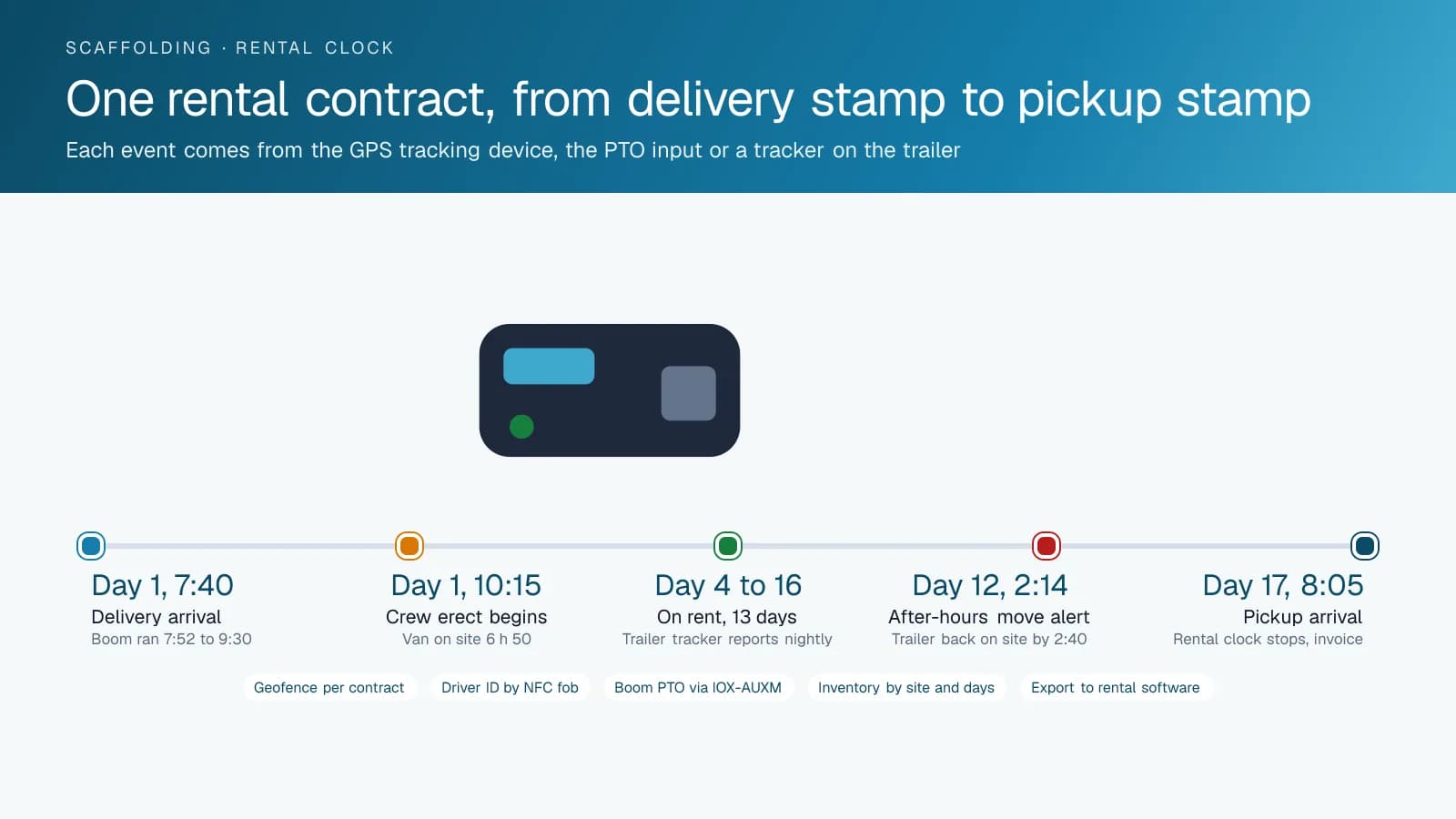
Inventory that lives on customer sites for weeks
The hardest thing a scaffolding company owns is the inventory that is not in the yard. Frames, planks, shoring posts and system components sit on twenty sites at once, and the office knows which site has what from the delivery slips. Battery-powered trackers on the scaffold trailers, and Bluetooth tags on the larger components and the hoists, keep the inventory on the same map as the trucks through weeks on a site. A dispatcher who needs forty frames for a rush job sees which site is near its dismantle date and has them, and a report lists every tracked asset by site and by days on rent.
Theft is the other reason. A trailer of frames and planks taken from a site overnight is a loss the company discovers when the crew arrives to dismantle, and the customer disputes responsibility. An alert fires the moment a tracked trailer moves outside the hours the company sets, and the tracker reports its position until it is recovered. High Point GPS sets the alert rules for after-hours movement, off-site departures and low battery once, and the office hears about a problem before the crew does. The tracker's position history also shows the customer that the trailer was on their site when it was taken.
Erect-and-dismantle labour with hours on site
Labour is billed separately from the rental, and a general contractor may question that line. The crew van's arrival and departure at the site geofence give the hours on site per crew per day, and the High Point GPS platform totals them per contract. A foreman's time sheet that says ten hours on a day the van was on site for seven is caught that week. An estimator who sees that a four-storey erect took two days rather than the day and a half in the bid adjusts the next quote, and the report by scaffold type and by crew shows which jobs are being underbid over a season.
Driver ID through the IOX-NFCREADERA matters here because crews take whichever van or flatbed is loaded for their site. A tap of the crew leader's fob before the trip attributes the hours on site, the driving events and the trip replay to that person. When a general contractor questions a labour line, the office replies with the van's arrival and departure and the crew leader's name for each day. The record comes from the GPS tracking device rather than a recollection, and it is the same record the estimator used to price the job.
Heavy trucks, inspections and hours of service
A boom truck and a loaded flatbed are the heaviest vehicles most scaffolding companies run, and they draw the most attention at a scale or a roadside inspection. Electronic DVIR in the driver app replaces the clipboard, walks the driver through the truck and the boom, time-stamps each item and routes a defect to whoever fixes it before the truck leaves the yard. For trucks that fall under the US or Canadian ELD mandate, the same app records hours of service on the same GPS tracking device. IFTA mileage by jurisdiction comes from the trip data for trucks that cross a border or a state line.
Maintenance runs on engine hours as much as mileage for a boom truck, and the High Point GPS platform tracks both per unit. A reminder fires when an oil change, a hydraulic service or a DOT inspection comes due, and engine fault codes reach the shop the day they appear. A hydraulic pressure fault on the boom is looked at before it fails with a load in the air. Driver scoring on speeding, harsh braking and idling is set per driver, and an AI dash cam on the boom trucks adds the road view when a claim is disputed. A supervisor coaches from a specific trip, and the insurer sees a fleet with a program.
Frequently asked questions
Can GPS tracking prove the delivery and pickup dates on a scaffold rental?
Yes. High Point GPS draws a geofence around each customer site, and the GPS tracking device stamps every truck's arrival and departure with the time and the driver from the NFC fob. The rental report lists the delivery and pickup stamps for each contract. If a customer pushes further, the trip replay backs up each stamp.
How do we know which site has which inventory?
Battery-powered trackers on scaffold trailers, and Bluetooth tags on larger components and hoists, report on the same map as your trucks. Tags report through any truck that passes nearby; trackers report on their own schedule. A report lists every tracked asset by site and by days on rent, and an alert fires when a trailer moves after hours.
Can it record how long the boom ran on a delivery?
Yes. An IOX-AUXM module on the GPS tracking device reads the boom's PTO circuit. Each delivery in the trip record then shows the arrival at the site, the moment the boom started and how long it ran. That answers a customer who says the truck arrived late or held up the work on site.
Do our boom trucks and flatbeds need an ELD?
It depends on the truck's weight class and how far it travels, and High Point GPS reviews that with each company. Where a truck falls under the US or Canadian ELD mandate, the driver app on the same GPS tracking device records hours of service. The same platform also handles DVIR and IFTA mileage.
How are the erect-and-dismantle hours recorded?
The crew van's arrival and departure at the site geofence give the hours on site per crew per day, and the crew leader's NFC fob shows who was in charge. The High Point GPS platform totals those hours per contract. The office attaches the report to the labour line of the invoice, with no time sheet needed.
Related solutions
Related guides
- Rental Equipment GPS Tracking: Billing, Returns and Utilization →
- How Does Trailer GPS Tracking Work, With or Without a Truck? →
- Asset Tracker Tags vs. Powered GPS Trackers for Equipment →
- Heavy Equipment Theft Recovery: How GPS Gets Stolen Machines and Trailers Back →
- IOX Meaning: What Is an IOX Port and What Does It Do? →
- How Does a Digital DVIR Work? Inspections, Defects and Repairs →
Get a free quote
- Over 500 fleets
- Since 2013
- 4.9 on Google (19 reviews)
What are you looking for?
Prefer to talk?Call 1-800-613-6323[email protected]