
Asset & Equipment Tracking
Asset Tracker Tags vs. Powered GPS Trackers for Equipment
Pick an asset tracker by how equipment moves: GPS asset tags suit tools riding with a tracked vehicle, powered trackers suit assets left alone for days.

Asset Tracker Tags or Powered Trackers: Which Should You Use?
The right asset tracker depends on how the equipment moves: use a Bluetooth asset tag on tools and equipment that travel with a tracked vehicle, and a standalone powered GPS tracker on assets that sit alone or move without your vehicles. A tag costs little and reports only when a Geotab GO device nearby detects it; a powered tracker such as the GO Anywhere Plus or the next-gen GO Anywhere costs more and reports from anywhere with cellular coverage. Pick the wrong one for an asset and you either waste money or lose visibility when you need it.
Work through the choice asset by asset instead of picking one approach for all your equipment. A mixed fleet of tools, trailers and heavy equipment needs both device types, each on the assets it suits, and a single standard SKU applied everywhere for simplicity will fit some of them badly.
How Do Bluetooth Asset Tracking Tags Work, and Where Do They Fit?
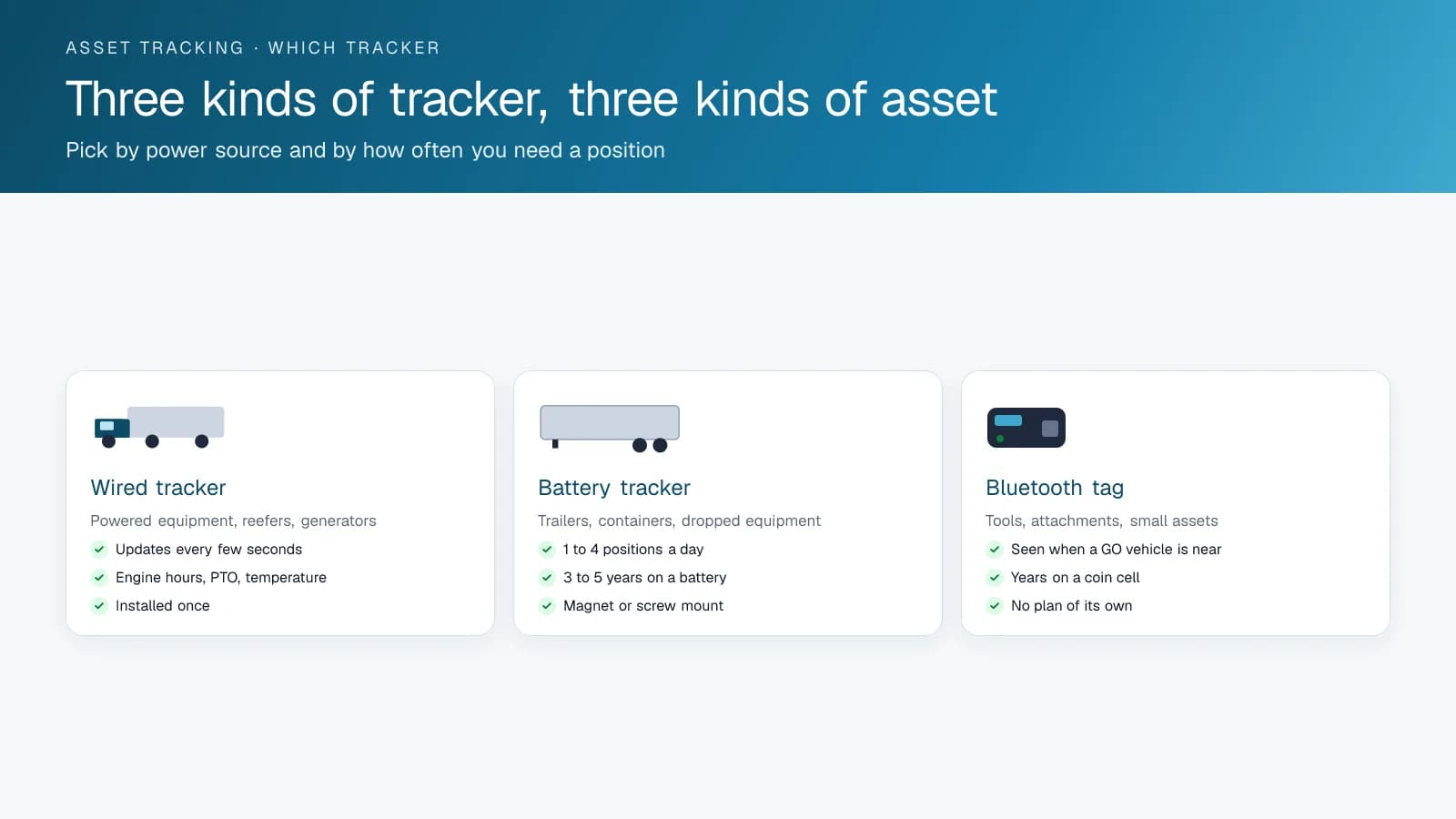
A Bluetooth asset tag is a small battery-powered beacon with no cellular connection of its own, heard by a GPS tracking device fitted with the IOX-BT module. It relays its location through the nearest GPS tracking device already installed in a vehicle. You avoid a second data plan for each tagged item, so ongoing cost stays low, and battery life typically runs from months to a couple of years depending on usage. The catch is that a tag only reports location when it's within range of a tracker-equipped vehicle, which makes it best for tools and smaller equipment that regularly travel with or near one.
A toolbox, compressor or generator that always rides on the same truck or trailer between job sites is a good fit. As long as a GPS tracking device passes nearby often enough, the location history stays useful, even though the tag never connects to a cell tower itself.
How Do Standalone Powered GPS Trackers Work, and Where Do They Fit?
A standalone powered tracker has its own battery, or runs on the asset's power with a backup battery, and its own cellular connection, so it reports location without any vehicle nearby. That independence costs more, in hardware and in an ongoing data plan for each unit. It's the right choice for assets that spend real time away from your vehicles: a generator dropped at a remote job site for weeks, or a trailer that different tractors pick up and drop off.
Long battery life matters for equipment that sits outdoors for long stretches. The next-gen GO Anywhere is rated for up to 10 years with hourly reporting, which cuts down on trips to the asset to check or swap a battery, and every one of those visits defeats part of the reason you track it remotely.
How Do Asset Tracker Tags and GPS Trackers Compare on Cost, Range and Battery Life?
As a rule of thumb, Bluetooth tags cost less per unit and per month but only report when they're near a vehicle. Powered trackers cost more per unit and typically carry a separate monthly data plan, but they report from anywhere with cellular coverage, with or without a vehicle nearby. For a large number of lower-value tools, the tag's lower recurring cost usually wins. For a smaller number of higher-value assets that travel alone, the tracker's independence usually justifies the extra spend.
Range needs more thought than it first seems to. A Bluetooth tag's range is short, typically tens of metres. That's plenty to confirm the tag is on the same truck, but once the truck drives off and leaves the asset behind, the tag stops reporting. Plan for that failure on assets that sometimes get separated from their usual vehicle.
A Simple Decision Framework
Ask three questions about each asset. Does it usually travel with or near a tracked vehicle? Is its value or theft risk high enough to justify a dedicated cellular connection? Do you need its location even when it sits alone for days or weeks? Two or three "yes" answers point to a standalone powered tracker. Mostly "no" answers, especially on the travels-alone question, point to a Bluetooth tag as the cheaper choice.
When you're unsure about a high-value asset, default to the powered tracker. Under-tracking a theft-prone machine usually costs far more than you save on a cheaper tag, especially if that tag turns out to have a blind spot at the moment you most need to see the asset.
The Three Questions, Applied
Here is the framework worked through for common assets. Two or three yes answers point to a powered tracker.
| Asset | Travels with a tracked vehicle? | Value or theft risk justifies a plan? | Sits alone for days? | Device |
|---|---|---|---|---|
| Hand tools and kits | Yes | No | No | Bluetooth tag |
| Towable compressor on the crew truck | Yes | Borderline | No | Bluetooth tag |
| Generator dropped at a site for a month | No | Yes | Yes | Battery tracker such as the GO Anywhere |
| Trailer pulled by the fleet's own tractors | Yes | Yes | Sometimes | Trailer tracker such as the GO Anywhere or GO Anywhere Plus |
| Trailer interchanged with partners | No | Yes | Yes | Powered tracker |
| Excavator with an electrical system | No | Yes | Yes | Wired ruggedized device |
| Survey instrument in the van | Yes | Yes | No | Bluetooth tag with a left-behind alert |
How Do You Set Up a Mixed Deployment?
Most equipment-heavy fleets end up running both device types side by side. A construction or rental fleet might put Bluetooth tags on every hand tool and small compressor, and standalone powered trackers on trailers, generators and any equipment that regularly sits at a site for a long stretch with no vehicle nearby.
Avoid guessing once at rollout and never revisiting the choice. As your business changes, an asset that started out travelling with a vehicle can end up sitting alone at a site for weeks. Check from time to time whether the device type you assigned to each asset still matches how your crews use it.
How Do You Track Trailers and Equipment With No Cab or Engine Port?
Wire a hybrid tracker to the asset's own electrical system when it has one, and use a battery-only tracker when it has none. Geotab's GO Anywhere Plus covers the first case: a 3-wire connection (power, ground and ignition) feeds it from the asset, and a replaceable backup battery, rated up to 3 to 5 years depending on use, keeps it reporting when that power is off. It runs on 12 V and 24 V systems, mounts with screws, bolts or cable ties, and records trips, distance, ignition and engine hours. On a loader or a generator with no OBD-II port, those engine hours are what drive the service schedule.
Unpowered assets such as dry van trailers, roll-off bins and dumpsters suit the next-gen GO Anywhere, which mounts without wiring and sends hourly location updates. If one of them is stolen, you can switch it to high-frequency tracking every 15 minutes to help recover it.
Remote job sites raise the coverage question. The GO Anywhere Plus offers direct-to-cell satellite fallback through select carriers, and Geotab states that availability depends on the carrier and region. For a vehicle or machine that already carries a GO device, the IOX-SATIRDv2 add-on reports position over the Iridium satellite network when cellular coverage is lost. Confirm which option applies to a given site before you count on it.
Can the GO10 Detect Bluetooth Tags Without an Add-On?
Yes. Geotab's GO10 vehicle device has Bluetooth Low Energy 5.4 built in, and its support document says it detects and relays signals from Geotab-compatible BLE beacons without any additional hardware. Older devices such as the GO9 hear the same tags through the IOX-Bluetooth add-on module. Either way, the platform shows each beacon's last known location on the map and keeps its location history in the trip history.
The GO Anywhere Plus can also hear tags, which turns a parked trailer or machine into a tag reader. Geotab sets one condition: the tracker must be wired to external power, because tag detection is not available in battery-only mode. A tool crate stored in a wired trailer at the site keeps reporting after the crew truck drives away, which closes part of the left-behind gap described above.
The tags themselves are third-party Bluetooth beacons from Geotab's Marketplace partners, such as Link Labs puck tags in North America, and Geotab says Small Asset Tracking is available to all users in North America and Europe. Pick the beacon model by how it mounts and what it has to survive before you order a batch.
What Should Your Fleet Do Next?
List your equipment and sort each item by how it moves: rides with a truck, has its own power, or sits unpowered. That list tells you where tags, wired trackers and battery trackers belong, and which of your vehicles may already have a device that can hear tags.
High Point GPS is a Montreal fleet telematics company and Geotab partner. We match a device to each asset, install the hardware with professional installers, and support your fleet in English and French across Canada and the United States. Send us your equipment list through the form on this page: choose Get a free quote and we will propose a mix that fits how your crews work.
Frequently asked questions
How long do Bluetooth asset tag batteries last?
Bluetooth asset tag batteries typically last from months to a couple of years, depending on usage and the specific device. The tag doesn't maintain its own cellular connection. It only broadcasts a short-range signal to a nearby GPS tracking device, which takes far less power than a cellular tracker reporting on its own.
Can a powered GPS tracker report location with no vehicle nearby at all?
Yes. A standalone powered tracker has its own cellular connection, so it reports its location anywhere it has coverage, with or without a tracked vehicle nearby. That independence is its main advantage over a Bluetooth tag, which only reports when it is within short range of a vehicle carrying a GPS tracking device.
Which option is cheaper long-term, tags or standalone trackers?
Bluetooth tags are generally cheaper per unit and per month because they avoid a separate cellular data plan, which makes them the better value for a large number of lower-value items. Standalone trackers cost more but earn it on higher-value assets that travel without any vehicle nearby.
Can I mix both tag types across the same fleet of equipment?
Yes, and most mixed equipment fleets should. Put Bluetooth tags on tools and smaller items that travel with a vehicle, and standalone powered trackers on higher-value assets that spend real time away from any vehicle. Both device types show up on the same platform, so you track every asset from one screen.
Can a GPS asset tracker send an alert when equipment leaves a job site?
Yes. With a tracker such as the GO Anywhere Plus, you draw a zone around the job site or yard and set a geofence alert that notifies you by email or SMS when the asset enters or exits it. The alert reaches you while the machine is moving, which matters for theft and unauthorized use far more than finding the gap at the next inventory count.
Do Bluetooth asset tags work with a GO9, or only with the GO10?
Both can work. The GO10 detects Geotab-compatible Bluetooth beacons with its built-in Bluetooth Low Energy radio, so it needs no extra hardware. A GO9 or other older GO device needs the IOX-Bluetooth add-on module to hear the same tags. In both cases the platform shows each tag's last known location on the map and keeps its location history.
Sources
Related solutions & products
Related terms
Continue reading
- Asset Tracking overview →
- Bluetooth Asset Tracking Tags and the IOX-BT: How They Work and What to Tag →
- Wired Reefer Temperature Monitoring for Multi-Compartment Refrigerated Trucks →
- One Bluetooth Gateway for Thirty Sensors on a Truck or Trailer →
- How GPS Equipment Tracking Works, and What Drives the Cost →
- More in Asset & Equipment Tracking →
Get a free quote
- Over 500 fleets
- Since 2013
- 4.9 on Google (19 reviews)
What are you looking for?
Prefer to talk?Call 1-800-613-6323[email protected]