
Asset & Equipment Tracking
Bluetooth Asset Tracking Tags and the IOX-BT: How They Work and What to Tag
Bluetooth asset tracking tags have no GPS: a vehicle device fitted with the IOX-BT hears them and reports where. See the range, battery and what to tag.
How Do Bluetooth Asset Tracking Tags and the IOX-BT Work?
Bluetooth asset tracking tags work through the IOX-BT, which lets a GPS tracking device hear tags on nearby equipment and report where and when it heard them to the High Point GPS platform. High Point GPS sells this as small asset and tool tracking: a module, a tag and the platform. The IOX-BT is an expansion module that plugs into the IOX port on a GPS tracking device and adds a Bluetooth Low Energy radio. The tag is a small sealed beacon fixed to the asset, such as a power tool, a ladder or a tool crate, and it broadcasts its identity every few seconds on a coin-cell or larger battery. In the High Point GPS platform, the tag shows up as an asset with a location, a last-seen time and, for sensor tags, a reading such as temperature.
The GPS tracking device does the work. Each time it hears a tag, it records which tag, when, and where the vehicle was at that moment, then sends that up with its regular telematics data. The tag has no GPS and no modem, which keeps it inexpensive and lets its battery last for years.
What Is the Range of a Bluetooth Asset Tag?
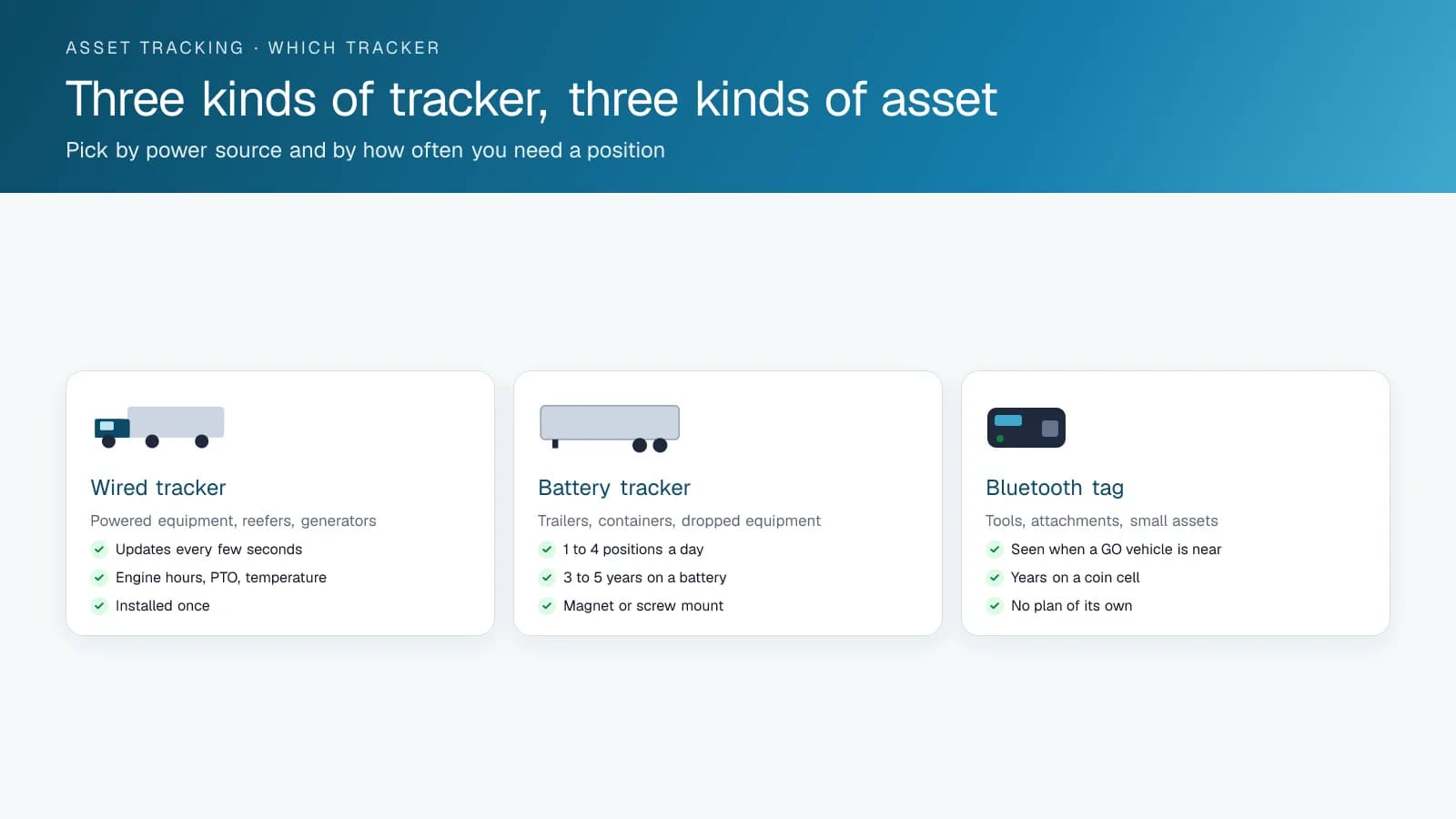
A GPS tracking device hears a tag within Bluetooth range, typically tens of metres in the open and less through steel. So a tagged asset's location is the location of the last vehicle that heard it. A toolbox in the yard is seen by each equipped truck that passes, an attachment on a site by the crew truck parked beside it, and a tool crate in a van reports from wherever the van goes. An asset where no vehicle fitted with the IOX-BT goes is never seen, so tag coverage equals fleet coverage, which suits a yard-and-site operation and doesn't suit a trailer dropped at a customer three provinces away.
For that trailer, use a tracker with its own GPS and modem, such as the battery-powered GO Anywhere or the wired GO Anywhere Plus. Both kinds of tracker show up on the same map.
Can Bluetooth Tags Report Temperature?
Some tags carry sensors on top of identity and presence. Temperature tags in a reefer body or a cooler give you a continuous cold-chain record through the vehicle's own device, and door sensors such as the ELA Puck MAG detect openings with a magnet. When a beacon's sampling isn't enough, the IOX port also accepts wired third-party sensors from the add-on library, and driver ID readers such as the IOX-NFCREADERA use the same port family.
Which Assets Should You Tag First?
Start with the assets that go missing or that crews hunt for most: power tools, ladders and toolboxes, attachments and buckets, and any tool or kit worth more than a few hundred dollars that moves between crews. Group them by type in the High Point GPS platform so a search for "where are the compactors" returns a list. Turn on last-seen alerts, so the platform flags an asset that has gone unheard longer than its normal cycle before someone needs it on a job. You mount each tag out of sight with screws or adhesive, then add it to the platform as an asset.
Tag Types and Where They Go
These are the beacon types Geotab supports for small asset tracking, with how each one mounts and the reading it adds.
| Tag | Mount | Adds | Battery |
|---|---|---|---|
| Puck beacon (ELA PuckID, Link Labs Puck Tags) | Adhesive or screws, hidden inside a cavity | Identity and last-seen location | Up to 3 years |
| Coin or slim beacon (ELA CoinID, LiteID) | Adhesive or screws, on small tools and kits | Identity, in a smaller format | Years |
| Temperature tag (ELA Puck T) | Inside a reefer body, cooler or tote at product height | Continuous temperature | Years |
| Door tag (ELA Puck MAG) | On a door frame, with its magnet on the door | Door open and close events | Years |
| Sensor-enabled beacon (select models) | Screws or adhesive | Ambient temperature, light and impact, plus battery level | Years |
Frequently asked questions
What is the IOX-BT?
The IOX-BT is an expansion module that plugs into the IOX port and adds a Bluetooth Low Energy radio to a GPS tracking device, so the device can hear nearby beacons on tools, attachments and equipment. It can monitor up to 60 beacons in range at once.
Do Bluetooth asset tracking tags have GPS?
No. A Bluetooth asset tag only broadcasts its identity. The GPS tracking device that hears it supplies the location and the connection to the High Point GPS platform. That keeps the tag inexpensive, but it is only located when a device fitted with the IOX-BT passes within range.
What is the range of a Bluetooth tag?
A Bluetooth tag is typically heard within tens of metres in the open, and less through steel. The platform places a tagged asset wherever a tracked vehicle last heard it, so coverage follows your fleet. Assets left far from your vehicles need a standalone tracker.
How long does a tag battery last?
A Bluetooth asset tag lasts several years on a coin-cell or larger battery, depending on the model and the broadcast interval. Tags last that long because they carry no GPS or modem and only send their identity every few seconds.
Can tags report temperature?
Yes. Temperature tags in a reefer body or cooler report readings through the vehicle's GPS tracking device, which gives you a continuous cold-chain record in the High Point GPS platform. Door sensors such as the ELA Puck MAG, and beacons that report light and impact, cover other conditions you need to log.
Related solutions & products
Free tools for this topic
Continue reading
- Asset Tracking overview →
- IOX-NFCREADERA: Driver ID by NFC Tap, So Every Trip Has a Name on It →
- IOX Meaning: What Is an IOX Port and What Does It Do? →
- What Is MyGeotab? The Fleet Platform High Point GPS Supports →
- How Does a GPS Tracking Device Work? From the Diagnostic Port to the Dashboard →
- More in Asset & Equipment Tracking →
Get a free quote
- Over 500 fleets
- Since 2013
- 4.9 on Google (19 reviews)
What are you looking for?
Prefer to talk?Call 1-800-613-6323[email protected]