
Compliance
FMCSA Hours of Service Rules: The 11 and 14 Hour Limits
FMCSA Hours of Service rules let property-carrying drivers drive 11 hours in a 14-hour window after 10 hours off. The US limits, breaks and exceptions.

What Are the Hours of Service Limits for Property-Carrying Drivers?
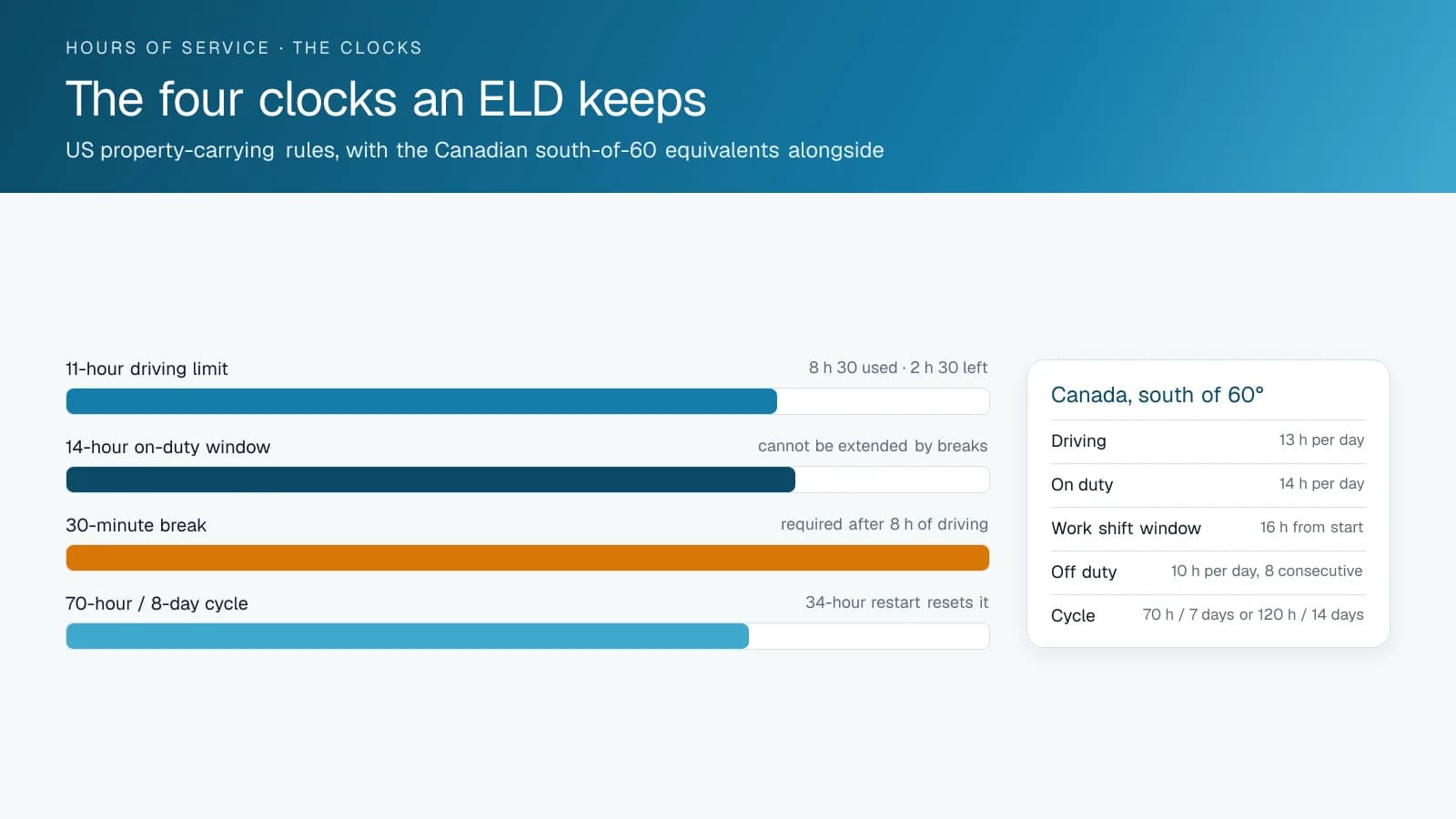
US Hours of Service (HOS) rules let a property-carrying driver drive up to 11 hours within a 14-hour on-duty window, and the window only opens after 10 consecutive hours off duty. A 30-minute break is required once you've driven 8 cumulative hours without a qualifying break. A weekly limit then caps you at 60 hours on duty in 7 days or 70 hours in 8 days, depending on whether your carrier operates every day. Those numbers, 11, 14, 10, 30, and 60/70, make up the framework most drivers need to know.
Drivers misread the 14-hour window more than any other limit. Once it opens, it runs on the wall clock and does not pause for breaks, fuel stops or loading. You can drive for only 11 of those 14 hours, and the window keeps counting whether the truck moves or not, so a long detention or a slow load comes straight out of your available driving time.
Which Hours of Service Exceptions Change the Math?
Two exceptions come up often enough to matter. The 150 air-mile short-haul exception lets qualifying drivers skip records of duty status, provided they start and end at the same reporting location and are released within 14 hours, though the carrier must still keep time records for them. The 16-hour "big day" exception lets certain drivers who return to their work reporting location extend the on-duty window to 16 hours once every 7 consecutive days, or again after a 34-hour restart, if they meet its conditions.
The 34-hour restart lets a driver reset the weekly 60/70-hour clock to zero by taking at least 34 consecutive hours off duty. The sleeper-berth provision lets drivers split the required 10 hours off into two qualifying periods. Each one comes with specific conditions, and the ELD is what tracks whether a driver stayed inside them.
What Counts as On-Duty Time Under the HOS Rules?
On-duty time is all the time from when a driver starts work, or must be ready to work, until the driver is relieved of all work and all responsibility for it. That definition in 49 CFR 395.2 is why the 14-hour window fills faster than many drivers expect: driving is only one of the activities that count.
The regulation lists the rest. Waiting at a terminal, a shipper or another facility to be dispatched counts, unless the carrier has relieved the driver from duty. So does inspecting or servicing the truck, loading and unloading or supervising it, staying with a vehicle being loaded, repairing a disabled truck or waiting with it, giving a drug or alcohol test sample when the carrier directs it, and any other work for a motor carrier. Paid work for a company that is not a motor carrier counts too, so a second job eats into the same limits.
Two details change how the log is kept. Resting in a parked truck or in the sleeper berth is not on-duty time. And the 30-minute break no longer has to be off duty: under 49 CFR 395.3, it can be off duty, sleeper berth, on-duty not driving, or a combination, as long as the 30 minutes are consecutive and without driving. A driver who spends 30 minutes at the dock without driving has taken the break, provided the ELD logs that time as on-duty not driving.
What Are the Limits for Bus and Passenger-Carrying Drivers?
Passenger-carrying drivers work under different limits, set in 49 CFR 395.5. A bus or motorcoach driver may drive up to 10 hours after 8 consecutive hours off duty, and may not drive after having been on duty 15 hours following those 8 hours off. The weekly limits match the trucking rules: 60 hours on duty in 7 consecutive days, or 70 hours in 8 days if the carrier runs vehicles every day of the week.
The 15-hour limit works differently from the 14-hour window for trucks. It adds up on-duty hours, so off-duty time taken during the day does not count toward it, while the property-carrying window runs on the clock from the moment the driver comes on duty. The 34-hour restart in the property-carrying rules is not part of the passenger-carrying limits. A fleet that runs both trucks and buses needs each driver's ELD set to the right ruleset, or the clocks on the display will be wrong for one group of drivers.
How Does an ELD Keep Drivers Inside the HOS Rules?
Hours of Service is the reason the ELD mandate exists. An Electronic Logging Device ties the driver's duty status to the vehicle's engine and movement data, so the 11-hour and 14-hour clocks run on their own and the driver, the dispatcher and an inspecting officer all see the same record. A good ELD warns drivers before they run out of hours, which lets them plan a stop instead of taking a violation.
For a fleet, HOS compliance no longer depends on someone doing the math by hand at the end of a shift. The platform's GPS tracking device handles HOS logging alongside GPS tracking and diagnostics, so dispatch can see who has hours left before assigning the next load. Nobody finds out a driver is out of hours after they've already committed to the run.
The Limits, Listed
The US property-carrying limits and main exceptions in one table. Rulemaking can change any of them, so confirm with the FMCSA before you rely on an exception.
| Rule | Limit | Notes |
|---|---|---|
| Driving | 11 hours | After 10 consecutive hours off duty |
| On-duty window | 14 hours | Runs on the clock; breaks do not pause it |
| Break | 30 minutes | After 8 cumulative hours of driving without one |
| Weekly cycle | 60 hours in 7 days or 70 hours in 8 days | Depends on whether the carrier operates every day |
| Restart | 34 consecutive hours off duty | Resets the weekly cycle |
| Sleeper berth split | 7 and 3 hours, or 8 and 2 | Both periods count toward the 10 hours off |
| Short-haul exception | 150 air-miles, released within 14 hours | No records of duty status if conditions are met; the carrier keeps time records |
| 16-hour exception | One 16-hour window every 7 consecutive days | Sooner after a 34-hour restart; conditions apply |
| Adverse conditions | Up to 2 extra hours driving and window | Unforeseen conditions only |
Frequently asked questions
What is the 11-hour rule?
The 11-hour rule lets a property-carrying driver drive for a maximum of 11 hours after 10 consecutive hours off duty. Those driving hours also have to fit inside the 14-hour on-duty window, which keeps running through breaks, so time spent waiting at a dock still counts against the day and can cut your driving time short.
Does the 14-hour window stop if I take a break?
No. Once it starts, the 14-hour on-duty window runs continuously and does not pause for breaks, meals, fuel or loading. The rules limit only your driving within that window to 11 hours. The window itself keeps counting, so a long detention at a shipper uses up time you could have spent driving.
What is the 34-hour restart?
It resets the weekly limit. A driver who takes at least 34 consecutive hours off duty brings the 60-hour-in-7-days or 70-hour-in-8-days clock back to zero and starts a fresh weekly cycle. The restart has its own conditions, and the ELD records whether the off-duty period met them.
Are Hours of Service rules the same in Canada?
No. Canadian federal HOS rules allow up to 13 hours of driving and use different daily and cycle limits from the US rules. That is why the ELD has to switch to the Canadian ruleset when a driver crosses the border, so the clocks it shows match the rules where the truck is operating.
Can the 30-minute break be taken while on duty?
Yes. Under 49 CFR 395.3, the 30-minute break required after 8 cumulative hours of driving can be off-duty time, sleeper-berth time, on-duty time spent not driving, or a mix of them. What matters is 30 consecutive minutes without driving. Waiting at a dock or doing paperwork counts, provided the ELD records that time as on-duty not driving.
How many hours can a bus driver drive in a day in the US?
A passenger-carrying driver in the US may drive up to 10 hours after 8 consecutive hours off duty, and may not drive after 15 hours on duty following that rest. The weekly limits of 60 hours in 7 days or 70 hours in 8 days still apply. These limits come from 49 CFR 395.5, separate from the trucking rules.
Sources
Related solutions & products
Related terms
Continue reading
- Compliance (ELD, DVIR, IFTA) overview →
- Canada Hours of Service Rules: Cycles and the 13-Hour Limit →
- Canada Approved ELD List: Are ELDs Mandatory, and Who Must Comply? →
- AOBRD vs ELD: What Changed in the Transition and Why It Matters →
- Hours of Service Rules by Province: Federal Rules, Provincial Rules and Who Follows Which →
- More in Compliance →
Get a free quote
- Over 500 fleets
- Since 2013
- 4.9 on Google (19 reviews)
What are you looking for?
Prefer to talk?Call 1-800-613-6323[email protected]