
Compliance
IRP in British Columbia: Apportioned Plates, Registration Fees and the Distance Schedule
Apportioned plates in British Columbia come from ICBC's Prorate office under IRP, with the fee split by where your fleet drives. Who needs them and why.
Who Issues Apportioned Plates Under IRP in British Columbia?
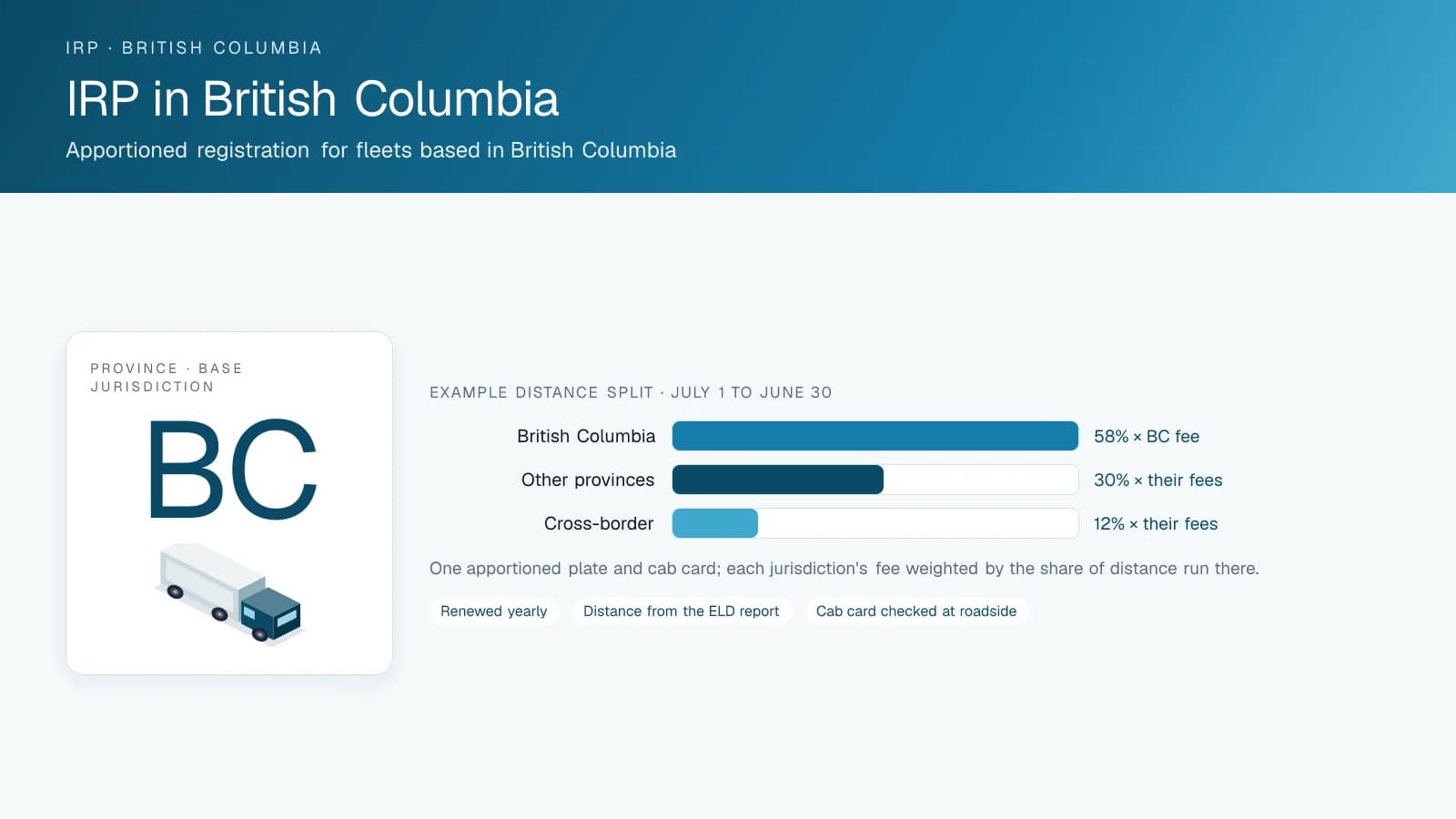
In British Columbia, ICBC administers IRP through its Prorate office, issuing apportioned plates and the cab card and collecting a fee split by where the fleet drives. Carriers who expect a transportation ministry are often surprised to deal with ICBC, the province's public auto insurer. IFTA sits elsewhere, with the Ministry of Finance. A Vancouver, Surrey or Kamloops carrier running port drayage to Alberta, or south through the Pacific Highway crossing into Washington, operates interjurisdictionally and registers with ICBC as its base jurisdiction.
What Drives the British Columbia Apportioned Fee?
The Port of Vancouver and the border shape BC's distance pattern: containers move east on the Trans-Canada and the Coquihalla to Alberta and beyond, and cross-border freight heads into Washington and Oregon. A reporting year can put a large share of a fleet's distance in Alberta and Washington, and each prices the apportioned fee on its own schedule. On mountain routes, trip sheets are much harder to reconstruct than on prairie runs. Telematics distance-by-jurisdiction reporting, built from continuously logged position, gives ICBC the schedule it asks for and gives you the same numbers for your IFTA return.
What Gets Checked at the Roadside and in an Audit?
Commercial Vehicle Safety and Enforcement inspection stations on the main highway corridors and near the US border check cab cards, weights and hours of service together, along with the carrier's BC National Safety Code safety certificate, which the province issues under the national NSC standard. A BC fleet that keeps IRP, IFTA, the NSC and a Canadian-certified ELD current from one telematics dataset has the simplest route to clean inspections at the scale.
IRP in British Columbia at a Glance
The essentials for a fleet based in British Columbia, in one place. Confirm current procedures and fee schedules with the agency before you renew.
| Item | British Columbia |
|---|---|
| IRP administered by | ICBC's Prorate office |
| Threshold | Power unit over 26,000 lb, or three or more axles, or a combination over 26,000 lb, in two or more jurisdictions |
| Credential | Apportioned plate and cab card per power unit; trailers not apportioned |
| Distance reporting period | July 1 to June 30 before the registration year |
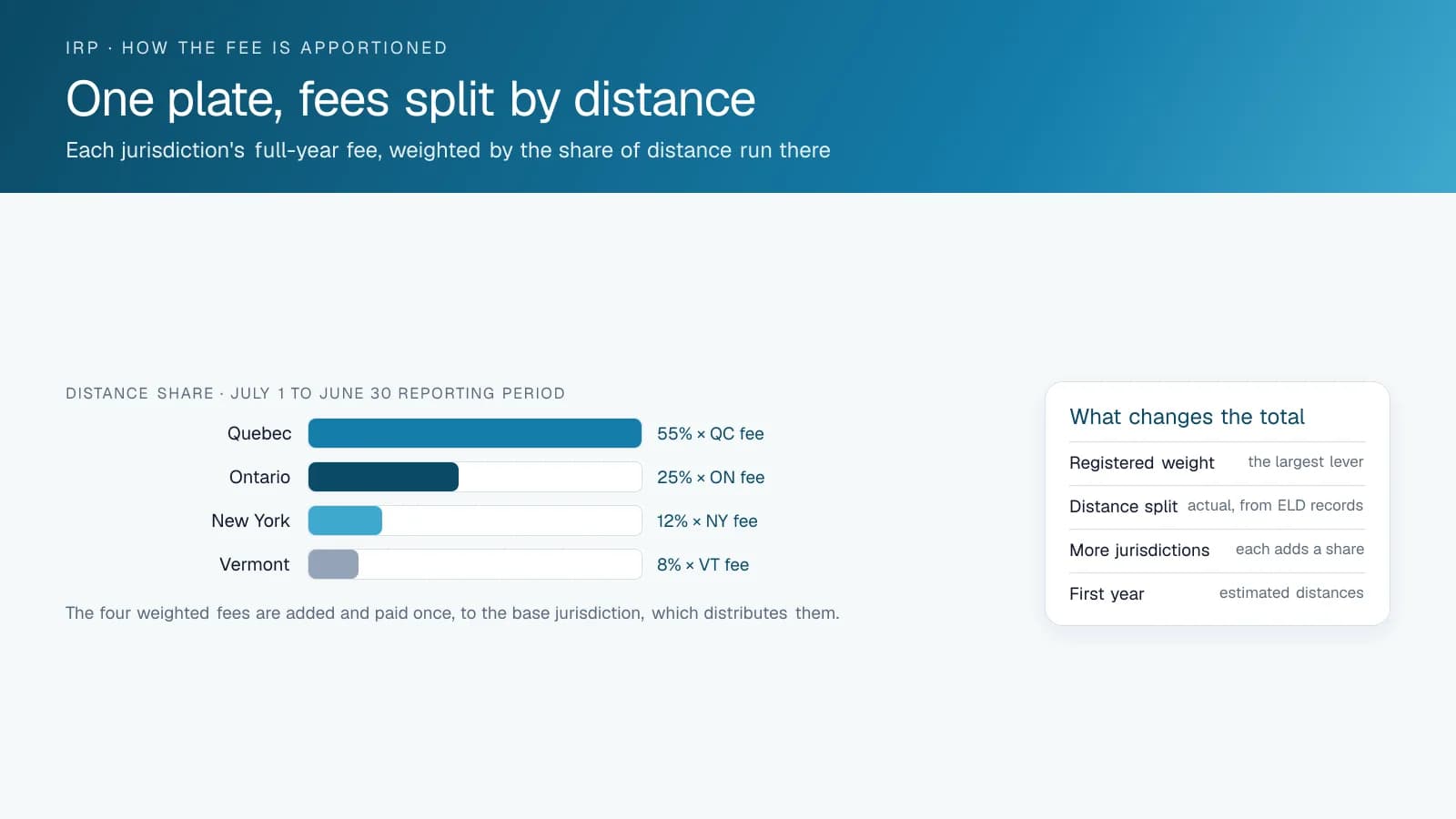
| Fee basis | Each jurisdiction's fee at the registered weight, weighted by distance share |
| First-year fleet | Estimated distance chart until a full year of actual distance exists |
| Audit window | Three years after the registration year closes |
| Distance source | ELD or GPS jurisdiction report, per unit |
Frequently asked questions
Who handles IRP registration in British Columbia?
ICBC's Prorate office handles IRP registration in British Columbia. Applications, renewals and supplements for the apportioned plate and cab card all go through that office, which also collects the apportioned fees. IFTA is a separate program, administered by the BC Ministry of Finance, so a carrier deals with two offices.
Does a truck based in British Columbia need IRP if it never leaves British Columbia?
No. A power unit that stays inside British Columbia registers with ICBC the ordinary way. IRP covers qualified vehicles that operate in two or more member jurisdictions, so the first regular run into Alberta or Washington triggers it. A one-off trip can travel on a trip permit instead of a full apportioned plate.
Which reporting period does the British Columbia distance schedule cover?
It covers July 1 to June 30 of the year before the registration year. The renewal filed with ICBC's Prorate office asks for actual kilometres per jurisdiction for each power unit over that window. A new fleet without a full year on record uses the estimated distance chart instead.
Does an apportioned plate from ICBC's Prorate office replace the IFTA licence?
No. The apportioned plate and cab card cover registration, and the IFTA licence and decals cover fuel tax. A British Columbia fleet that crosses into Alberta needs both. If either one lapses, the truck can be stopped at the roadside, so track both renewal dates side by side.
How long must IRP distance records be kept in British Columbia?
Keep them for at least three years after the close of the registration year they support. ICBC's Prorate office can audit that window and asks for distance by jurisdiction tied to a unit and a date. GPS trip logs supply that record directly, without rebuilding it from paper trip sheets.
Related solutions & products
Service areas
Related terms
Continue reading
- Compliance (ELD, DVIR, IFTA) overview →
- IFTA BC: British Columbia Filing Guide, Fees and eTaxBC →
- IFTA and IRP in Canada: The Base Jurisdiction Office for Every Province and Territory →
- Who Needs IRP? Apportioned Registration Requirements and How to Apply →
- IRP in North Carolina: NC IRP Registration, Apportioned Fees and the Distance Schedule →
- More in Compliance →
Get a free quote
- Over 500 fleets
- Since 2013
- 4.9 on Google (19 reviews)
What are you looking for?
Prefer to talk?Call 1-800-613-6323[email protected]