
Compliance
IRP Ontario: IRP Plates, Apportioned Registration, Fees and the Distance Schedule
IRP plates in Ontario come from ServiceOntario. Who needs apportioned registration, what sets the fee and where the distance figures come from.
Who Issues IRP Plates in Ontario?
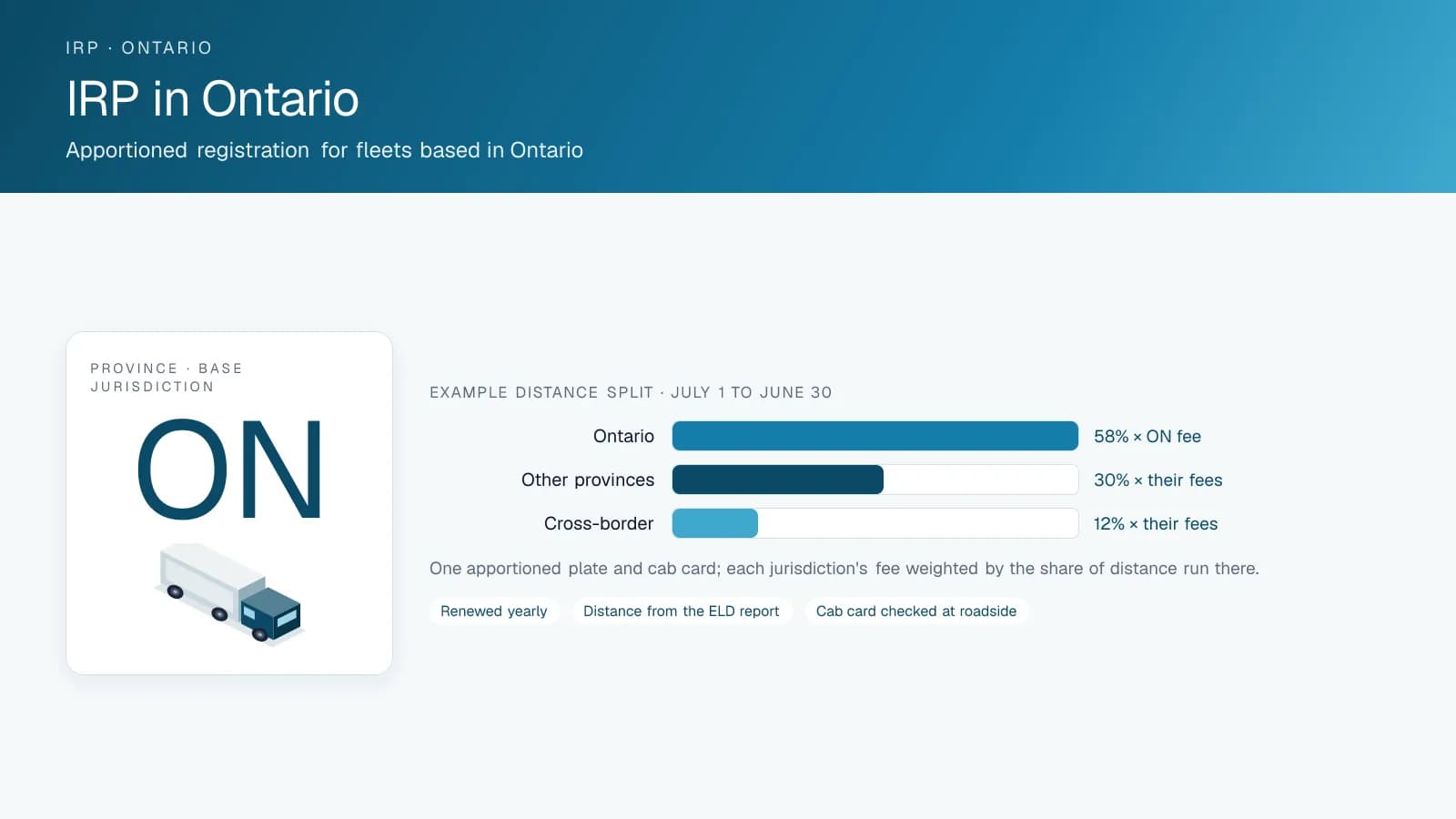
Ontario carriers that run qualified vehicles into other provinces or states register under IRP with ServiceOntario, get IRP plates and pay an apportioned fee split by where the fleet drives. Since March 3, 2025, ServiceOntario provides all IRP services: you apply online, by email or in person by appointment. A Toronto, Mississauga or Windsor carrier crosses borders almost by default: the 401 runs to Quebec at one end and to Michigan at the other, and the Peace Bridge, the Blue Water Bridge and the Ambassador Bridge put New York and Michigan within a short drive of the province's main freight routes.
What Sets the Ontario Apportioned Fee?
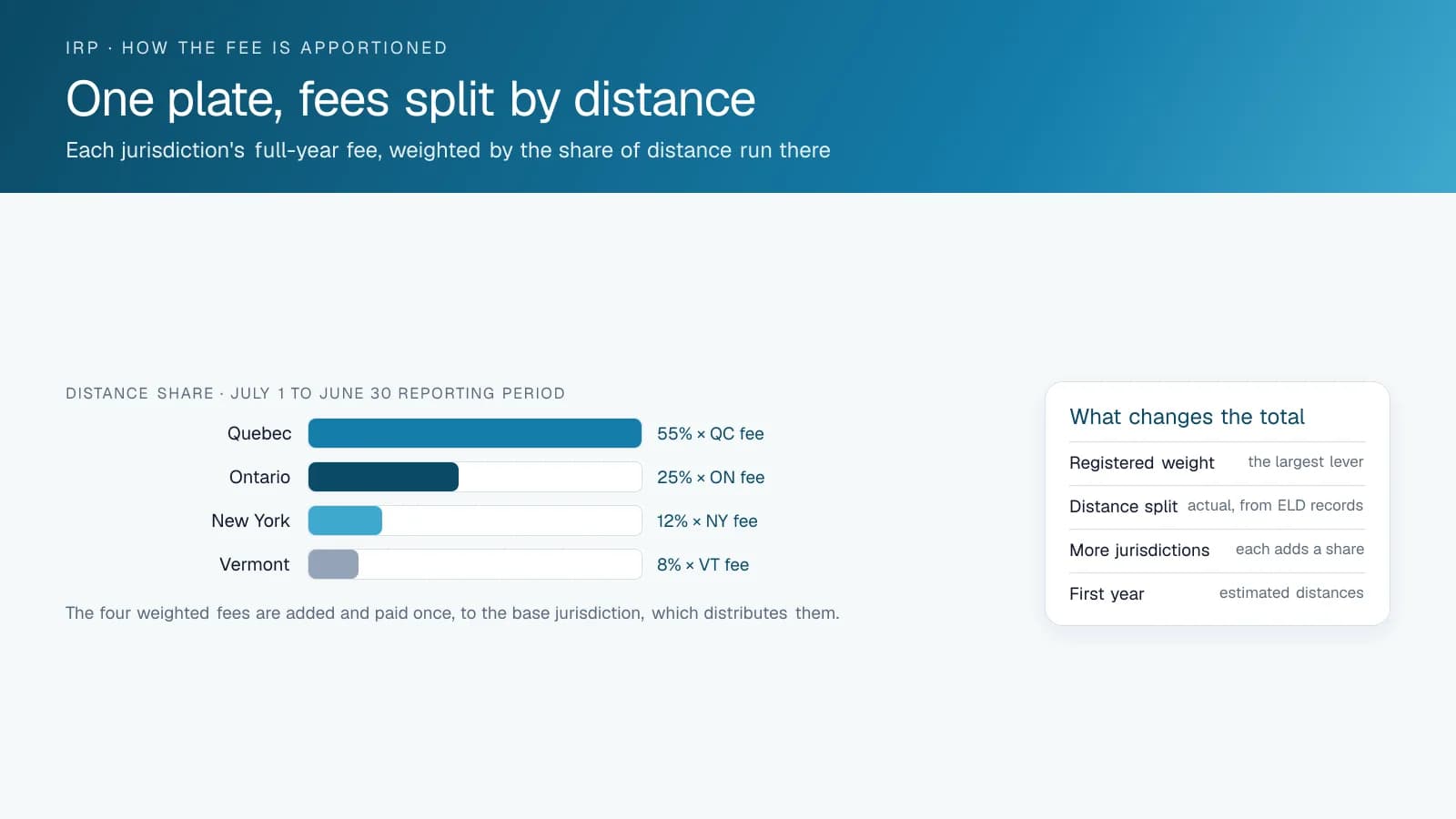
Because of that geography, an Ontario distance schedule runs long. In one reporting year a GTA fleet can log meaningful percentages in Quebec, Michigan, Ohio, Indiana, Illinois, New York, Pennsylvania and New Jersey, and each of those jurisdictions charges its own scheduled fee at the truck's registered weight. Carriers that rebuild the split from trip sheets across a dozen jurisdictions lose money in both directions. A telematics report of distance by jurisdiction, built from continuously logged position, gives you the schedule as a measurement. Run the same report for the quarter and you have the IFTA return you file with the Ministry of Finance.
What Gets Checked at Roadside and in an Audit?
Ontario's Commercial Vehicle Operator's Registration (CVOR) is the province's own safety and operating credential, and it sits alongside IRP and IFTA. When MTO enforcement officers do a roadside inspection, they check all of them. If you keep your apportioned plates, IFTA decals, CVOR and ELD current from one system, the inspection time goes to the truck and not to the paperwork.
IRP in Ontario at a Glance
The basics for an Ontario-based fleet, in one table. Check current procedures and fee schedules with ServiceOntario before you renew.
| Item | Ontario |
|---|---|
| IRP administered by | ServiceOntario (all IRP services since March 3, 2025) |
| Threshold | Power unit over 26,000 lb, or three or more axles, or a combination over 26,000 lb, in two or more jurisdictions |
| Credential | Apportioned plate and cab card per power unit; trailers not apportioned |
| Distance reporting period | July 1 to June 30 before the registration year |
| Fee basis | Each jurisdiction's fee at the registered weight, weighted by distance share |
| First-year fleet | Estimated distance chart until a full year of actual distance exists |
| Audit window | Three years after the registration year closes |
| Distance source | ELD or GPS jurisdiction report, per unit |
Frequently asked questions
Who handles IRP registration in Ontario?
ServiceOntario has handled all IRP registration since March 3, 2025. Applications, renewals and supplements for the apportioned plate and cab card go through it online, by email or in person by appointment. Each power unit gets its own plate and cab card, and trailers are not apportioned, so the paperwork follows the trucks in your fleet.
Is IRP required for an Ontario fleet that only runs inside the province?
No, not until the fleet crosses a border. A vehicle that never leaves Ontario keeps a standard Ontario registration through ServiceOntario. The apportioned plate becomes necessary once a qualified vehicle runs regularly into another member jurisdiction, such as Quebec. A truck that only crosses now and then can use a trip permit for each occasional trip.
Where do the kilometres on an Ontario IRP application come from?
They come from the fleet's own records for July 1 to June 30 before the registration year, split by jurisdiction and by unit. An ELD or GPS distance-by-jurisdiction report is the accepted source. A first-year fleet without a full year of actual distance files with Ontario's average per-vehicle distance chart, published by IRP, Inc.
Is IRP the same as IFTA in Ontario?
No. IRP apportions the annual registration fee, which you pay through ServiceOntario, while IFTA settles fuel tax every quarter. Both need distance by jurisdiction and share the 26,000-pound threshold, but they are separate credentials with separate renewals. One telematics distance report can feed both, so you don't rebuild the numbers twice.
How long does Ontario keep the IRP audit window open?
The audit window stays open for three years after the registration year ends, which is how long the IRP Plan requires distance records to be kept. Keep the per-unit, per-jurisdiction distance records for those three years, along with the ELD or GPS logs behind them, so you can show an auditor where every reported kilometre came from.
Related solutions & products
Service areas
Related terms
Continue reading
- Compliance (ELD, DVIR, IFTA) overview →
- ONT-TAXS Online: IFTA Ontario Login, Filing and Renewal →
- IFTA and IRP in Canada: The Base Jurisdiction Office for Every Province and Territory →
- Ontario CVOR Explained: The Commercial Vehicle Operator's Registration, Safety Rating and Abstract →
- Who Needs IRP? Apportioned Registration Requirements and How to Apply →
- More in Compliance →
Get a free quote
- Over 500 fleets
- Since 2013
- 4.9 on Google (19 reviews)
What are you looking for?
Prefer to talk?Call 1-800-613-6323[email protected]