
Dispatch & Routing
Route Optimization Software for Small Business: Twelve Stops, Two Vans, One Morning
A small business with two or three vans does not need enterprise routing; it needs the morning's stops in a sensible order, on the driver's phone, with an ETA the customer can be told. Here's what small-business route optimization actually does, a before-and-after on a real-sized day, what it costs, and how it connects to the tracking you may already have.
The Small-Business Version of the Problem
A plumber with three vans, a bakery with two delivery routes, a florist on a Saturday: the routing problem is the same one large fleets solve, at a size where the owner has been solving it in their head. The stops for the day come in from a booking system, a spreadsheet or a phone; someone groups them by area and hands each driver a list; the drivers reorder it in the van. It works until the day has twelve stops and a time window, and the two vans cross each other's paths twice.
Before and After
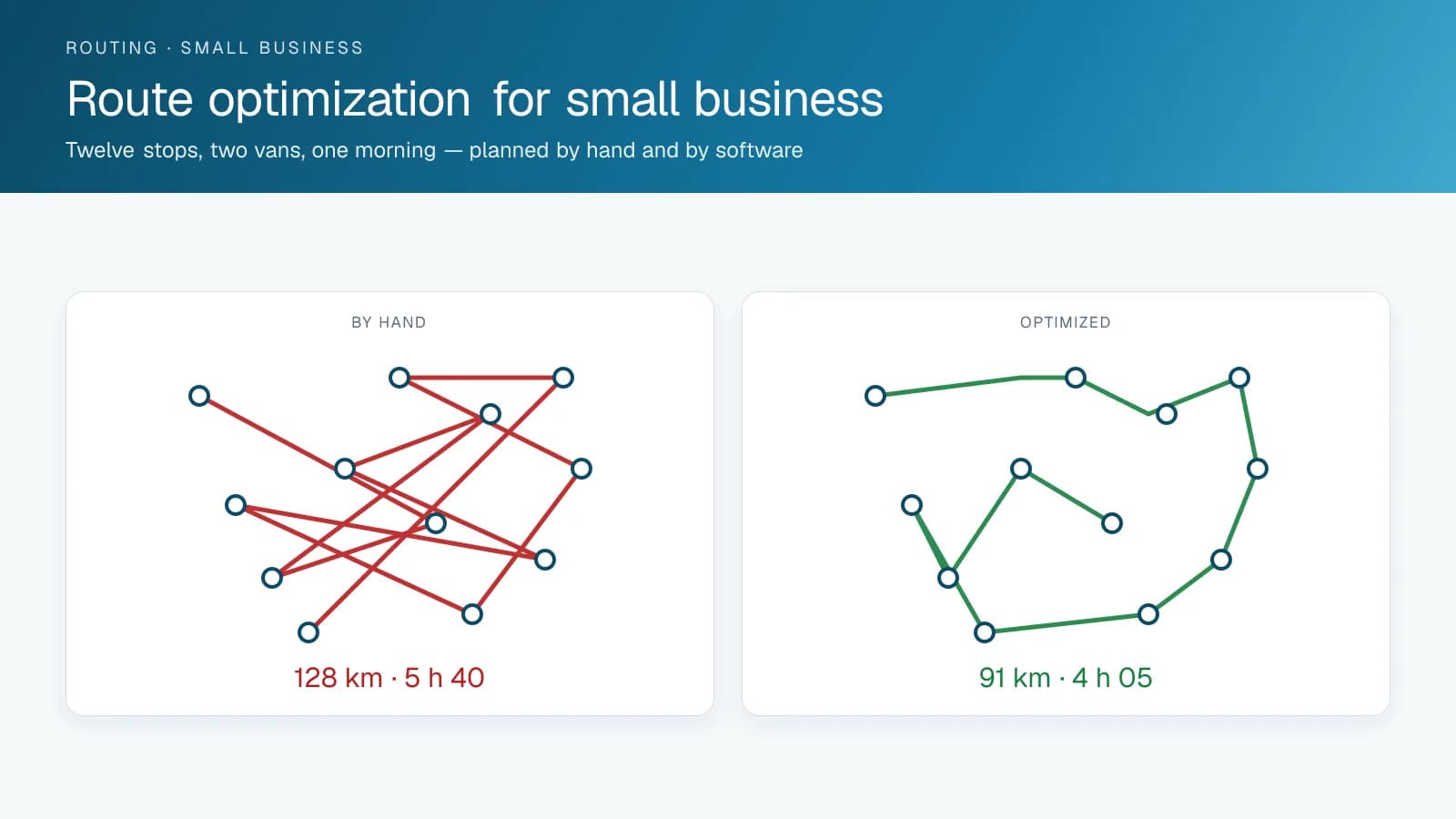
Twelve stops across a city, two vans, one with a 9-to-11 window and one customer who is not home before ten. Planned by hand along neighbourhood lines, the two routes ran 128 km and the last drop landed at 3:40 in the afternoon, with one van backtracking across town for the time window. The optimizer, given the same stops, the two vans and the two constraints, produced routes of 91 km finishing at 2:05, with the windowed stop placed second on the nearer van and the late customer last on the other. That is 37 km and an hour and a half of driver time saved on one ordinary day, which for a small business is a fourth van it did not have to buy.
What It Costs and How It Connects
Small-business routing tools are priced per driver or per vehicle per month, typically in the low tens of dollars, with a planning screen for whoever builds the day and a phone app for the driver with the stop list, navigation and proof of delivery. Connected to a GPS tracking platform such as MyGeotab through the Marketplace, the tool also knows where the vans are, so a stop added at eleven goes to the van that is actually closest, and the owner can tell a customer an ETA from the screen instead of calling the driver. Fleets already tracking their vans add routing as an app rather than a new system.
Choosing One
Ask whether it handles time windows and vehicle-specific rules, whether the driver app works offline, whether it imports stops from the booking or invoicing system the business already uses, whether it re-sequences during the day from live positions, and what happens to the price when the fleet grows from three vans to eight. High Point GPS sets up routing tools connected to MyGeotab for small fleets in Quebec, Ontario and the northeastern US, alongside the tracking device install.
Frequently asked questions
Is route optimization worth it for a small business?
With more than a handful of stops per van and any time windows, yes. A typical day saves 10 to 30 percent of distance and an hour or more of driver time, which is a van the business does not have to add.
What does small-business route optimization cost?
Usually in the low tens of dollars per driver or vehicle per month, including the planning screen and the driver app.
Can it connect to my GPS tracking?
Yes. Routing tools on the Geotab Marketplace use the vans' live positions to assign new stops and give customers ETAs.
Do I need a dispatcher to use it?
No. The owner or office builds the day in a few minutes; the drivers follow the stop list in the app.
What about free route planners?
Free tools sequence a single route well but rarely handle multiple vehicles, time windows, a driver app with proof of delivery, or live re-sequencing.
Related solutions & products
Related terms
Continue reading
- Dispatch & Routing overview →
- How Route Optimization Works: A Worked Example for a 40-Stop Day →
- Route Optimization Software for Last-Mile Delivery: Multi-Stop Planning Explained →
- Dispatch Software for Security Patrol and Guard Companies →
- What Is Dispatch Software? How It Works and Why Fleets Use It →
- More in Dispatch & Routing →
Get a free quote
What are you looking for?