
Compliance
What Does IRP Registration Look Like? The Cab Card, Apportioned Plate and Account Number
A cab card is the IRP registration document itself, carried in the truck: unit, VIN, registered weights, jurisdictions and expiry, read line by line.
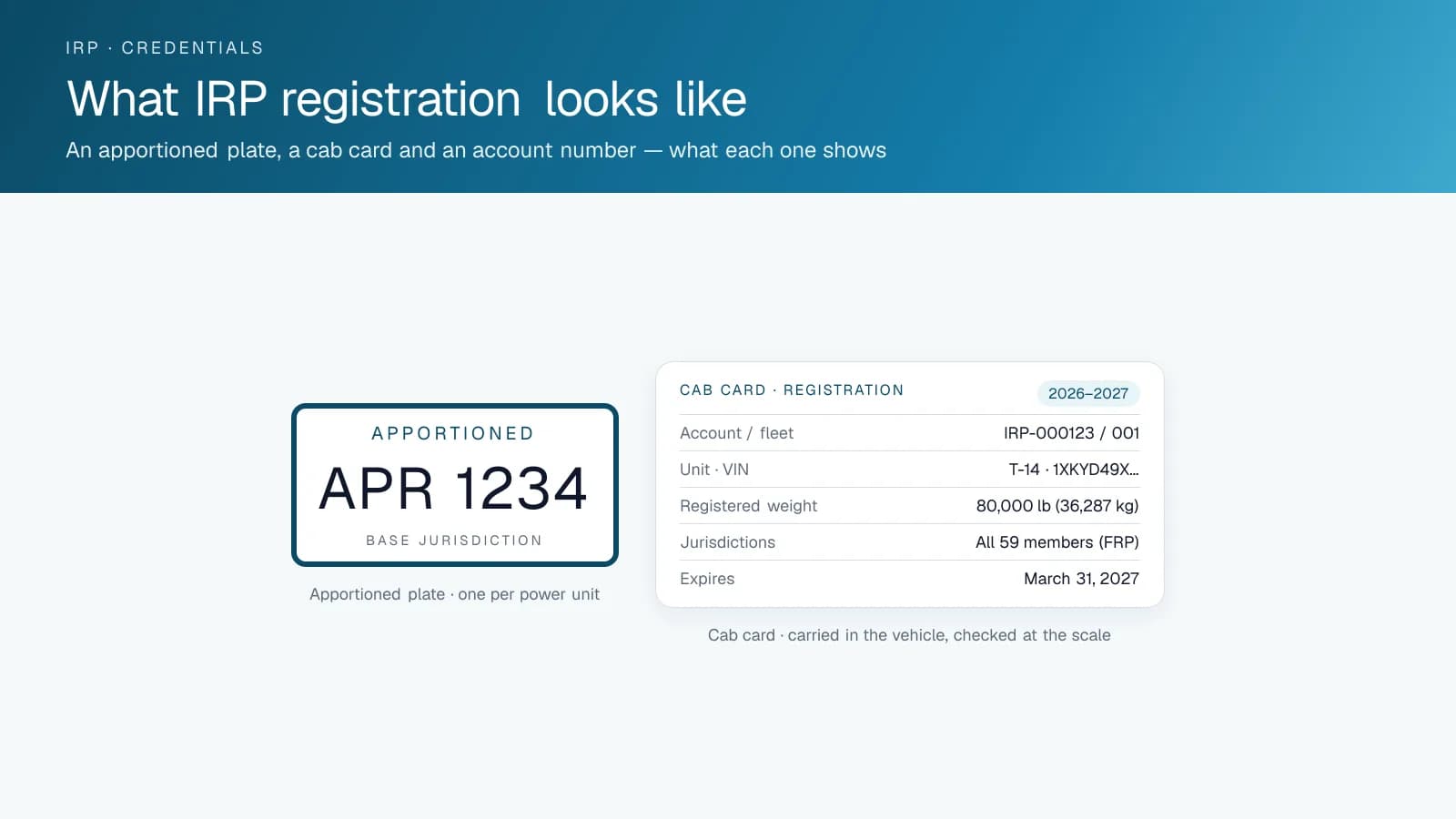
What Does an IRP Apportioned Plate Look Like?
IRP registration looks like three things: a cab card carried in the cab (the registration document itself), an apportioned plate on the power unit, and an account number with the base jurisdiction. The plate comes from the base jurisdiction and reads 'Apportioned' (or 'APP', 'PRP' for prorate, or the local equivalent) where an ordinary commercial plate would show its designation. It is the only plate the power unit carries, and it is valid in every IRP member jurisdiction. Trailers are not apportioned and usually carry an ordinary trailer plate from the base jurisdiction; trailer registration follows each jurisdiction's own law. Some jurisdictions issue a validation sticker for the registration year, and others rely on the cab card alone.
What Is on an IRP Cab Card, and Is It the Same as Registration?
The cab card is the registration document itself, and it is the thing an inspector reads. It names the registrant and the base jurisdiction account and fleet number, and identifies the unit by number and VIN. It states the registered gross weight, often per jurisdiction, since a carrier may register different weights in different places. It lists the jurisdictions the vehicle is registered for, which since the Full Reciprocity Plan means all of them, and shows the registration year and expiry date. The driver must carry it in the vehicle, on paper or in electronic form where the jurisdiction allows. Operating without a current cab card is a violation in its own right, and the penalty depends on the jurisdiction.
Cab Card vs Registration: How Is It Different From a Regular One?
A cab card is a registration: for an apportioned truck, it is the only registration certificate there is. The IRP Plan defines it as the evidence of registration, other than the plate, that the base jurisdiction issues for an apportioned vehicle, and the cab card and the apportioned plate are the sole registration credentials that vehicle receives. The difference from an ordinary registration is reach, since one card covers every IRP jurisdiction printed on it.
An ordinary truck registration (the vehicle permit in Ontario, the registration certificate in Quebec, the registration card from a US state) is issued for one province or state and shows one registered weight. A vehicle that qualifies for IRP and leaves its home jurisdiction on that registration alone needs a trip permit for each jurisdiction it enters. The cab card replaces those permits. The carrier pays every jurisdiction's share through the base jurisdiction, and the card lists each jurisdiction with the weight registered there.
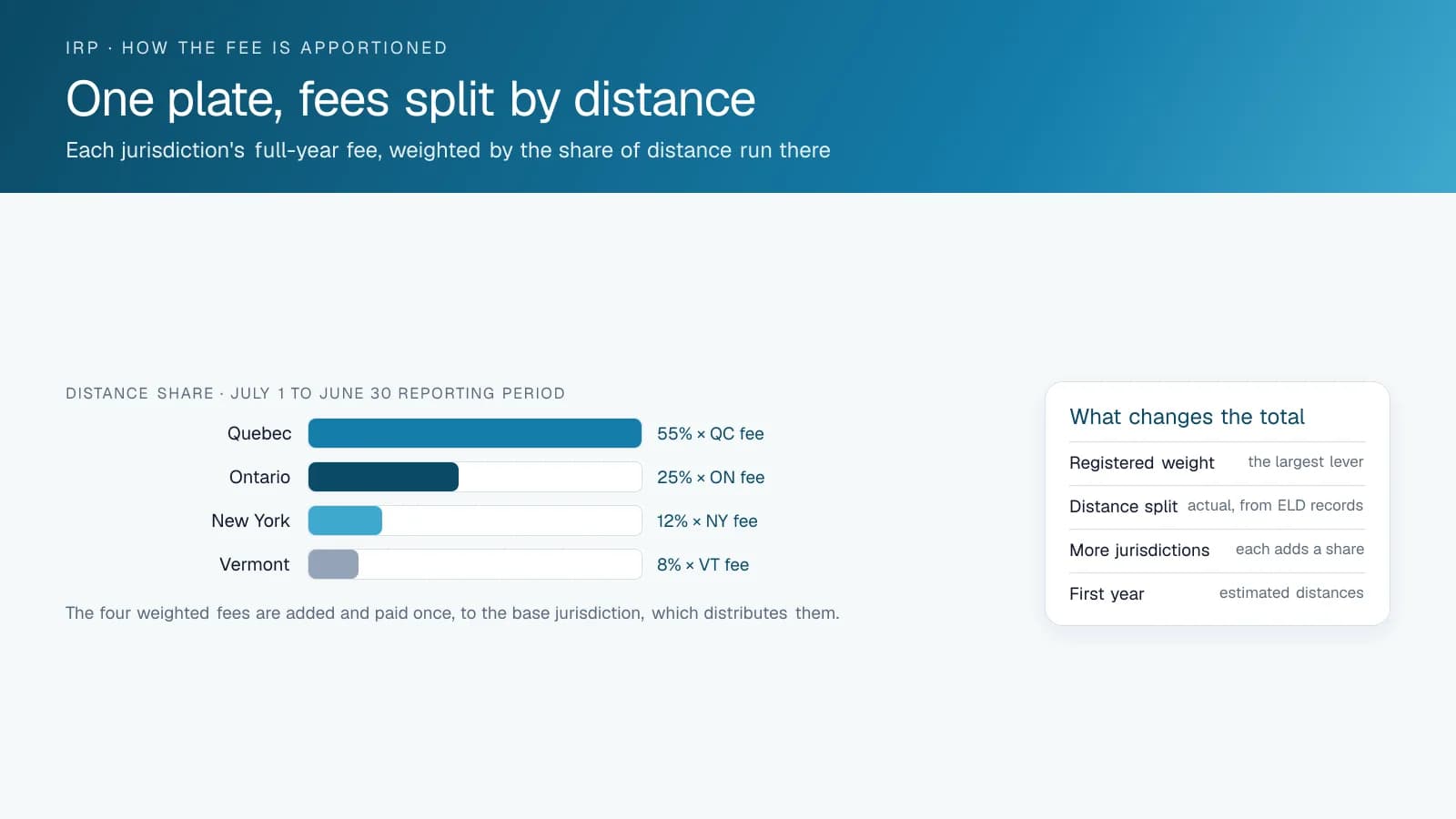
Those shares are set by the distance the fleet travelled in each jurisdiction during the reporting period, and an IRP audit checks the reported distances against operational records, which the Plan says can include data from on-board recording devices. The High Point GPS platform records mileage by jurisdiction from each trip, the same figures behind its IFTA reports, so the distance schedule for an IRP renewal can start from recorded trips.
What Is the IRP Account Number?
The IRP account number identifies the carrier with its base jurisdiction, usually paired with a fleet number when a carrier runs more than one fleet. It appears on the cab card and on every application, supplement and renewal, and the jurisdiction's audit staff use it when they ask for distance records. It is separate from the USDOT number, the IFTA licence number and, in Ontario, the CVOR number. The same truck carries all of those too, and an inspection can check any of them.
What Does an Inspector Check at the Scale?
At a scale, the officer reads the plate and matches it to the cab card. They check the cab card's expiry, compare its registered weight with the scale reading, and confirm that the jurisdiction they are standing in is listed. After that come the IFTA decals and licence, the ELD and the driver's documents. The usual citations are a truck over its registered weight, an expired cab card, or a vehicle that should be apportioned and is not. Keeping IRP, IFTA and ELD records current from one telematics dataset, with document copies in a High Point GPS platform add-in such as GeoDocs, puts the documents an inspector asks for in one place.
Reading a Cab Card, Line by Line
Every cab card carries the same fields, and inspectors read them in the same order. A driver who knows what each field means can answer questions at the scale instead of handing over the card and waiting.
| Field | What it shows | What an inspector checks |
|---|---|---|
| Registrant and account number | The carrier and its IRP account | Matches the carrier on the USDOT marking |
| Base jurisdiction | The province or state that issued the plate | Matches the plate |
| Unit number and VIN | The specific power unit | Matches the vehicle |
| Registered weight per jurisdiction | The weight the fee was paid on, listed by jurisdiction | Vehicle is not over its registered weight where it is |
| Jurisdictions | Every member jurisdiction the vehicle may operate in | The vehicle is registered for the jurisdiction it is in |
| Expiry | End of the registration year | Card and plate are current |
Frequently asked questions
What does an IRP registration look like?
An IRP registration has three parts: an apportioned licence plate on the power unit, a cab card carried in the vehicle, and an account number with the base jurisdiction. The cab card lists the unit, its registered weights, its jurisdictions and the expiry date.
What is an IRP registration number?
It is the carrier's account number with its base jurisdiction, usually paired with a fleet number. It is printed on the cab card and used on every application, renewal and audit request, and it is separate from the USDOT number and the IFTA licence number.
What do I need for IRP registration?
You need proof of an established place of business in the base jurisdiction, a USDOT number, vehicle titles and the registered weight for each unit. Add a distance schedule for the July-to-June reporting period and, for vehicles of 55,000 lb or more used on US highways, proof of paid heavy vehicle use tax (IRS Form 2290 Schedule 1).
Can an IRP cab card be electronic?
Often, yes. Many jurisdictions now accept an electronic cab card on a phone or tablet. Check your base jurisdiction's rule and carry paper wherever it is required, since operating without a current cab card can bring a citation at a roadside inspection.
Do trailers get an apportioned plate?
No. Trailers are not apportioned under IRP. A trailer usually carries an ordinary trailer plate from the base jurisdiction and travels on the power unit's apportioned registration. Only the power unit gets the apportioned plate and the cab card that goes with it.
Is a cab card the same as a registration?
Yes. Under the International Registration Plan, the cab card is the registration certificate for an apportioned vehicle, issued by the base jurisdiction and carried in the truck. It differs from an ordinary registration in scope: instead of covering a single province or state, it covers every IRP jurisdiction listed on it, with the weight registered in each.
What is the difference between apportioned and combination plates?
An apportioned plate is issued under IRP to a truck that runs in two or more jurisdictions, with a cab card listing each one. A combination plate is a state plate type outside IRP, and the rules vary by state. In Texas, it covers a truck or tractor over 10,000 lb pulling a semitrailer over 6,000 lb, and carriers who apportion get apportioned plates instead.
Sources
Related solutions & products
Related terms
Continue reading
- Compliance (ELD, DVIR, IFTA) overview →
- Who Needs IRP? Apportioned Registration Requirements and How to Apply →
- IRP in Saskatchewan: Apportioned Registration, Fees and the Distance Schedule →
- Michigan IRP: Apportioned Registration, Fees and the Distance Schedule →
- New Jersey IRP: Apportioned Registration, Plates, Fees and the Distance Schedule →
- More in Compliance →
Get a free quote
- Over 500 fleets
- Since 2013
- 4.9 on Google (19 reviews)
What are you looking for?
Prefer to talk?Call 1-800-613-6323[email protected]