
Compliance
What Is a DVIR? Meaning, Rules and What to Inspect
A DVIR (driver vehicle inspection report) is a driver's written record of vehicle defects. What the FMCSA rule requires, what to inspect and what to keep.
What Does DVIR Stand For, and What Does the Rule Require?
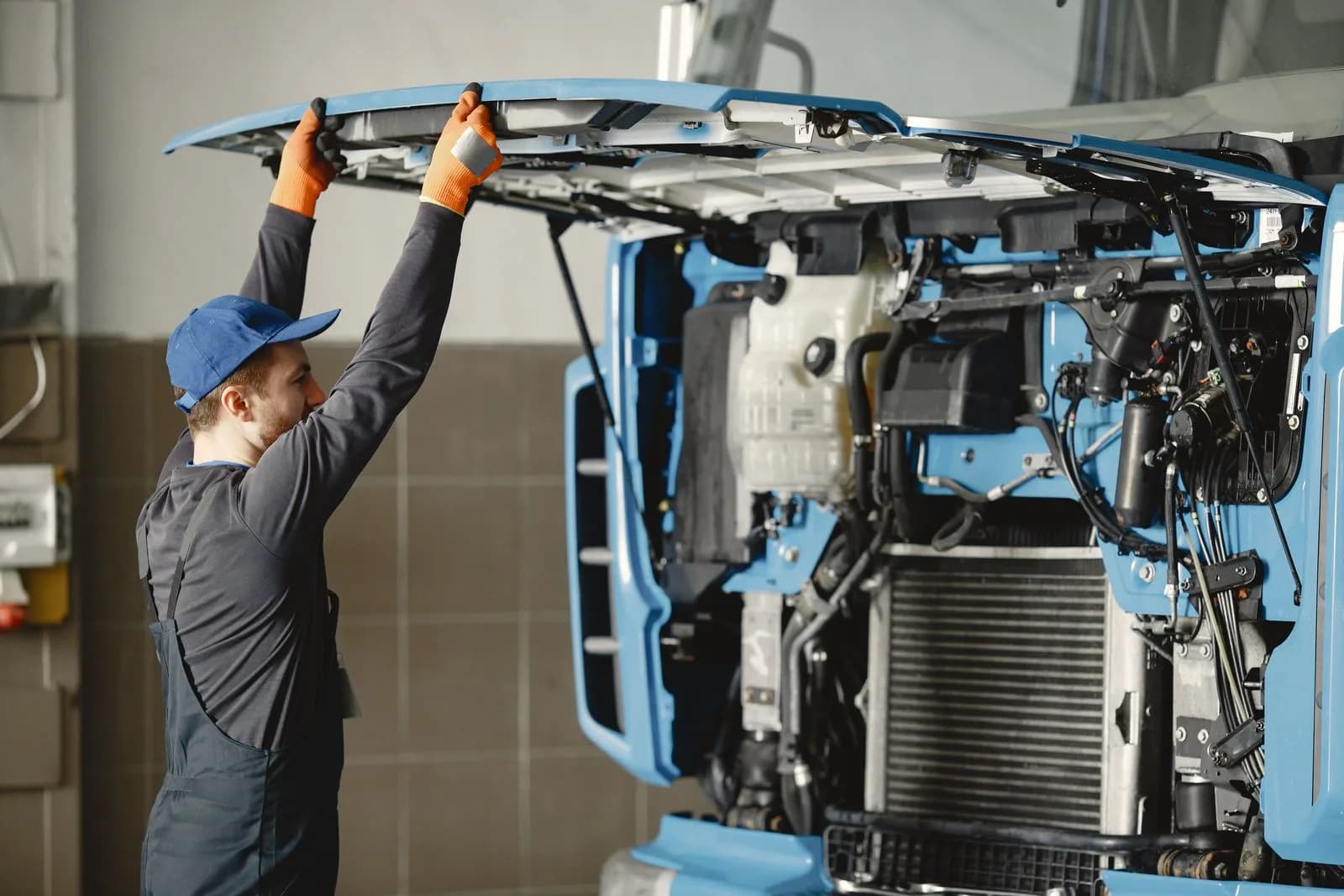
A DVIR (Driver Vehicle Inspection Report) is a written report a commercial driver prepares on the condition of their vehicle. Under 49 CFR 396.11, the driver must prepare one at the end of each working day whenever they find a defect or deficiency that could affect safe operation or cause a breakdown. It sits next to ELD hours-of-service logging and IFTA fuel tax reporting, and of the three, it's the one most fleets ignore until an inspector asks for it.
Fleets often blur two separate things: the pre-trip walkaround a driver does before heading out, and the DVIR itself, which is the end-of-day written report. Plenty of fleets have drivers doing a careful walkaround every morning without ever putting it into the written record the rule requires. Checking the vehicle out of habit won't protect you the way a documentation trail does if something goes wrong later. A DVIR app on the driver's phone puts each inspection on that trail.
Carriers carry a matching duty. When a DVIR reports a defect, the carrier must repair anything that affects safety before the vehicle goes back on the road, and certify that the repair was made or wasn't necessary. A DVIR that gets filed and then ignored defeats the purpose of the requirement, and if that vehicle is later involved in an incident, a minor maintenance issue becomes a real liability problem.
What Does a Driver Inspect for a DVIR?
The rule lists the parts and systems a driver must check for defects likely to affect safe operation: service brakes, including trailer brake connections, the parking brake, steering, lighting and reflectors, tires, the horn, windshield wipers, mirrors, coupling devices, wheels and rims, and emergency equipment. That list is broader than most people assume, so give drivers a written checklist instead of relying on their memory at the end of a long shift.
The defects that show up most often on a DVIR are the unglamorous ones: a burned-out marker light, a mirror that's cracked or knocked out of alignment, a tire with uneven wear or low tread, or a trailer coupling that isn't seating properly. None sounds serious on its own. Roadside inspectors are trained to look for exactly these, though, and each one is cheap to fix at your own shop and expensive to have flagged at a scale house.
Many people believe a DVIR has to be filed every day regardless of vehicle condition. Under the US rule, that hasn't been true since 2014 for property-carrying vehicles and since 2020 for passenger-carrying vehicles: a driver who finds no defect doesn't need to file a DVIR that day. Canada works differently. Provincial rules based on National Safety Code Standard 13 require a trip inspection every 24 hours and a current inspection report in the vehicle, even on a day with no defects (in Quebec, the ronde de sécurité).
Who Has to Complete a DVIR?
In the US, the DVIR rule covers drivers of commercial motor vehicles in interstate commerce as FMCSA defines them. That means a vehicle with a weight rating or actual weight of 10,001 pounds or more, a vehicle designed or used to carry more than 8 passengers (including the driver) for compensation, or more than 15 passengers without compensation, and any vehicle hauling hazardous materials in a quantity that requires placards. The report covers each vehicle the driver operated that day, so a driver who switches trucks mid-shift prepares one for each truck where a defect turned up.
Section 396.11 of 49 CFR exempts three kinds of operation: private carriers of passengers on a nonbusiness basis, driveaway-towaway operations, and motor carriers that operate only one commercial motor vehicle. On a two-driver team, one signature is enough when both drivers agree on the defects listed.
Canada draws the line by weight and seats. National Safety Code Standard 13 applies to trucks, tractors and trailers with a registered gross vehicle weight over 4,500 kg, and to buses with more than 10 designated seats, including the driver. Each province applies the standard through its own rules and may exempt some vehicles, so confirm with the province where the vehicle travels.
How Does a Driver Complete a DVIR, Step by Step?
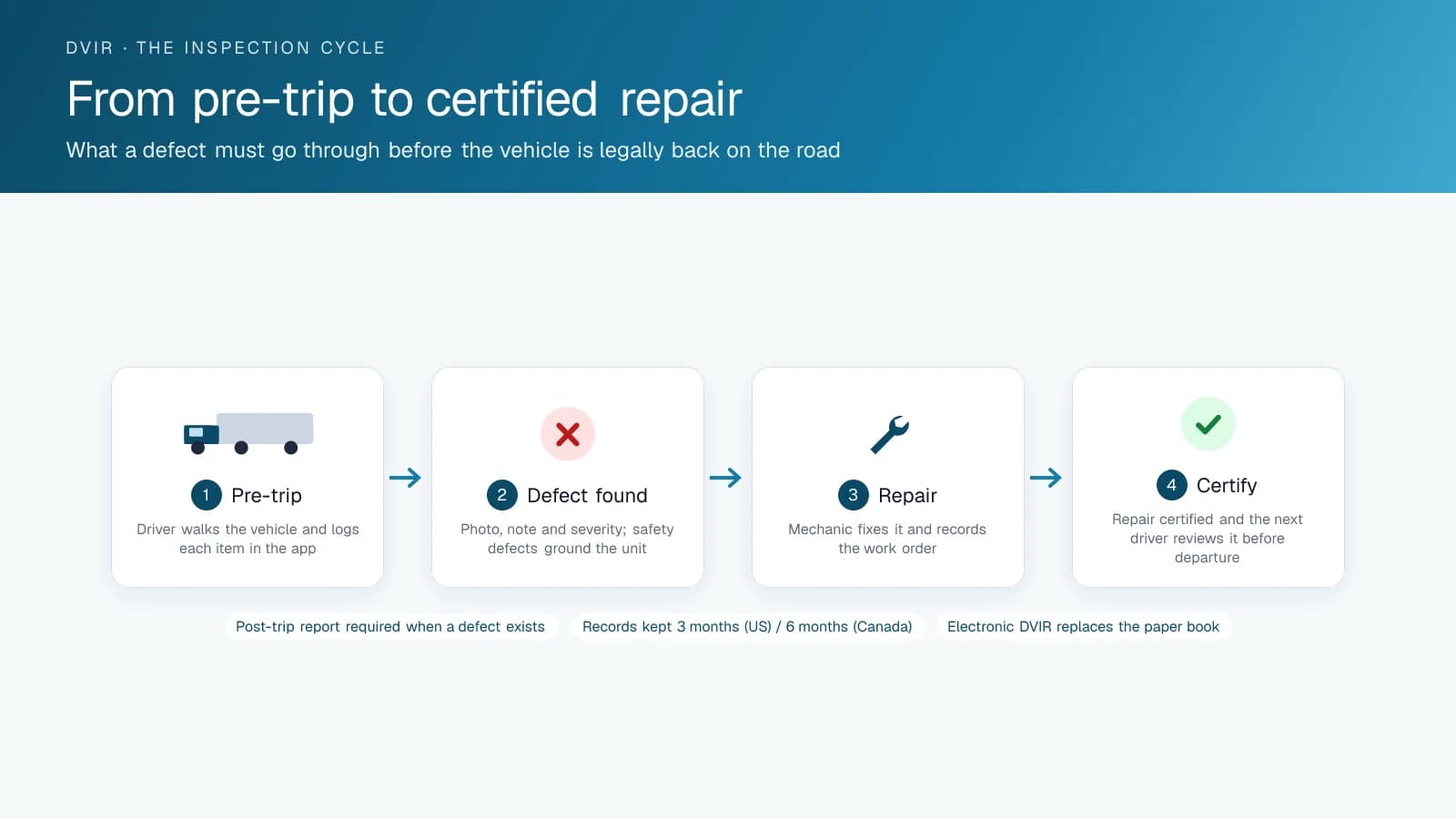
A DVIR runs in a loop, from one driver's review to the next driver's signature. Under 49 CFR 396.13, before driving, the driver must be satisfied the vehicle is safe, review the last DVIR when one was prepared, and sign it to confirm the review and the carrier's repair certification. The rest of the loop looks like this.
Write each defect so a mechanic who never saw the truck can find it: the component, what is wrong and where. "Left mirror bracket cracked" gets fixed; "mirror bad" gets a phone call. In Canada, Standard 13 adds a hard stop: a major defect goes on the inspection report, is reported to the carrier immediately, and nobody may drive the vehicle until it is fixed.
In Geotab Drive, the app High Point GPS deploys for DVIR, drivers perform the inspection, certify a previous inspection that flagged defects, and mark defects as repaired. Open major and minor defects must be resolved before the next inspection on that vehicle.
| Step | Who | What the US rule requires |
|---|---|---|
| Review before driving | Driver | Be satisfied the vehicle is safe; review and sign the last DVIR (49 CFR 396.13) |
| Inspect | Driver | Check the parts and accessories listed in 49 CFR 396.11 on each vehicle driven |
| Report | Driver | Identify the vehicle, list every defect found or reported, and sign; no report if there is no defect |
| Repair | Carrier or its agent | Fix anything likely to affect safe operation before the vehicle runs again |
| Certify | Carrier or its agent | Certify on the report that the defect was repaired or that repair was unnecessary |
| Keep | Carrier | The report, the repair certification and the driver's review, for three months |
What Happens at a Roadside Inspection?
Roadside inspections, most commonly carried out under the Commercial Vehicle Safety Alliance's inspection levels, routinely check vehicle condition against the same systems a DVIR covers: brakes, lights, tires, coupling devices and the rest of the list. If an inspector finds a defect that should have been caught and reported, or one that was reported and never repaired, they have grounds to place the vehicle out of service on the spot. The driver and load then sit at the side of the road until it's fixed.
That risk turns DVIR compliance into more than paperwork. A clean, consistent DVIR history keeps you compliant, and it documents that defects are found and fixed before a vehicle goes back on the road.
Are Electronic DVIRs Allowed?
Yes. For a long time, fleets were unsure whether a fully electronic DVIR workflow, filled out on a phone or tablet instead of paper, satisfied the rule. FMCSA has since issued a final rule confirming that DVIRs may be created, signed, maintained and transmitted electronically, consistent with the agency's general electronic signature and recordkeeping standard under 49 CFR 390.32. In practice, an electronic DVIR tied to your GPS platform is time-stamped, harder to lose, and visible to dispatch and maintenance the moment the driver files it, instead of sitting in a folder in the cab.
Paper or electronic, the report, the repair certification and the next driver's review must be kept for three months from the date the report was prepared. An electronic system that stores records automatically removes the risk of a filing cabinet gap turning into a violation. Some platforms go further and hold a vehicle back from dispatch until an open safety defect is marked repaired, which a paper process has no real way to enforce.
Why Run DVIR on the Same Platform as ELD and GPS?
The High Point GPS platform handles DVIR alongside ELD and HOS logging and GPS tracking, in the Geotab Drive app, the same app and login drivers use for hours of service. A defect the driver reports in the app shows up for dispatch and maintenance in the place they already check location and hours. Compare that with a paper DVIR, which has to travel from the truck cab to the shop before anyone acts on it. The person deciding whether a vehicle goes out today looks at the record the driver just filed, without waiting for someone to relay it by word of mouth.
Paper and Electronic DVIRs, Side by Side
Here is what changes when the report moves from the clipboard in the cab to the driver app, on the points that decide compliance.
| Item | Paper DVIR | Electronic DVIR in the driver app |
|---|---|---|
| Where it is filed | A form in the cab, later a binder | The driver's app, instantly in the High Point GPS platform |
| Tied to | Whatever the driver writes | Driver, vehicle and time, plus the location when that data is available |
| Defect reaches the shop | When the form does | The moment it is filed |
| Repair certified | A signature on the form, if it is found | In the platform, with who and when |
| Next driver's review | Depends on the binder | Shown at the next pre-trip; confirmed in the app |
| Open major or minor defect | Dispatcher must remember | Must be resolved before the next inspection on that vehicle |
| Missing inspection | Unknown | Visible as a gap |
| Three-month retention | Filing cabinet | Automatic; exportable by vehicle and date |
| Auditor's request | A search | An export |
Frequently asked questions
Do I need to file a DVIR if my driver found no defects?
Not in the US. Under 49 CFR 396.11, revised in 2014 for property-carrying vehicles and in 2020 for passenger-carrying vehicles, a driver only has to prepare a DVIR when they find a defect or deficiency. In Canada, provincial trip inspection rules still require a current inspection report every 24 hours.
How long do DVIR records need to be kept?
Keep the DVIR, the repair certification and the next driver's review for three months from the date the report was prepared, per 49 CFR 396.11(a)(4). The rule applies whether the DVIR is on paper or electronic. An electronic system that stores each report automatically makes it easier to produce the records when an auditor asks.
Can a DVIR be completed and signed electronically?
Yes. FMCSA has confirmed that DVIRs may be created, signed, maintained and transmitted electronically under the agency's electronic signature and recordkeeping standard (49 CFR 390.32). A fully digital DVIR workflow, with drivers filing on a phone or tablet, satisfies the requirement in the same way a paper form does.
What happens if a defect on a DVIR is never repaired?
Don't dispatch the vehicle again until anything affecting safe operation is fixed and the repair is certified. If a roadside inspector finds an unrepaired defect that should have been addressed, the result can be an out-of-service order on top of the underlying violation, with the driver and load stopped until it's fixed.
Who has to complete a DVIR?
In the US, drivers of commercial motor vehicles in interstate commerce: 10,001 pounds or more, more than 8 passengers for pay or 15 without, or placarded hazardous materials. Driveaway-towaway operations, nonbusiness passenger carriers and carriers with a single vehicle are exempt. In Canada, trip inspections cover trucks over 4,500 kg and buses with more than 10 seats.
Does the next driver have to sign the DVIR?
Yes, when the last DVIR listed a defect. Under 49 CFR 396.13, the next driver reviews that report before driving and signs it to confirm the review and that the carrier certified the repair. The signature is not needed for defects on a towed unit that is no longer part of the combination. The carrier keeps that review for three months.
Sources
- Federal Register: Electronic Driver Vehicle Inspection Reports
- FMCSA: Hours of Service
- eCFR, 49 CFR 396.11, Driver vehicle inspection report(s)
- eCFR, 49 CFR 396.13, Driver inspection
- eCFR, 49 CFR 390.5, Definitions (commercial motor vehicle)
- CCMTA, National Safety Code Standard 13, Trip Inspection
- Geotab support, Asset inspections in Geotab Drive
Related solutions & products
Related terms
Continue reading
- Compliance (ELD, DVIR, IFTA) overview →
- How to Pass a DOT Inspection: Checklist and Inspection Levels →
- CSA Score: What It Measures and How to Improve It →
- Is There a Free ELD? What Owner-Operators Really Pay →
- Manitoba Safety Fitness Certificate: Who Needs One, How to Apply and How the Carrier Profile Works →
- More in Compliance →
Get a free quote
- Over 500 fleets
- Since 2013
- 4.9 on Google (19 reviews)
What are you looking for?
Prefer to talk?Call 1-800-613-6323[email protected]