
GPS Fleet Tracking & Telematics
What Is Telematics? Fleet Telematics and GPS Data Explained
Telematics is a vehicle device that collects data and sends it over a cellular network to fleet software. What fleet telematics captures beyond GPS.
What Is Telematics?
Telematics is the use of a device in a vehicle to collect data and transmit it, usually over a cellular network, to a platform where people can use it. The word combines telecommunications and informatics. GPS location is one piece of that data, but telematics covers much more than a dot on a map: in a commercial fleet, the term means the whole system of device, connection and software. In a fleet set up by High Point GPS, that is a Geotab GO device in each vehicle sending location, engine and driving data to MyGeotab.
The term predates modern fleet software by decades. Early telematics systems in the 1990s and 2000s mostly handled basic location reporting over slow, expensive cellular data connections. Two things have changed since then. A modern device can capture and transmit far more data at an affordable cost, and the software built on top can make sense of it. That software layer is what separates a useful telematics platform from a device that reports a location every so often.
What Does a Telematics Device Capture?
A commercial GPS tracking device connects at the vehicle's diagnostic port and reads far more than location. It records speed, harsh acceleration and braking events, engine fault codes, fuel consumption, idle time and hours-of-service data, each tied to a precise timestamp and location. With that combination, a platform can tell a vehicle stopped in traffic from one that has been idling in a parking lot for three hours.
Engine fault codes deserve a mention of their own because fleets often overlook them. The device reads the same diagnostic trouble codes a mechanic's scan tool would, so a check-engine-level fault can trigger a maintenance alert the moment it happens. Without that alert, you find out days later, when a driver finally mentions a dashboard light.
How Does Telematics Data Get From the Vehicle to Your Dashboard?
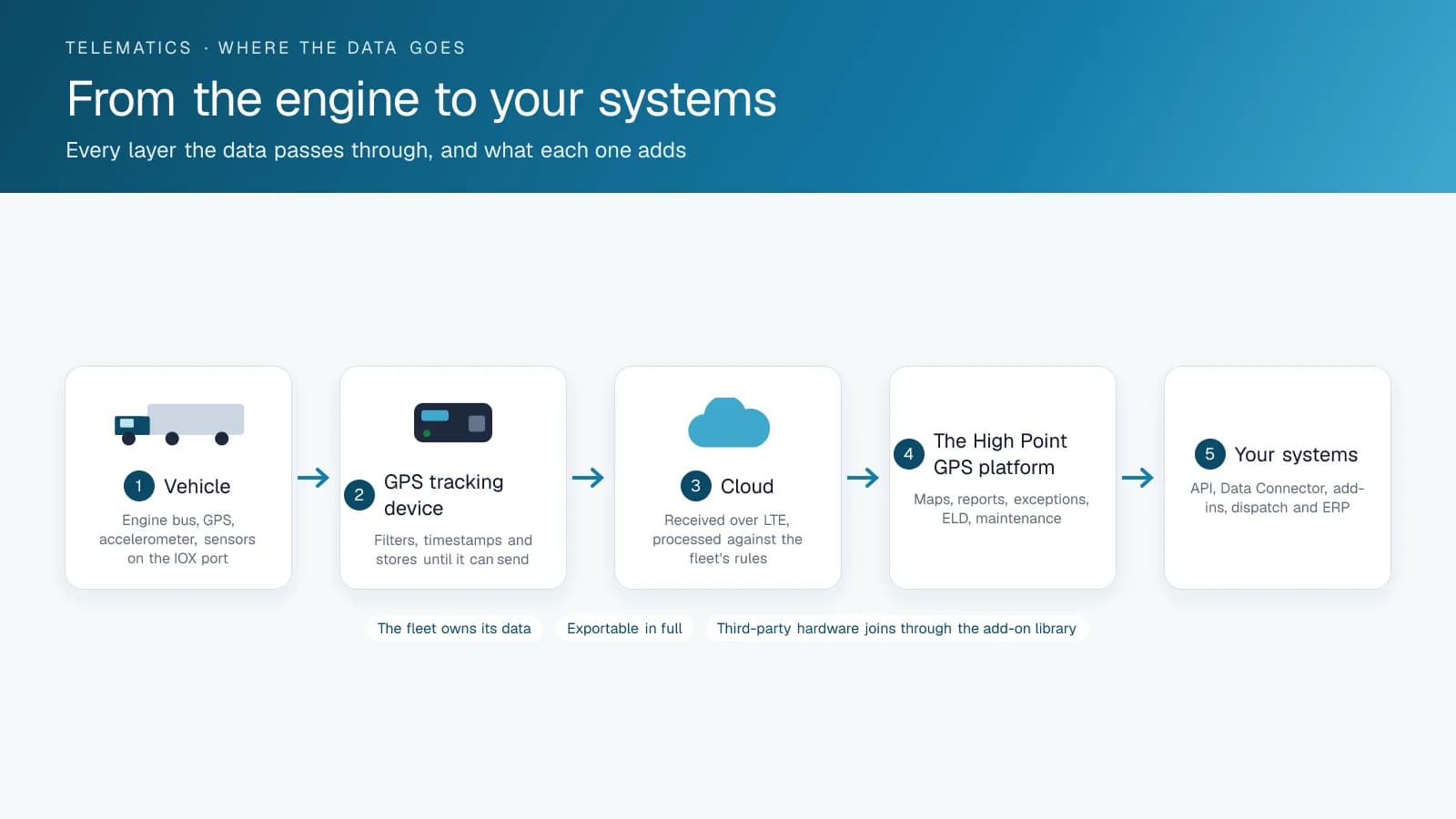
The device reads data off the vehicle's engine control module, packages it and sends it over a built-in cellular connection to the platform's servers, typically in near real time. The servers process it and display it on a dashboard such as the High Point GPS platform, and the same data is available through reports or an API for other software to use. The full trip from engine to dashboard usually takes seconds to a couple of minutes.
That near-real-time pipeline is what makes automated alerts possible. A fleet manager no longer has to pull a report at the end of the day to see what happened. The platform pushes a notification as soon as a harsh-braking event, a fault code or a geofence violation occurs, so you manage the fleet while events unfold instead of reviewing yesterday's activity after the fact.
How Does a Telematics Device Connect to Different Vehicles?
A fleet telematics device connects through the vehicle's diagnostic port, and which port that is depends on the vehicle. Cars and light trucks from model year 1996 on have the OBD-II port, which the US Environmental Protection Agency requires on all 1996 and newer light-duty vehicles. Heavy trucks carry engine data on the SAE J1939 heavy-duty vehicle network. Geotab's GO10, for example, is certified on Transport Canada's ELD list with both SAE J1939 and SAE J1979 (OBD-II).
Installation follows the port. Geotab lists separate 16-pin light-duty and heavy-duty OBD-II T-harnesses for the GO10, plus a 3-wire kit for a wired install; the GO10 always goes in with a harness instead of plugging straight into the port. That is part of why High Point GPS treats installation as part of the service: the right harness for each make and model year decides whether the device reads the engine at all.
Equipment with no engine port, such as trailers, generators or containers, gets a battery-powered asset tracker instead. It reports location, but no engine data, so plan your reports around what each unit can actually send.
Is Fleet Telematics Required by Law?
Telematics as such is not required, but the ELD rules in both countries require most commercial drivers who keep logs to use an electronic logging device, and an ELD is a telematics device: it synchronizes with the engine to record driving time automatically. In the US, the FMCSA ELD rule's compliance date was December 18, 2017, and carriers had to replace their last grandfathered AOBRDs with ELDs by December 16, 2019. US ELDs are self-certified by their makers and registered with FMCSA.
In Canada, federally regulated truck and bus drivers have had to use an ELD since June 12, 2021, and enforcement began in January 2023. Canadian devices must be certified by an accredited third-party body and appear on Transport Canada's list, and US-based carriers running in Canada need a device that meets the Canadian standard as well.
For a fleet already under the ELD rules, the device in the cab is the start of a telematics system. On the High Point GPS platform, the same device that logs hours also reports location, engine fault codes and driving events, so GPS tracking, maintenance alerts and driver scoring come from hardware the fleet already needs.
What Is Fleet Telematics Used For?
Fleets use telematics data for a handful of recurring jobs: safety coaching from harsh-event and speeding data, maintenance scheduled on actual engine hours and fault codes instead of a calendar guess, route and idle-time analysis to cut fuel spend, and compliance reporting for ELD and IFTA. Most fleets don't use all of it on day one. They usually start with location and safety, then add maintenance and compliance reporting once the platform is part of daily operations.
Idle time is easy to ignore, and it adds up fast across a fleet. A vehicle idling for long stretches burns fuel and racks up engine hours without covering any distance. Telematics shows that cost vehicle by vehicle, where an aggregate fuel bill would bury it and nobody has time to dig.
Consumer Telematics vs. Commercial Fleet Telematics
Many people search for telematics because of their personal car, usually through an insurer's usage-based discount program that scores driving behaviour from a phone app or a small plug-in dongle. Those programs use the same idea, but they are much lighter systems than commercial fleet telematics. A fleet system has to handle dozens or thousands of vehicles, connect to compliance and maintenance workflows, and put the data under the control of fleet managers instead of insurers.
More new vehicles now come with factory-embedded telematics hardware, which helps explain the growth of telematics-based insurance programs for consumers. Commercial fleets still tend to fit a dedicated aftermarket device across the board. The main reason is consistency: one device gives the same data quality and feature support across a mixed fleet of makes, model years and vehicle types, instead of depending on whatever each manufacturer happened to build in.
How to Choose a Telematics Provider
A lot rides on the device and the platform behind it, so the provider matters more than it would for a simpler tool. Check how the provider handles data ownership and access control, and whether the platform is open enough to integrate with software you already run. Ask how fast new data, such as a harsh-braking event, reaches the dashboard. Then confirm the hardware is proven on the vehicle types and model years in your fleet, beyond the newer light-duty vehicles used in a sales demo.
Ask who installs and supports the hardware, too. On most vehicles the device connects at the diagnostic port through a T-harness, with no wires cut; vehicles without a usable port take a 3-wire kit. A fleet can install it itself, but we always recommend a professional installer, and a provider that installs and supports the hardware usually gives a smoother rollout than one that ships a box and leaves you to work it out.
How Telematics Turns Data Into a Decision, in Five Steps
The path telematics data takes, followed step by step as one fault code becomes a repair.
| Step | What happens | Example |
|---|---|---|
| 1. Capture | The device reads the engine bus, GNSS and accelerometer | Coolant temperature code P0217 appears on the bus at 09:12 |
| 2. Transmit | Data sent over LTE, buffered when out of coverage | Code and the readings around it reach the cloud at 09:12 |
| 3. Process | The platform applies the fleet's rules | Rule: any coolant code opens a maintenance ticket |
| 4. Present | Dashboard, report, alert or API | Shop supervisor receives an alert; the ticket appears in the maintenance system |
| 5. Decide | A person acts on it | Truck routed to the shop after the current stop; a hose replaced instead of a head gasket |
What Is Geotab Tracking?
Geotab tracking means a Geotab GO telematics device in each vehicle reporting into MyGeotab, Geotab's web-based fleet management software. The device logs GPS position, speed, engine data and accelerometer readings and sends them over cellular; MyGeotab turns them into a live map, trip history, engine health alerts, rules and reports. Geotab was founded in 2000 in Oakville, Canada, and it owns the design of both the GO hardware and the software.
MyGeotab shows vehicle locations in near real time, with Active Tracking for faster updates and a Privacy Mode to manage driver privacy. It runs in 17 languages, French (Canada) among them, so a bilingual fleet can give each manager the interface in their own language. Through the Geotab SDK and the Geotab Marketplace, the same data can feed other software or add-ins for cameras, temperature tracking and tire pressure.
Geotab reports more than 700 partners, and High Point GPS is one of them: we work with Geotab, and our fleets run on the High Point GPS platform built on Geotab hardware and MyGeotab. Our professional installers connect the GO device at the diagnostic port through a T-harness, with no wires cut, and we set up the rules, reports and add-ins each fleet needs.
What Does Telematics Data Look Like?
Telematics data is a stream of time-stamped records, each tied to one vehicle: positions, engine readings, fault codes and rule events. Geotab's API documentation names the record types a fleet works with every day, and the table shows what each one holds.
Fuel is a good example of how raw readings become usable numbers. A GO device saves a total fuel used record and a separate total fuel used while idling record after each ignition off, whatever standard the vehicle uses to report fuel (OBD-II, J1708 or J1939). That is how a platform can report idle fuel by vehicle across a mixed fleet.
Fleet staff see these records through maps, reports and alerts, while other software reaches them through the MyGeotab API, which accepts requests over secure HTTPS connections only, with TLS 1.2 as the minimum version. Who in the company can see which records is set by the fleet's administrators through user permissions.
| Record type | What it holds | What a fleet uses it for |
|---|---|---|
| GPS log record | Date and time, latitude, longitude and speed in km/h | Live map, trip history, speeding and mileage |
| Status data | One engine or vehicle value (a diagnostic) with its reading and time | Fuel level, coolant temperature, odometer, engine hours |
| Fault data | A fault code from the engine system, with time, count and severity | Maintenance alerts and repair tickets |
| Exception event | The rule broken, the driver, when it started and ended, and its duration | Safety coaching, idling and after-hours use reports |
What Should Your Fleet Do Next?
Decide which questions you want telematics to answer first, such as where vehicles are, how they are driven or when they need service, then list your vehicles by make, model year and type. Those two lists tell a provider which device and harness each vehicle needs and which reports to set up on day one.
High Point GPS is a Montreal fleet telematics company and Geotab partner. We install Geotab devices with professional installers, configure the High Point GPS platform around your questions, and support your fleet in English and French across Canada and the United States. Use the free quote form on this page: select Get a free quote and tell us about your fleet.
Frequently asked questions
Is telematics the same thing as GPS tracking?
Not quite. GPS tracking, meaning location, is one component of telematics. Telematics also covers engine diagnostics, driver behaviour, fuel and idle data, and compliance logging, all sent from the vehicle to a software platform. Location tells you where a vehicle is; the rest of the telematics data tells you how it is being driven and what condition it is in.
Does every vehicle support telematics?
Most vehicles built in the last two decades have an OBD-II or 9-pin diagnostic port that a telematics device can connect to. Some newer vehicles also have factory-embedded telematics, but commercial fleets typically still use a dedicated aftermarket device to get consistent data across a mixed fleet.
Who can see my fleet's telematics data?
The fleet's own administrators control access through user permissions on a platform like the High Point GPS platform. Under the High Point GPS terms, vehicle information that identifies the fleet or its drivers is not disclosed to third parties unless the law requires it. Administrators decide who in the company can see which data, and they can change those permissions as roles change.
How quickly does telematics data show up after something happens?
Typically within seconds to a couple of minutes. Data travels from the vehicle's engine control module through the device's cellular connection to the platform. That is fast enough for real-time alerts on harsh braking, fault codes or geofence violations, so you can act on an event right away instead of reading about it in an end-of-day report.
Is an ELD a telematics device?
Yes. An ELD synchronizes with the vehicle's engine to record driving time automatically, which makes it a telematics device with a regulatory job. The US compliance date was December 18, 2017, and Canada's mandate for federally regulated carriers took effect June 12, 2021, with third-party certified devices only. Geotab devices installed by High Point GPS appear on Transport Canada's certified list.
Which port does a fleet telematics device connect to?
On cars and light trucks from model year 1996 on, it connects to the OBD-II diagnostic port, which the US EPA requires on all of them. Heavy trucks carry engine data on the SAE J1939 network. Geotab's GO10 connects through a light-duty or heavy-duty T-harness, or through a 3-wire kit when a wired install suits the vehicle better.
What is Geotab tracking?
Geotab tracking is fleet tracking built on a Geotab GO device in the vehicle and MyGeotab, Geotab's web-based fleet software. The device sends position, speed, engine data and driving events over cellular, and MyGeotab shows them as a live map, trip history, alerts and reports. Fleets usually get it through a Geotab partner, such as High Point GPS, that installs and supports it.
What kinds of records make up telematics data?
Telematics data is made of time-stamped records tied to a vehicle. In Geotab's system, GPS log records hold position and speed, status data holds engine values such as fuel level or odometer, fault data holds engine fault codes with a severity, and exception events record when a fleet rule, such as a speeding or idling rule, was broken.
Sources
- US EPA, OBD Frequently Asked Questions
- SAE International, J1939 Serial Control and Communications Heavy-Duty Vehicle Network
- Transport Canada, List of certified electronic logging devices
- Geotab Support, HRN-XGS16K2-LD light-duty OBD-II T-harness
- Geotab Support, HRN-XGS16K2-HD heavy-duty OBD-II T-harness
- Geotab Support, HRN-XCW03K3 3-wire kit
- FMCSA, Electronic Logging Devices
- FMCSA, ELD Fact Sheet
- Transport Canada, Electronic logging devices for commercial drivers and motor carriers
- Transport Canada, ELD Q&As
- Geotab: About Geotab
- Geotab: MyGeotab fleet management software
- Geotab Developers: LogRecord
- Geotab Developers: StatusData
- Geotab Developers: FaultData
- Geotab Developers: ExceptionEvent
- Geotab Developers: GO Device Logging
- Geotab Developers: MyGeotab API concepts
Related solutions & products
Related terms
Continue reading
- GPS Fleet Tracking & Management Software overview →
- Switching Telematics and Fleet Tracking Providers Without Losing a Week →
- GPS Fleet Tracking Buyer's Guide and Checklist →
- Small Fleet GPS Tracking: What It Changes for Your Fleet →
- The Questions Worth Asking a Fleet Tracking Vendor Before You Sign →
- More in GPS Fleet Tracking & Telematics →
Get a free quote
- Over 500 fleets
- Since 2013
- 4.9 on Google (19 reviews)
What are you looking for?
Prefer to talk?Call 1-800-613-6323[email protected]