
Industry
GPS Fleet Tracking for Employee Shuttles & Corporate Fleets
GPS fleet tracking for employee shuttles and corporate pool fleets: live arrival times, on-time reports and a record of who took which vehicle.
Updated September 21, 2026
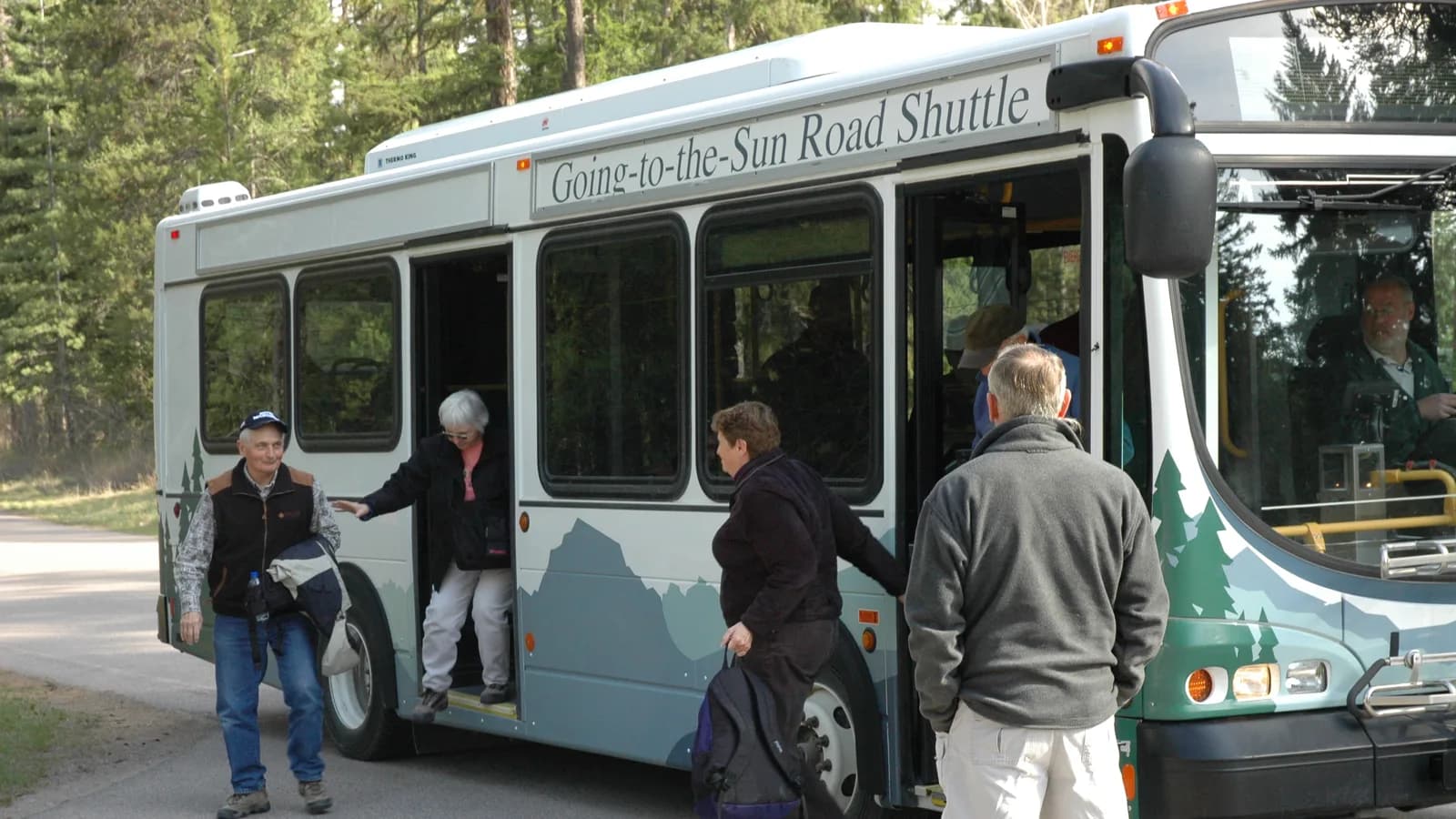
An employee shuttle is judged by the person standing at the stop at 7:50 who has to be at their desk at 8:00. GPS tracking from High Point GPS puts every shuttle on one live map, and gives employees an arrival estimate they can check from their phone. The facilities or HR team gets the on-time record that the contract with the operator and the budget conversation with finance both depend on. The GPS tracking device records each loop, each stop and the time spent at it, and a shuttle that habitually leaves the parking structure two minutes early shows up in the report. Corporate pool vehicles are the other half of the picture: sedans and vans signed out by staff, driven across the region and returned late, dirty or with a new scratch. Driver ID through an NFC tag or a keyless reservation system records who took which vehicle and when. The trip record shows where it went, how it was driven and whether it left the region it was booked for. Driver scoring holds employees to the company's driving policy, and after-hours and weekend movement generates an alert. Engine-hours maintenance, fault codes and fuel-card reconciliation keep a fleet that nobody owns personally in service, and the utilization report shows which vehicles could be cut. A tracking page for employees and the High Point GPS platform login for facilities come from the same database.
Common challenges
- Employees who miss the shuttle or wait in the cold because nobody can tell them when it will arrive
- On-time and ridership disputes with a shuttle contractor, with only the contractor's own log as evidence
- Pool vehicles signed out on a clipboard, returned late, and nobody sure who had them on the day the parking ticket was issued
- Personal and after-hours use of company vehicles that shows up as fuel cost and mileage nobody can explain
- A pool fleet sized by guesswork, with some vehicles idle for weeks and others never available
- Fuel-card charges that do not match the vehicle's location, discovered months later
How High Point GPS helps
- Live shuttle position and arrival estimate employees check from a phone or a lobby screen
- On-time performance by loop, stop and hour, from geofence arrival records rather than the contractor's log
- Ridership counts by stop and by loop where a passenger counter or card reader is installed
- Pool vehicle sign-out with driver ID through an NFC tag or a keyless reservation system
- Alerts for after-hours movement, geofence exits and vehicles that leave the region they were booked for
- Driver scoring on speeding, hard braking and seat belt use, held to the company's driving policy
- Utilization reports by vehicle showing days used, kilometres and idle days, for right-sizing the pool
- Engine-hours maintenance, fault codes and fuel-card reconciliation for vehicles no one owns personally
A shuttle employees trust
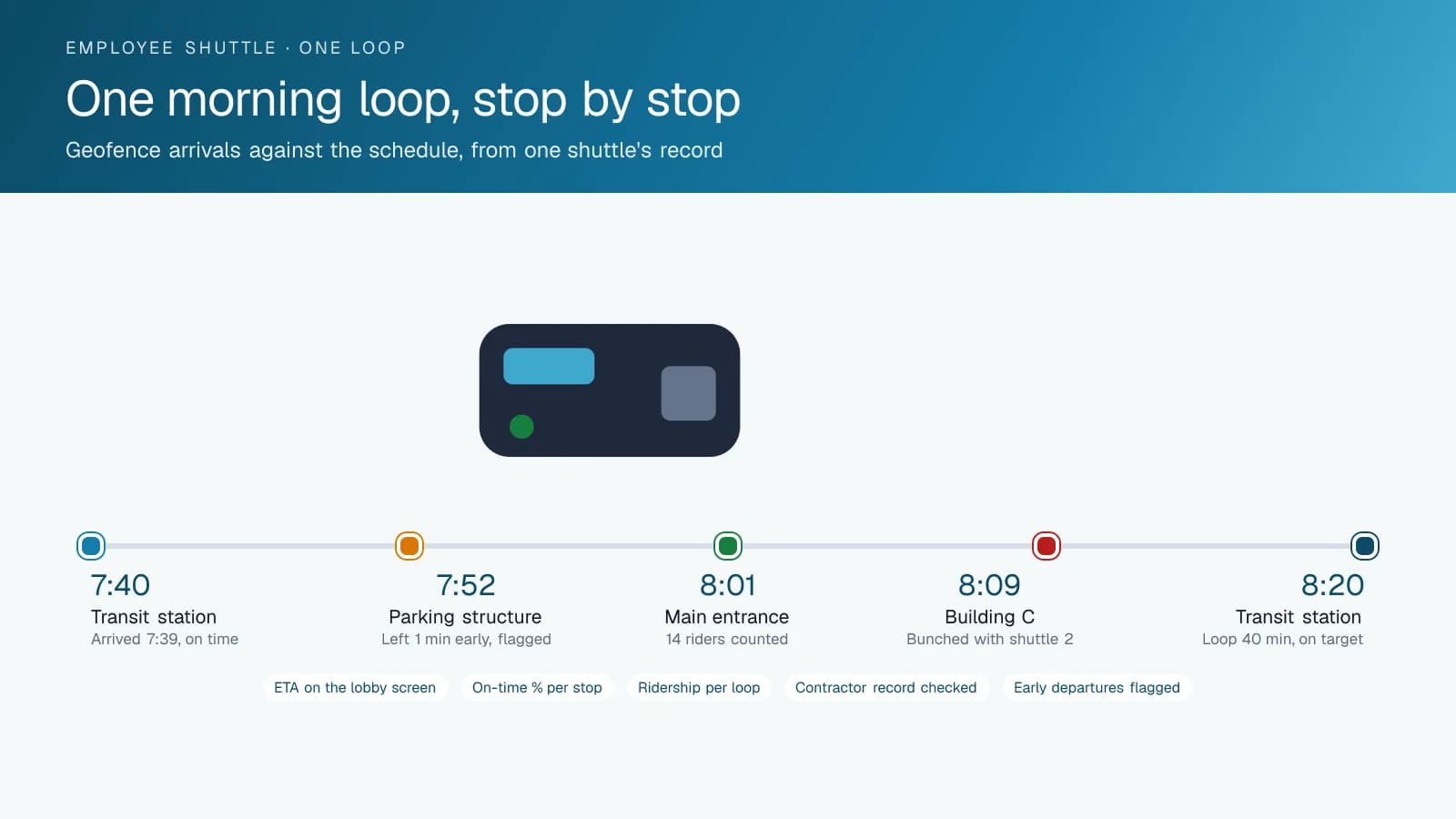
The shuttle loop is only useful if people rely on it, and people rely on what they can see. A tracking page from High Point GPS, opened on a phone or shown on a screen in the lobby, shows each shuttle on the loop and its arrival estimate for every stop. An employee at the transit station decides whether to wait or to walk based on a number rather than on hope. Geofences at each stop record the actual arrival and departure of every shuttle on every loop, and a stop the shuttle skipped or left early appears in the day's report without anyone complaining first.
Most employee shuttles are run by a contractor, and the contract has an on-time target. The geofence record measures it independently: arrivals per stop per hour, the percentage inside the window, and the trips where the shuttle bunched with the one behind it. Ridership from a passenger counter or a badge reader at the door shows which loops are full and which run empty at 2 pm. When the contract comes up for renewal, facilities negotiates from a year of its own data, and the conversation about adding a loop or dropping one starts from counts rather than impressions.
Who has the pool car?
A pool vehicle is signed out on a clipboard, driven for the day and returned to a spot. When the parking ticket, the toll invoice or the body damage appears three weeks later, the clipboard rarely settles who had it. With an IOX-NFCREADERA reader in the cab, the employee taps a badge before driving, and every trip is attributed to them. Where the company uses a keyless reservation system, the reservation opens the vehicle and the GPS tracking device records the trip under that booking. Either way, the trip record shows where the vehicle went, when it came back and how it was driven.
Rules follow from the record. An alert fires if a pool vehicle moves outside business hours, leaves the region it was booked for or crosses into personal-use territory the policy does not allow. A geofence around the office lot records the return time, and a vehicle booked until 5 pm that comes back at 8 pm shows in the report. Fuel-card integration matches each purchase to the vehicle's location at the time, and a fill-up 60 kilometres from the vehicle's position gets flagged the same day rather than at the quarterly review.
Driving policy that applies to everyone
Employees driving a company vehicle are driving under the company's name and the company's insurance. Driver scoring in the High Point GPS platform measures speeding, hard braking, fast cornering and seat belt use on each trip and reports by employee. The fleet coordinator sees who drives within policy and who does not, with the specific trip to discuss. High Point GPS sets thresholds to match the policy in the employee handbook, with tighter rules on the campus loop where pedestrians are everywhere. A monthly scorecard shared with managers is often enough; the driver who is consistently at the bottom is the exception that needs a conversation.
AI dash cams are optional in a corporate fleet and common in shuttles. A road-facing camera records what happened in front of the shuttle, and event-based clips reach the coordinator only when hard braking, a collision or a distraction event triggers them. When a shuttle is rear-ended at a stop or a pool car is involved in a parking-lot collision, the video and the trip record settle the claim quickly and keep the premium where it is. Employees are told what the cameras record, and the retention policy is set by the company rather than by default.
Right-sizing and maintaining a fleet nobody owns
A pool fleet grows by requests and shrinks by nobody. The utilization report in the High Point GPS platform shows, for each vehicle, the days it moved, the kilometres it covered and the days it sat, over a quarter or a year. A sedan used four days in three months is a lease payment that can be cancelled; a van booked every day with a waiting list is a reason to add one. Facilities managers who bring this report to the budget meeting tend to keep the vehicles they need and lose the ones they do not, and the argument is over in one slide.
Vehicles nobody owns get the least care. Engine fault codes reach the fleet coordinator as the vehicle logs them, and maintenance reminders run on engine hours and mileage rather than on a calendar that assumes every vehicle drives the same amount. Shuttles that idle at the stop with the heat on for waiting passengers accumulate engine hours a mileage schedule would miss. Electronic inspections in the driver app give the shuttle contractor's drivers a pre-trip checklist, and a defect on a shuttle reaches the contractor and facilities at the same time, with a photo attached.
Frequently asked questions
Can employees see the shuttle's location?
Yes. High Point GPS sets up a tracking page that shows each shuttle on the loop and its arrival estimate for every stop. Employees open it on a phone or see it on a lobby screen. The page shows the shuttle and nothing else about the company's fleet, and it works for a contractor-run shuttle as well as your own.
Can we track a contractor's shuttles?
Yes. The contractor's shuttles carry a GPS tracking device on your database, or the contractor shares access from its own, and facilities sees arrivals, departures and on-time performance for every loop. The record is independent of the contractor's log, which matters when the contract's on-time target is being measured at renewal.
How does the system know who has a pool vehicle?
Employees tap a badge on an NFC reader in the cab before driving, and every trip is attributed to them. Where the company uses a keyless reservation system, the booking opens the vehicle and the trip is recorded under it. A vehicle that moves without a tap or a booking generates an alert to the fleet coordinator.
Can it flag personal or after-hours use?
Yes. Alerts fire when a vehicle moves outside business hours, leaves a defined region or exits a geofence it should stay within. Fuel-card integration flags purchases that do not match the vehicle's location. The company sets the rules to match its policy, and the report shows the exceptions rather than every trip.
Will it help us decide how many vehicles we need?
Yes. The utilization report shows, for each vehicle, the days it moved, the kilometres it covered and the days it sat, over any period. It shows which vehicles could be removed and where demand exceeds supply. Many corporate fleets find that report alone justifies the tracking in the first year.
Related solutions
Related guides
- Keyless Monitor: The Command Centre for a Shared Vehicle Pool →
- Keyless and Keyless Lite: Phone-as-Key for Shared Fleet Vehicles →
- IOX-NFCREADERA: Driver ID by NFC Tap, So Every Trip Has a Name on It →
- Can My Employer Track My Work Vehicle? GPS and the Law →
- How Geofencing Works for Fleet Tracking →
- Fuel Card Integration: How It Actually Works →
Get a free quote
What are you looking for?