
Industry
GPS Fleet Tracking for Furniture & Appliance Delivery
GPS tracking for furniture and appliance delivery fleets that keeps two-person crews on their windows, tells customers when the truck is coming, records the time spent at every door, and settles damage and no-show disputes with trip replay and dash cam video.
Updated September 21, 2026
A furniture or appliance delivery is not a parcel drop. Two people, a liftgate, a sixty-minute window the customer planned their day around, and a product that has to arrive without a scratch. When the truck runs late, the store hears about it; when a sofa arrives marked, the crew and the customer tell different stories; when the customer says nobody came, the dispatcher has nothing but the driver's word. High Point GPS puts every delivery truck on one live map with its stop list, so the dispatcher sees which crews are ahead, which are behind and which window is about to be missed. Customers get an accurate ETA text rather than a four-hour promise. The GO device records the arrival time at each address and the minutes at the door, and an IOX-AUXM input on the liftgate circuit shows exactly when the gate cycled at that stop. Road- and driver-facing AI dash cams add the video: the truck in the driveway, the crew carrying the range up the steps, the time on the clock. A no-show claim, a damage claim or a chargeback from a retailer is answered from the record rather than argued. Route planning built for heavy stops, driver scoring on the trucks that carry the most valuable loads, and maintenance on engine hours round out a platform that a store's delivery department or a third-party delivery contractor runs from one MyGeotab database.
Common challenges
- Delivery windows promised at the store that dispatch cannot see the truck keeping or missing until the customer calls
- Customers waiting at home with no better ETA than a four-hour block and a phone number to call
- Time at the door that stretches from twenty minutes to an hour with no record of why, pushing every later stop off its window
- Damage claims where the customer says the crew scratched the floor and the crew says the product was already marked
- No-show and attempted-delivery disputes with nothing to prove the truck was in the driveway at the time on the ticket
- Liftgate use, idling and route choices that only show up as fuel cost at the end of the month
How High Point GPS helps
- Every truck on one live map with its stop list, the window for each stop and a colour for on time, at risk and missed
- Customer ETA notifications by text or email from the truck's actual position and remaining stops, not a morning estimate
- Arrival and departure records at each address from geofences, with the minutes at the door on every delivery
- Liftgate cycles read from the truck's own circuit through an IOX-AUXM input, tied to the stop and the time
- Road- and driver-facing AI dash cams with event video for no-show, damage and driving disputes
- Route planning that respects two-person stop durations, truck size and the windows already promised
- Driver scoring on speeding, hard braking and cornering with the load, and idling in the customer's driveway
- Engine-hours maintenance reminders and fault codes sent to the shop before a liftgate truck goes down on a Saturday
Keeping the Window Without Calling the Driver
The dispatcher's day is a list of windows and a list of trucks, and the question all day is whether the two still line up. On the live map, each truck carries its remaining stops and the window for each one, and the platform recalculates the arrival estimate as the truck moves. A crew that spends an extra forty minutes assembling a bed frame turns the next three stops amber before anyone has to guess. The dispatcher can shift a stop to another crew, call the customer ahead of time or simply watch, instead of ringing the driver for a status that is out of date by the time the call ends.
The customer sees the same thing in a simpler form. A notification goes out when the truck is a set number of stops away or a set number of minutes out, with an ETA taken from the truck's position rather than the morning's plan. A second message confirms the delivery is done. The store stops fielding the where-is-my-couch call, and the customer who is not home when the truck arrives has fewer reasons to say nobody warned them. The same replay supports the store's own follow-up: the customer service desk confirms the delivery time from the record before it calls the customer back.
The Record at the Door
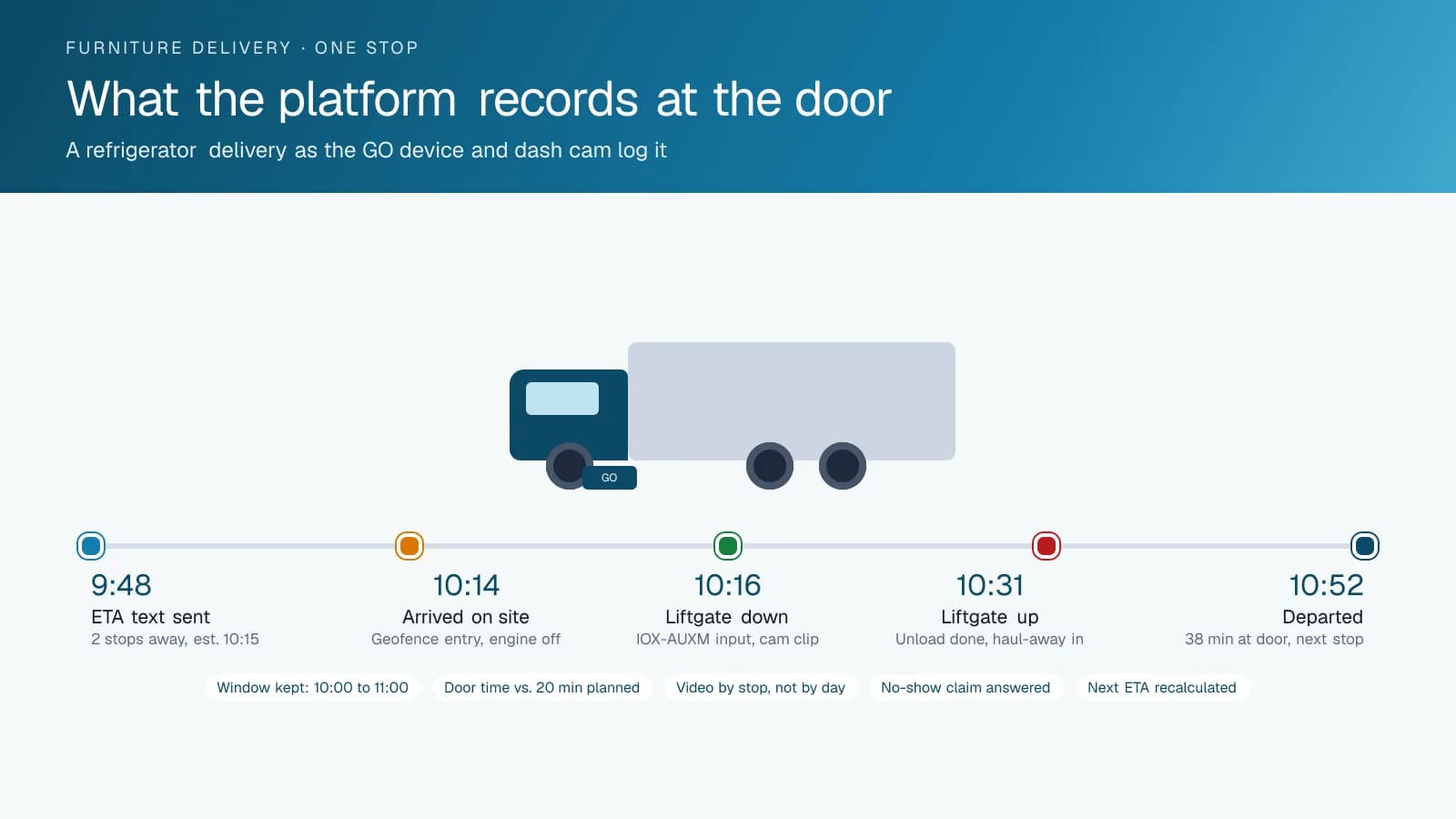
Every delivery address becomes a geofence, either drawn in advance from the stop list or created automatically when the truck stops. The GO device records the moment the truck enters, the moment it leaves and everything in between: engine on or off, whether it idled, how long the stop lasted. An IOX-AUXM input wired to the liftgate circuit adds when the gate went down and came back up. The stop record for a refrigerator delivery reads like a receipt: arrived 10:14, liftgate down 10:16, liftgate up 10:31, departed 10:52. Thirty-six minutes at the door, and the dispatcher can see which part was the walk-up and which was the haul-away.
Stop durations across a week show the pattern. Some addresses take an hour because of the building; some crews take an hour everywhere. High Point GPS sets up the report that separates the two, and the delivery manager plans routes and coaches crews from actual door times rather than the standard twenty minutes the scheduling software assumes. Crews that consistently run over get a specific conversation about a specific address, and crews that run under get their day loaded a little heavier. Over a season, the standard stop time in the scheduler moves toward what the record shows.
Settling Damage and No-Show Claims With Video
The claims are what make furniture delivery expensive. A customer reports a gouge in the hardwood; a retailer charges back a delivery marked incomplete; a customer insists the truck never came on a day the driver marked attempted. Each one used to be settled by whoever argued longest. With trip replay, the truck's position at the address and the time it spent there are a matter of record. With a road-facing dash cam, the driveway, the front door and the time on the clock are on video. A driver-facing camera shows the crew leaving the cab and returning, which is the evidence that someone actually knocked.
Video is retrieved by trip and by event, so a claims review means pulling the clips from one stop rather than scanning a day of footage. A collision on the way to a stop produces the same evidence: the forward view, the speed, the braking. High Point GPS configures retention and access policies with the delivery company, and the retailer or insurer receives an export rather than a login. When the retailer's claim window is short, that turnaround is the difference between a chargeback absorbed and a chargeback reversed. The driver never has to hunt for the footage.
Routing Heavy Stops and Keeping the Trucks Running
A route that works for parcels fails for appliances. Stops take thirty to ninety minutes, trucks cannot use every street, and the windows were promised days ago at the register. Route planning in the platform takes the stop durations from past deliveries at similar addresses, the truck's size and the windows already committed, and builds a day that each crew can actually finish. When a same-day add-on comes in, the dispatcher sees which crew can absorb it without breaking a window that is already promised. The dispatcher sees the answer on the map before the customer is called back.
The trucks themselves are the other constraint. A liftgate truck out of service on a Saturday takes twenty deliveries with it. Maintenance reminders on engine hours and mileage keep the service schedule honest, and engine fault codes reach the shop as the truck logs them. Fuel-card integration matches each purchase to the truck and the driver, and idling reports show which crews leave the engine running for the whole haul-away. The report that matters most to the owner shows the cost per delivery by crew and by truck, and it is built from the same records.
Frequently asked questions
Can customers get a live ETA for their delivery?
Yes. The platform sends a text or email when the truck is a set number of stops or minutes away, with an arrival estimate based on the truck's actual position and remaining stops. A second notification confirms completion. The delivery company decides the trigger and the wording. Windows and notification triggers can differ by region or by product line.
How does it prove the crew was at the address?
A geofence at each delivery address records when the truck arrived, how long it stayed and when it left. Trip replay shows the route there. With dash cams, the driveway and the crew leaving the cab are on video with the time stamp, which settles a no-show or attempted-delivery dispute. The record is exported as a trip report or a video clip.
Does it record liftgate use?
Yes. An IOX-AUXM input on the GO device reads the liftgate circuit, so each stop record shows when the gate went down and came up. That confirms the delivery was physically made and shows how much of the stop was spent unloading. The input is wired at installation and needs nothing from the crew during the day.
Will the route planning handle two-person stops?
Yes. Route planning uses real stop durations from past deliveries, the truck's size and the windows already promised to build a day the crew can finish. Same-day additions are placed on the crew that can absorb them without breaking a committed window. High Point GPS sets the initial stop-time assumptions with the delivery manager.
What happens with damage claims?
The stop record shows the truck at the address and the time spent there. Dash cam video from the road-facing camera shows the driveway and door, and the driver-facing camera shows the crew coming and going. Clips are pulled by stop and exported to the retailer or insurer. Retention is set to the claim window the delivery company works with.
Related solutions
Related guides
- Delivery Fleet Management: How Last-Mile Companies Hit Delivery Windows →
- Route Optimization Software for Last-Mile Delivery: Multi-Stop Planning Explained →
- Dash Cam Footage and Insurance Claims →
- How Geofencing Works for Fleet Tracking →
- What Is a Geotab IOX and What Does It Do? →
- Public Tracking Portal: Giving Customers and Residents a Live Map Without a MyGeotab Login →
Get a free quote
What are you looking for?