
Industry
GPS Fleet Tracking for Railway Maintenance & Hi-Rail Fleets
GPS tracking for railway maintenance and hi-rail fleets: work block entry and clear times, on-rail versus on-road hours, and full records with no coverage.
Updated September 22, 2026
A railway maintenance fleet works where the map ends: hi-rail trucks that drive to a crossing, drop their rail gear and run the subdivision on the track, signal maintainers covering hundreds of kilometres of line, and crew vans that shuttle track gangs to the block. The questions a roadmaster or a fleet supervisor has to answer are specific. Was the hi-rail inside its track authority limits during the work-block window, and when did it clear? How many hours did each truck run on rail versus on road, for maintenance and for the crew's own records? Where is the crew van when a block is cancelled at 5:10 in the morning? GPS tracking for hi-rail fleets answers all of them from the same GPS tracking device. Geofences drawn along the subdivision and around each work block give arrival and clear times to the minute. An IOX-AUXM input on the rail-gear circuit records every transition from road to rail. Trips through subdivisions with no cellular coverage are stored on the device and uploaded when the truck reaches a town. Maintenance runs on engine hours rather than mileage, because a truck that idles all shift beside a track gang barely moves. Bluetooth asset tags cover the tampers, welders and generators the crews leave at the block, and AI dash cams record grade crossings and the approach to the rail. High Point GPS builds the setup around the railway's territory and its work-authority process.
Common challenges
- Work-block and track-authority limits documented only by the foreman's radio call and a paper record, with nothing to prove when the truck actually cleared
- No record of how many hours each hi-rail spent on the rail versus on the road, for maintenance, for billing or for an incident review
- Trips through subdivisions with no cellular coverage that disappear from the map for hours, or never make it into the record at all
- Trucks that idle all shift beside a track gang and reach a service interval on hours long before the odometer says so
- Crew vans, trailers and towed equipment scattered across a territory, with no way to know what is at which block
- Grade-crossing incidents and near misses with the truck's own approach speed and stop unrecorded
How High Point GPS helps
- Geofences along each subdivision and around each work block, with entry and clear times recorded to the minute
- Rail-gear up and down read from the truck's own circuit through the GPS tracking device's IOX-AUXM inputs, giving on-rail versus on-road time per trip
- Offline trip storage on the GPS tracking device, uploaded in full when the truck returns to coverage, with no gap in the record
- rugged GPS tracking devices and Bluetooth asset tags for tampers, welders, generators and trailers left at the block
- Engine-hours maintenance reminders and fault codes for trucks that idle all shift and rarely move
- Live location of crew vans and hi-rails for the dispatcher who reassigns a gang when a block is cancelled
- AI dash cams with road-facing and driver-facing views, recording grade crossings and the approach to the rail
- Driver ID and electronic DVIR in the driver app, with a hi-rail-specific inspection checklist for the rail gear
Proving the work block: in at 8:27, clear at 11:52
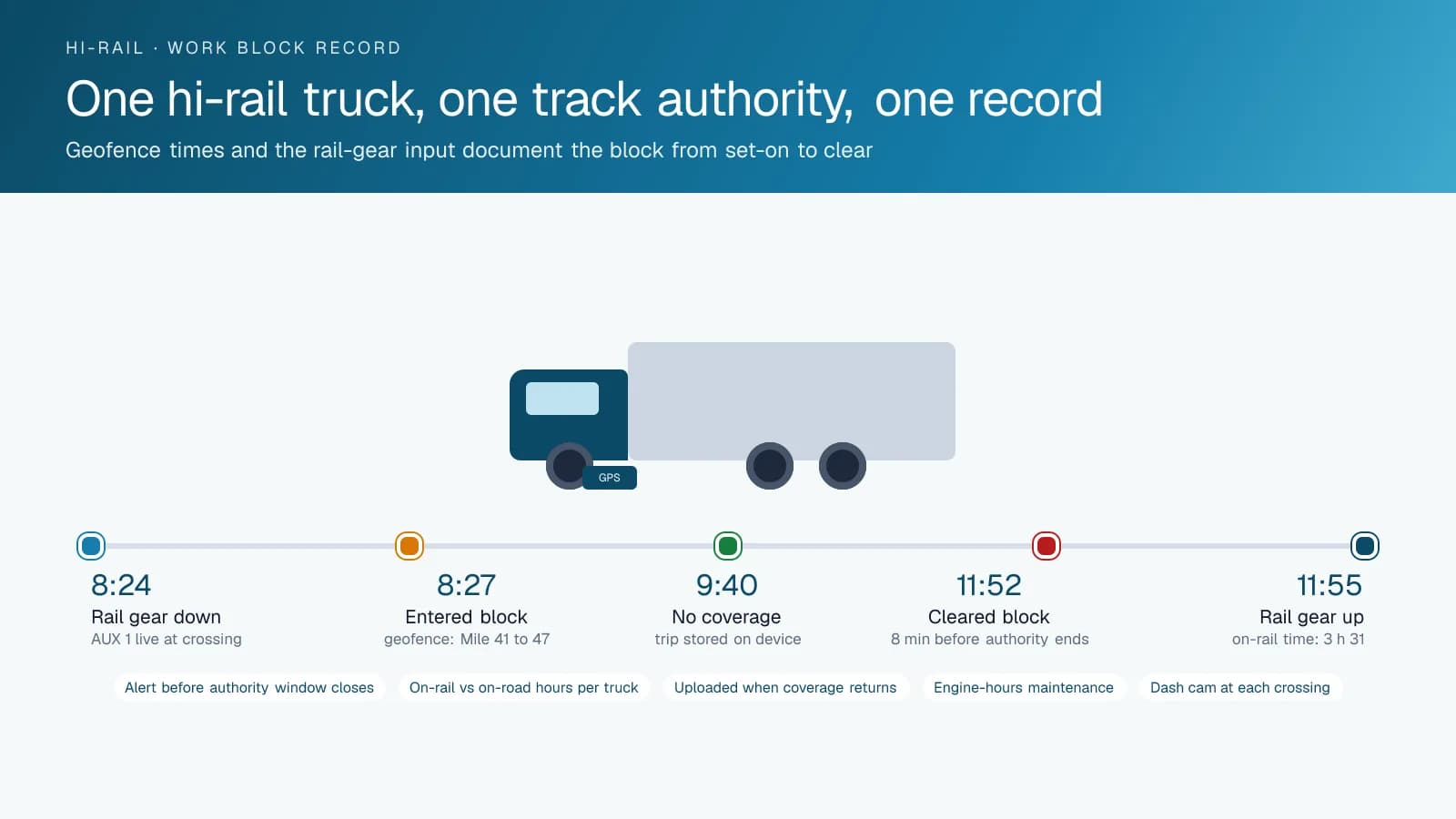
A track authority gives a crew a defined stretch of line for a defined window, and the railway's rules require that the crew be clear of it before the window ends. The foreman's radio call and the paper authority say what was agreed. The GPS tracking device says what happened. High Point GPS draws a geofence along each subdivision, split at the mileposts or control points the railway uses, and a narrower one around each day's work block. The record then shows the hi-rail entering the block at 8:27, moving within it through the morning and clearing at 11:52, eight minutes before the authority expired.
That record matters most when something goes wrong: a train delayed because a block was not released on time, a hi-rail found on the track outside its limits, or a review after a close call. It also matters on a normal day, because the same times feed the daily work report without the foreman transcribing them. Where a railway wants it, an alert fires when a truck is still inside a block geofence a set number of minutes before the authority window closes, giving the dispatcher time to call the crew.
On the rail or on the road: one circuit tells the difference
A hi-rail truck's rail gear has a hydraulic or electrical circuit that is live when the guide wheels are down. An IOX-AUXM module on the GPS tracking device reads that circuit, and every transition becomes a timestamped event in the trip: gear down at the crossing at 8:24, gear up at the next crossing at 11:55. From that, the High Point GPS platform separates on-rail hours from on-road hours for each truck, each day, each crew. The rail-gear inspection interval the manufacturer specifies runs on those hours, not on a guess, and a crew that bills on-rail time to a project has the figure without a foreman reconstructing it from memory.
The same event answers the question a roadmaster asks after an incident: was the truck on the rail at that moment, at what speed, and where? Speed rules can be set separately for the two modes, with a lower limit while the gear is down, and the driver-facing dash cam catches distraction on either. Hours of service and driver apply to the trucks that fall under the rules, with electronic DVIR carrying a hi-rail-specific checklist for the gear, the insulation and the wheel wear that a paper form tends to skip.
Subdivisions with no coverage and trucks that never move
Much of a maintenance-of-way territory has no cellular signal. The GPS tracking device keeps recording anyway. Position, speed, the rail-gear input and engine data are stored on the device through the whole trip and uploaded the moment the truck returns to coverage, so the map catches up and the record is complete. A supervisor reviewing yesterday's work sees the full run through the subdivision, not a gap between two towns. High Point GPS fits rugged GPS tracking devices to trucks that work in dust, vibration and cold, and Bluetooth battery trackers to trailers and equipment that have no power of their own.
Maintenance for these trucks cannot run on mileage. A hi-rail that idles beside a gang for eight hours has run a full shift on its engine and moved twelve kilometres. Reminders on engine hours, with fault codes from the engine sent to the shop as they appear, keep the service interval honest and catch a charging or cooling fault before it strands a crew at a block. Fuel-card integration matches fuel purchases to each truck and flags the fill that does not fit the engine hours.
Crews, equipment and grade crossings
A crew van's location at 5:10 in the morning decides whether a cancelled block becomes a lost day. With every van and hi-rail on one live map, the dispatcher sees which gang is closest to the alternate work and calls them before they reach the original site. Bluetooth asset tags on tampers, welders, generators and compressors, and battery trackers on trailers, show what was left at which block and what came back. When a generator goes missing from a siding, the last-seen record and the geofence history narrow the search to a location and a time.
Grade crossings are where a hi-rail fleet meets the public. A road-facing AI dash cam records the approach, the stop and the set-on at every crossing, and the driver-facing camera flags distraction or fatigue on long runs between sites. When a motorist disputes an incident at a crossing, the railway has the video, the speed and the rail-gear state from the same minute. High Point GPS installs the cameras and devices to the railway's standard, tests the rail-gear input on each truck at install, and sets the reporting groups so each territory and each gang sees its own records.
Frequently asked questions
Can it prove when a hi-rail entered and cleared a work block?
Yes. High Point GPS draws geofences along each subdivision and around each work block, and the GPS tracking device records the truck's entry and clear times to the minute. The record shows the truck's movements within the block and supports the daily work report, an incident review and any dispute over whether the authority was released on time.
How does it know whether the truck is on the rail or on the road?
An IOX-AUXM module on the GPS tracking device reads the rail-gear circuit, which is live when the guide wheels are down. Each transition is a timestamped event, and the High Point GPS platform reports on-rail and on-road hours separately for each truck and each day. Speed rules can differ between the two modes.
What happens in subdivisions with no cellular coverage?
The GPS tracking device stores position, speed, the rail-gear input and engine data on board throughout the trip and uploads everything when the truck returns to coverage. The record is complete; only the live view is delayed. Bluetooth asset tags on equipment are read by any nearby GPS tracking device when it passes.
Our trucks idle all shift and barely move. How is maintenance scheduled?
On engine hours. The GPS tracking device reads engine hours directly from the truck, and maintenance reminders run on those hours as well as mileage. Fault codes reach the shop as they appear. A hi-rail that idled eight hours beside a gang counts a full shift toward its next service.
Can it track the tampers, welders and trailers our crews leave at the block?
Yes. Bluetooth asset tags on powered and unpowered equipment are picked up by the GPS tracking device in any passing truck, and battery trackers on trailers report on their own. The platform shows what was left at which block, what came back and where a missing item was last seen.
Related solutions
Related guides
- How Geofencing Works for Fleet Tracking →
- What Is an IOX Port and What Does It Do? →
- Fleet Maintenance: Engine Hours vs. the Calendar →
- GPS vs. Cellular Tracking: How Fleet Tracking Actually Connects →
- GPS Asset Tags vs. Powered Trackers: Which to Use →
- High Point GPS DVIR: How Digital Vehicle Inspection Reports Work →
Get a free quote
What are you looking for?