
Industry
GPS Fleet Tracking for Sales & Service Fleets
GPS fleet tracking for sales and service fleets: automatic mileage and expense records, a visit log per customer, personal-use privacy and duty of care.
Updated September 22, 2026
A sales and service fleet does not look like a fleet from the outside. It is forty sedans and compact SUVs parked in employees' driveways, driven by account managers, sales reps and field technicians who are measured on calls made and tickets closed, not on how they drive. The finance team sees it differently: a mileage claim on a spreadsheet, a fuel-card statement that does not match it, a personal-use benefit calculated from a driver's own estimate, and a vehicle count nobody has questioned in years. GPS tracking for sales and service fleets replaces that guesswork with records. The GPS tracking device plugs into each car's diagnostic port and logs every trip: start, end, distance, duration and the stops in between. A geofence around each customer site turns those stops into a visit log that can feed the CRM through the open API. Drivers mark trips business or personal with one tap, and the mileage record for taxable-benefit and expense purposes builds itself. Speeding, hard braking and distracted driving are scored per driver, which is how an employer shows it took its duty of care seriously if a rep is in a collision on a work trip. Utilization reporting shows which cars sit idle and whether a pooled fleet could be smaller. High Point GPS configures the policy, the privacy settings and the reports so the program is accepted by drivers and useful to finance from the first month.
Common challenges
- Mileage and expense claims filled in from memory at month end, with no way to check them against actual trips
- Personal-use and after-hours driving that nobody can quantify, which makes the taxable-benefit calculation a guess
- Sales managers asking how many customer visits a rep made and getting a number from the rep's own calendar
- No record of how company cars are driven, and no defence if an employee is hurt in a collision on a work trip
- A pooled fleet that has grown by one car at a time, with no data on which vehicles are actually needed
- Fuel-card charges that cannot be matched to a vehicle, a trip or a driver
How High Point GPS helps
- Automatic trip logs from the GPS tracking device with start, end, distance and stops, replacing paper mileage sheets
- One-tap business or personal trip classification in the driver app, with the totals ready for expense and benefit reporting
- Geofences around each customer site that produce a visit record: arrival, departure and time on site per account
- Open API and add-ins that push visit records and mileage into the CRM or expense system the company already uses
- Personal-use privacy mode that stops location reporting on personal trips while the mileage total is still counted
- Driver scoring for speeding, hard braking, cornering and seat-belt use, weighted for light-duty highway driving
- Utilization and idle-vehicle reports that show which cars in a pooled fleet can be returned at lease end
- Fuel-card integration that matches every fill-up to the vehicle, the driver and the odometer reading
Mileage records that build themselves
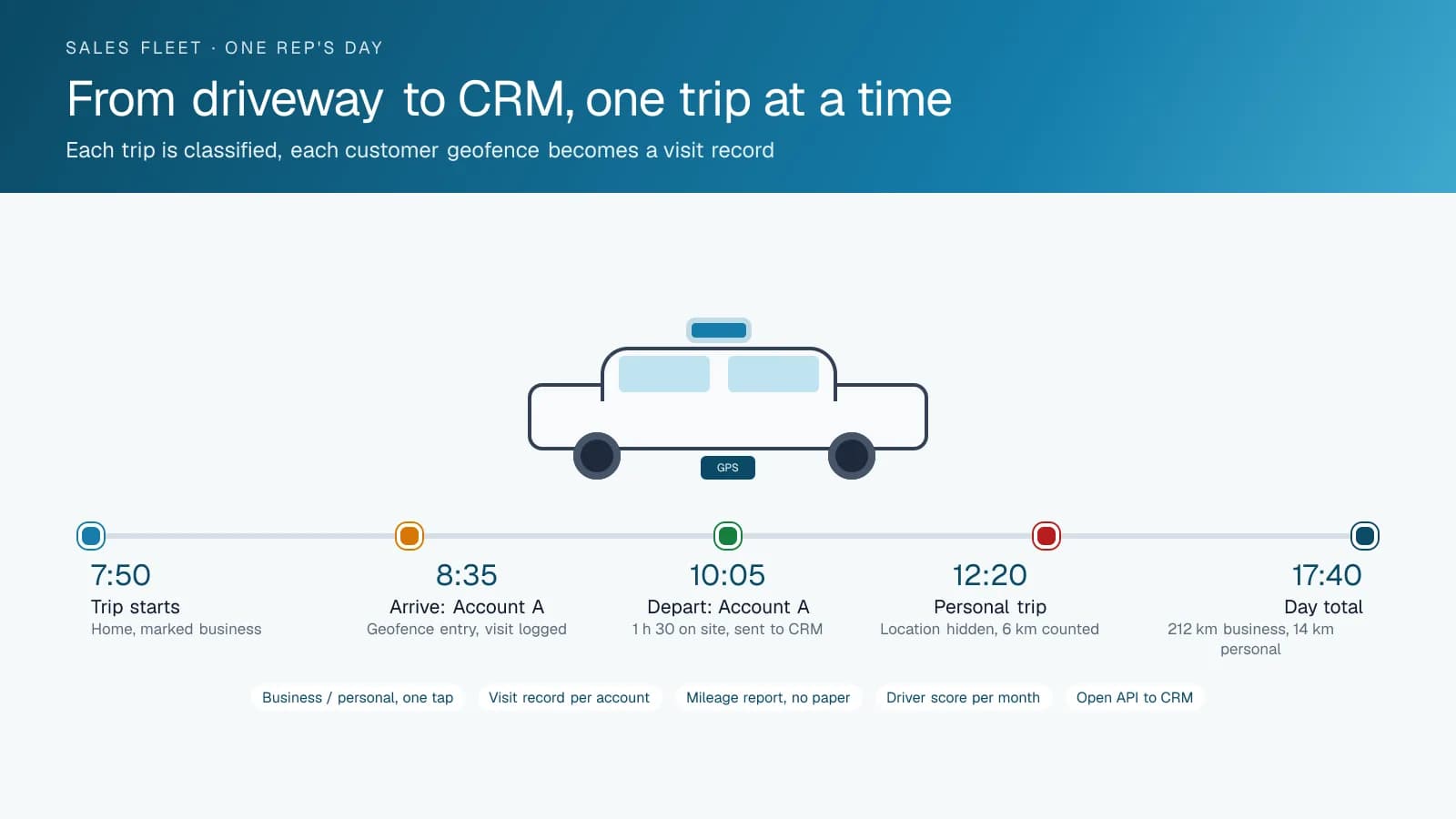
The monthly mileage claim is the most disliked form in a sales organization and the least trusted one in finance. With a GPS tracking device in each car, every trip is logged as it happens: the start address, the end address, the distance and the time. The rep opens the driver app and swipes a trip as business or personal, or the platform classifies it by schedule and geofence and the rep only corrects the exceptions. At month end the business mileage total is a report, not a reconstruction, and the personal-use total is on the same page. That is the record an employer needs when it calculates a taxable benefit for a company car, and it is the record a driver needs when an expense claim is questioned.
Fuel goes on the same record. High Point GPS connects the company's fuel cards to the High Point GPS platform so each transaction is matched to the vehicle, the driver logged in at the time and the odometer reading. A fill-up on a Saturday two hundred kilometres from any customer stands out on its own. A fill-up that exceeds the tank's capacity stands out too. Finance stops auditing by sampling and starts auditing by exception.
A visit log for every customer account
A geofence around each customer site turns the trip log into something a sales manager can use. Every arrival inside the zone is a visit, with the time in and the time out, and the visit belongs to whichever rep was logged in to that car. The weekly report shows visits per account and time on site, which is the number the sales meeting has always wanted and never had. For service technicians the same record shows how long the last three calls at a site took, which is the starting point for a conversation about whether the site needs a different service plan.
The visit records do not have to stay in the High Point GPS platform. The open API lets High Point GPS push each geofence arrival into the CRM as an activity on the account, or build a small add-in that shows the CRM contact list on the map. A rep who left a site at 14:10 sees the visit already logged when they open the account in the CRM. A manager reviewing a territory sees which accounts have not had a visit in sixty days without asking anyone.
Personal use, privacy and a policy drivers accept
A company car goes home at night, and the driver's evening and weekend trips are not the employer's business. The tracking program has to say so and prove it. High Point GPS configures a personal-use mode. When the driver marks a trip personal, or when the trip falls outside the working hours in the policy, the platform records the distance for the mileage total but does not report location or speed. The driver sees the same rule on their own screen. That is what makes the program accepted rather than resented, and it is what an HR department needs to answer a privacy question from an employee or a union.
The written policy matters as much as the setting. High Point GPS provides a template covering what is recorded, who can see it, how long it is kept and what personal use means, adapted to the province or state the fleet operates in. The policy, the driver's acknowledgment and the platform's configuration are then consistent, which is the position an employer wants to be in when the question is asked.
Duty of care and a fleet the right size
An account manager driving eight hundred kilometres a week is a professional driver whether or not their job title says so, and their employer owes them a duty of care on the road. Driver scoring in the High Point GPS platform records speeding by the posted limit, hard braking, sharp cornering and seat-belt use, and produces a monthly score per driver. A manager reviews the scores, holds a short conversation with the two or three drivers who need one and records that they did. If a rep is later injured in a collision on a work trip, the employer can show it monitored driving and acted on what it saw. An AI dash cam adds video of the collision itself for the drivers or routes where the exposure justifies it.
Utilization reporting answers the other question finance asks: do we need this many cars? The report shows days driven per vehicle per month, average trip distance and the vehicles that sat for a week or more. A pooled fleet of fifty often turns out to run comfortably on forty-two. The lease-end decision on each car is then a number, and the reservation system for the pool that remains runs on the same driver ID and geofence data.
Frequently asked questions
Can drivers switch tracking off for personal trips?
Yes, within the company's policy. The driver marks a trip personal in the driver app, or the platform applies personal mode outside working hours. Location and speed are not reported on those trips, but the distance is still counted so the mileage and personal-use totals stay complete.
Does it replace the paper mileage log for taxable-benefit records?
It produces the business and personal distance totals per vehicle and per driver, with the trip-level detail behind them, which is what most employers use as the basis for the benefit calculation. Your accountant or payroll team applies the rules for your jurisdiction to those figures.
Can the visit records go into our CRM?
Yes. Geofence arrivals and departures are available through the High Point GPS open API, and High Point GPS can push them into a CRM as an activity on the account, or build the High Point GPS platform add-in that shows CRM accounts on the map. Which CRM you use determines the exact connector.
How do drivers react to being tracked?
Best when the policy is clear before the devices go in. Drivers see the same rules the company applies, personal trips are private, and the mileage claim they used to fill in by hand is done for them. Most fleets find the expense-report time saved outweighs the objection.
Does the GPS tracking device work in leased sedans and SUVs?
Yes. The GPS tracking device plugs into the diagnostic port under the dash of almost any light-duty vehicle and is removed in seconds at lease return, leaving no trace. Installation takes a few minutes per car, and High Point GPS can coordinate it at the office or the dealer.
Related solutions
Related guides
- How Geofencing Works for Fleet Tracking →
- High Point GPS Personal Conveyance: How to Set It Up and Stay Compliant →
- The High Point GPS API: What You Can Actually Build →
- Fuel Card Integration: How It Actually Works →
- GPS Fleet Tracking for Small Business: What a 3 to 20 Vehicle Fleet Needs →
- Do Dash Cams Actually Lower Fleet Insurance Premiums? →
Get a free quote
What are you looking for?