
Industry
GPS Fleet Tracking for Tree Service & Arborists
GPS tracking for tree care companies that shows where every bucket truck, chipper and crew is, records boom and chipper hours from the equipment itself, bills storm work with time-stamped proof, and protects saws, stump grinders and trailers from theft.
Updated September 21, 2026
A tree service fleet is a mix of things that move under their own power and things that get towed, and the office needs to know where all of it is. GPS tracking for tree service and arborists puts every bucket truck, chip truck, crane and crew pickup on one live map, and Bluetooth tags on the chippers, stump grinders and trailers show which truck each one left with and where it was dropped. The Geotab GO device reads the vehicle's own circuits through IOX-AUXM auxiliary inputs, so boom hours on the bucket truck and PTO time on the chipper are recorded from the equipment rather than from a crew leader's notebook. Those hours drive maintenance on the equipment that actually matters, and they are the record behind every storm-work invoice: a utility or a municipality that pays by the hour sees the truck's arrival at the address, the boom active for three hours and the departure, all stamped. Dispatch sees which crew is finishing a removal and which one is closest to the next estimate, and the trip replay shows a homeowner exactly when the crew arrived and left. Geofences around the yard and the equipment lot raise an alert when a trailer moves at 2 a.m., and a battery tracker on a stump grinder reports its position for months. High Point GPS sets it up for crews who spend all day away from any desk.
Common challenges
- Chippers, stump grinders and trailers that leave the yard behind one truck and come back behind another, if they come back at all
- Boom and chipper hours tracked on paper, so maintenance intervals are guesses and warranty claims lack proof
- Storm-work invoices to utilities and municipalities disputed for lack of arrival, departure and equipment-hour records
- Crews spread across a dozen job sites with the office unable to say which one is free for the next estimate
- Saws, climbing gear and small equipment stolen from job sites and trucks with no way to know where they went
- Bucket trucks and chip trucks run hard through storm season with maintenance slipping until something fails
How High Point GPS helps
- Live map of every bucket truck, chip truck, crane and crew pickup with the job it is on
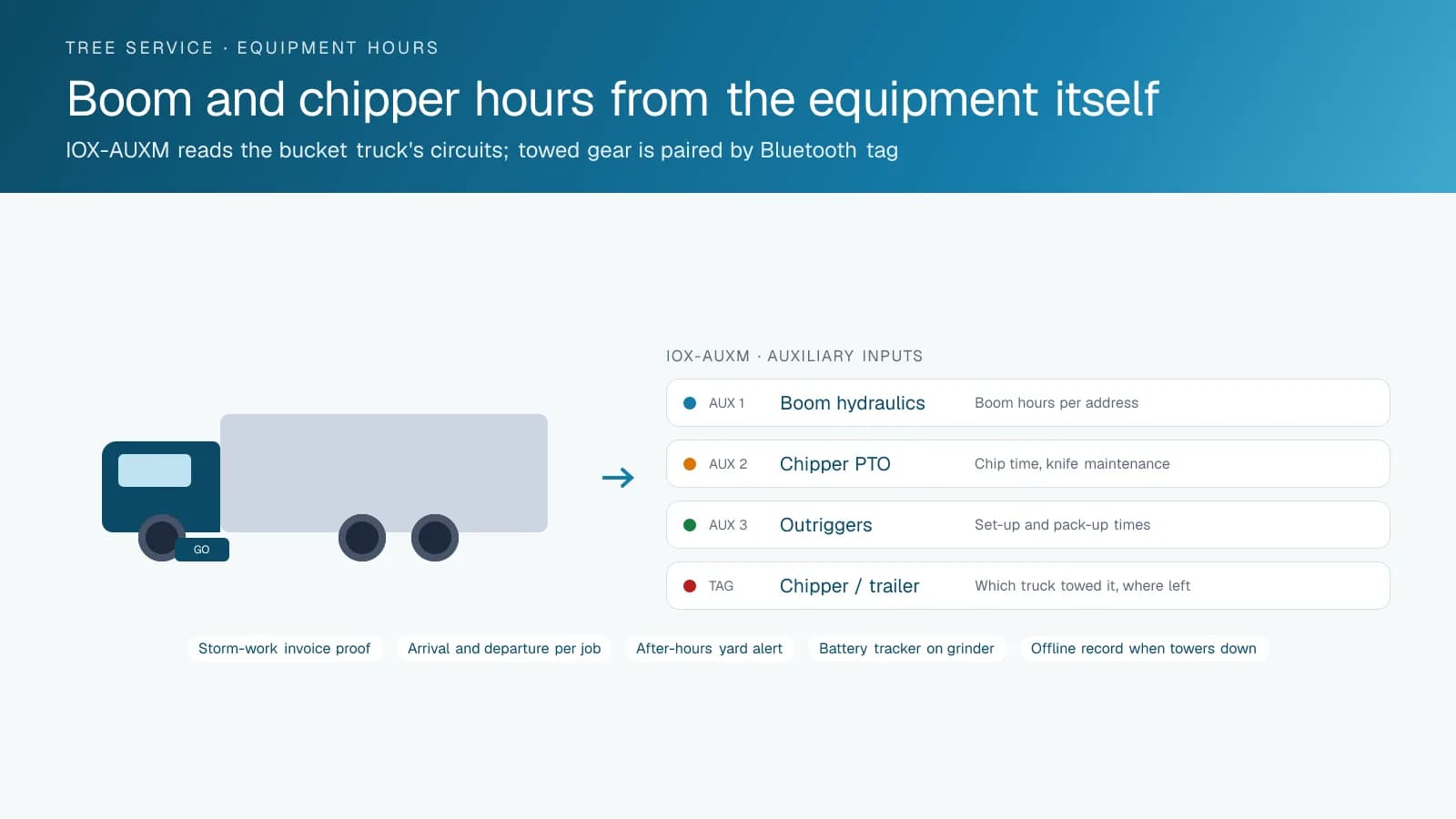
- Bluetooth tags on chippers, stump grinders and trailers that show which truck towed each one and where it was left
- Boom hours and chipper PTO time recorded from the equipment's own circuits through IOX-AUXM inputs
- Storm-work reports with arrival, departure and equipment-active hours per address, ready to attach to an invoice
- Dispatch view that shows which crew is wrapping up and which is closest to the next job or estimate
- Geofences around the yard and equipment lot with after-hours movement alerts for trailers and towed equipment
- Battery-powered trackers on stump grinders and high-value equipment that report for months without a charge
- Maintenance reminders on engine hours, boom hours and PTO hours, with fault codes from the truck sent to the shop
Crews, Trucks and Towed Equipment on One Map
A tree company's morning starts with trucks leaving the yard, each towing something. The GO device in each truck reports where it goes, and a Bluetooth tag on the chipper or the trailer behind it tells the platform which truck it left with. When the crew drops the chipper at a job and takes the truck to the dump, the tag's last-seen position stays at the job, and the map shows the chipper there and the truck on the road. The office sees every crew, every truck and every piece of towed equipment without a single phone call, and the crew leader never has to report where he left the stump grinder.
Dispatch works from the same view. A customer calls for an estimate on the way to another job, and the dispatcher sees which crew is closest and whether they are finishing or just setting up. A crane is needed for a removal across town, and the map shows where it is and how long it has been there. When a homeowner asks what time the crew arrived, the geofence on the address gives the arrival and departure to the minute. High Point GPS sets these views up so the person in the office can answer without leaving the map.
Boom Hours and Chipper PTO from the Equipment Itself
Engine hours on a bucket truck say how long the truck ran, not how long the boom worked. An IOX-AUXM module on the GO device reads the boom's hydraulic circuit and the chipper's PTO, and the trip record then shows the boom active from 8:41 to 11:58 at one address and the chipper engaged for two hours at the next. Those are the hours that wear the equipment. Maintenance intervals for the boom, the hydraulics and the chipper knives run on them rather than on the truck's odometer, and a warranty claim on a boom cylinder comes with a real hour count.
The same hours are the record behind a bill. A commercial customer paying by the hour for a removal, or a municipality paying for pruning along a street, sees the equipment-active time next to the arrival and departure times. There is no argument about whether the crew was working or waiting. High Point GPS maps the inputs during installation, documents which input reads what on each truck, and builds the report so the equipment hours appear per job and per address rather than as a raw log the office has to interpret.
Billing Storm Work With Proof
After a storm, a tree company's crews work for a utility, a municipality or an insurer, and every one of them audits the invoice. The trip record for each truck shows the arrival at each address, the departure and the boom and chipper hours in between, all stamped by the GO device rather than filled in from memory at the end of a sixteen-hour day. The storm-work report lists each address, each truck, each crew and the equipment hours, and the office attaches it to the invoice. When the auditor questions a line, the trip replay shows the truck at the address with the boom active.
Storm work also strains the trucks. Bucket trucks run day and night for a week, and a hydraulic leak or a charging fault that would be a minor shop visit in June strands a crew in the field. Fault codes from the truck reach the shop the moment the engine logs them, and the maintenance schedule on boom and engine hours shows which trucks are due before the next front comes through. Trips are stored on the device when a crew is working in an area where cell service went down with the power lines and uploaded when coverage returns, so the storm record is complete.
Theft, Recovery and the Equipment That Walks Away
Tree equipment is stolen because it is valuable, portable and often left overnight. A geofence around the yard and the equipment lot raises an alert when a trailer or a truck moves outside working hours, and the live map shows where it is going while the police are on the phone. A battery-powered tracker on a stump grinder or a large chipper reports position on a schedule for months and can be set to report more often when it moves. Bluetooth tags on saws and climbing gear in the truck do not track them across the city, but they do record which truck they were in and when they were last seen, which narrows a loss to a job site and a day.
The records also settle the internal question of who had what. When a saw is missing, the tag history shows the truck it rode in and the last job where it was read. When a trailer that was supposed to be at the yard is at a crew member's house, the geofence report says so. High Point GPS sets the alert rules with the company so an after-hours move by the on-call crew during a storm does not page everyone, while a trailer leaving the lot on a Sunday night does.
Frequently asked questions
Can I track chippers and trailers that have no engine?
Yes. A Bluetooth tag on the chipper or trailer is read by the GO device in whichever truck tows it, and the platform records which truck it left with and where it was dropped. For equipment left on sites for long periods, a battery-powered tracker reports its position for months without a charge.
How does the system record boom hours?
An IOX-AUXM module on the GO device reads the boom's hydraulic circuit, or the chipper's PTO, from the truck's own wiring. The trip record then shows when the boom was active and for how long at each address, and maintenance intervals for the boom and hydraulics run on those hours.
Will this help with storm-work invoices to a utility?
Yes. The storm-work report lists each address, the truck's arrival and departure and the boom and chipper hours in between, all stamped by the device. The office attaches it to the invoice, and when the utility's auditor questions a line, the trip replay shows the truck at the address with the boom active.
What happens if a crew is working where there is no cell signal?
The GO device stores the trip, the positions and the boom and PTO inputs on the device and uploads them when the truck returns to coverage. The record for a storm day in an area where the towers went down with the power is complete once the truck is back in range.
Can I get an alert if a trailer leaves the yard at night?
Yes. A geofence around the yard with an after-hours rule sends an alert when a truck or a tagged trailer moves outside working hours, and the live map shows where it is heading. High Point GPS tunes the rules so the on-call crew responding to a storm does not trigger it while a Sunday-night departure does.
Related solutions
Related guides
- Equipment Theft Recovery: How GPS Gets Stolen Machines and Trailers Back →
- GPS Asset Tags vs. Powered Trackers: Which to Use →
- What Is a Geotab IOX and What Does It Do? →
- Fleet Maintenance: Engine Hours vs. the Calendar →
- How Geofencing Works for Fleet Tracking →
- GPS Fleet Tracking for Landscaping and Lawn Care: Crew Time, Equipment and Snow Season →
Get a free quote
What are you looking for?