
Industry
GPS Fleet Tracking for Truckload Carriers
GPS fleet tracking and ELD compliance for truckload carriers: hours of service, IFTA, trailer tracking, billable detention and dash cam video for claims.
Updated September 21, 2026
A for-hire truckload carrier lives on margins that a single audit, a lost trailer or a disputed claim can erase. The tractor has to run legal hours, the fuel tax has to be filed by jurisdiction, the trailer has to be where the load is, and the driver has to want to stay. High Point GPS builds the operation on the GPS tracking device in every tractor and the driver app in the cab. The driver gets a certified ELD for both the US and Canadian mandates, and the safety manager gets an hours-of-service summary that shows violations before a roadside inspection does. IFTA distance by jurisdiction comes from the same GPS record, with fuel-card purchases matched to it, so the quarterly return is a report rather than a reconstruction. Battery-powered trackers on trailers report their position and their dwell at each shipper and receiver, which is the detention record the carrier bills against. Driver scoring is set to reward the drivers the carrier wants to keep rather than to catch the ones it does not, and AI dash cams with road- and driver-facing views put video behind every collision claim and every disputed event. Fuel economy by driver and by lane, engine fault codes to the shop, maintenance on engine hours and an open API into the TMS and payroll round out a platform that a carrier runs from one High Point GPS platform database.
Common challenges
- Hours-of-service violations discovered at roadside or in an audit rather than in the office the day they happened
- IFTA returns assembled from trip sheets and fuel receipts, with distance by jurisdiction that does not match the odometer
- Trailers that are somewhere in a customer's yard, unbillable while they sit and unfindable when a load is ready
- Detention time the carrier cannot bill because the only record is the driver's word against the shipper's
- Drivers leaving for a competitor after a safety score they consider unfair or a dispatch they consider blind
- Collision and cargo claims settled against the carrier because there was no video and no reconstructable record
How High Point GPS helps
- The driver app ELD for US and Canadian hours-of-service rules, with ruleset switching for cross-border runs
- Hours-of-service summary and violation reports for the safety manager, with remaining drive time visible to dispatch
- IFTA distance by jurisdiction from the GPS record, with fuel-card purchases matched to the trip for the quarterly return
- Trailer tracking with battery-powered trackers, showing the position, the tractor it is paired with and the days it has sat
- Geofence arrival and departure at every shipper and receiver, the time-stamped dwell that detention is billed against
- AI dash cams with road- and driver-facing views, event-based video retrieved by trip for claims and coaching
- Driver scoring on speed, harsh events, idling and fuel economy, presented to the driver as a scorecard rather than a verdict
- Fuel economy by driver, by lane and by tractor, with fault codes to the shop and maintenance on engine hours
Hours of service without a roadside surprise
The ELD mandate made the log electronic; it did not make the carrier compliant. Compliance is what happens in the office the morning after. The driver app in the cab gives the driver a certified ELD for both the US and Canadian rules and switches rulesets on a cross-border run, and the driver sees remaining drive time and the next required break on the same screen. The safety manager sees the whole fleet: every driver's remaining hours, every violation from the previous day and every unassigned driving segment that needs to be claimed or annotated before it becomes an audit finding.
Dispatch works from the same hours. A load planner who can see that a driver has four hours left will not send them on a six-hour run and hope. When a roadside inspection happens, the driver transfers the logs from the app and the officer sees a clean record; when an audit happens, the reports High Point GPS configured at setup give the violation history, the edits and the annotations for the period requested. Trips are stored on the device through dead zones and uploaded when coverage returns, and the log is never missing a segment.
IFTA from the GPS record, and the trailer where the load is
IFTA reconciles distance by jurisdiction against fuel bought by jurisdiction, and the trip sheet is where the numbers go wrong. The GPS tracking device records every kilometre with the state or province it was driven in, and the High Point GPS platform totals it by jurisdiction per tractor for the quarter. A fuel-card integration matches each purchase to the trip it belongs to, and the quarterly return comes out of a report rather than a shoebox. The same record supports IRP, and it answers an auditor who wants to see the distance behind a specific quarter's filing without a driver reconstructing a route from memory.
A truckload carrier's trailer pool is its second fleet, and it moves without an engine. Battery-powered trackers report each trailer's position on a schedule and more often when moving, and the platform shows which tractor it is paired with and how many days it has sat at a given location. A dispatcher looking for an empty trailer near a pickup finds it on the map rather than by phoning drivers. A trailer that has been in a customer's yard for eleven days is a conversation with the customer about trailer-pool terms, backed by the geofence record of when it arrived.
Detention you can bill and drivers who stay
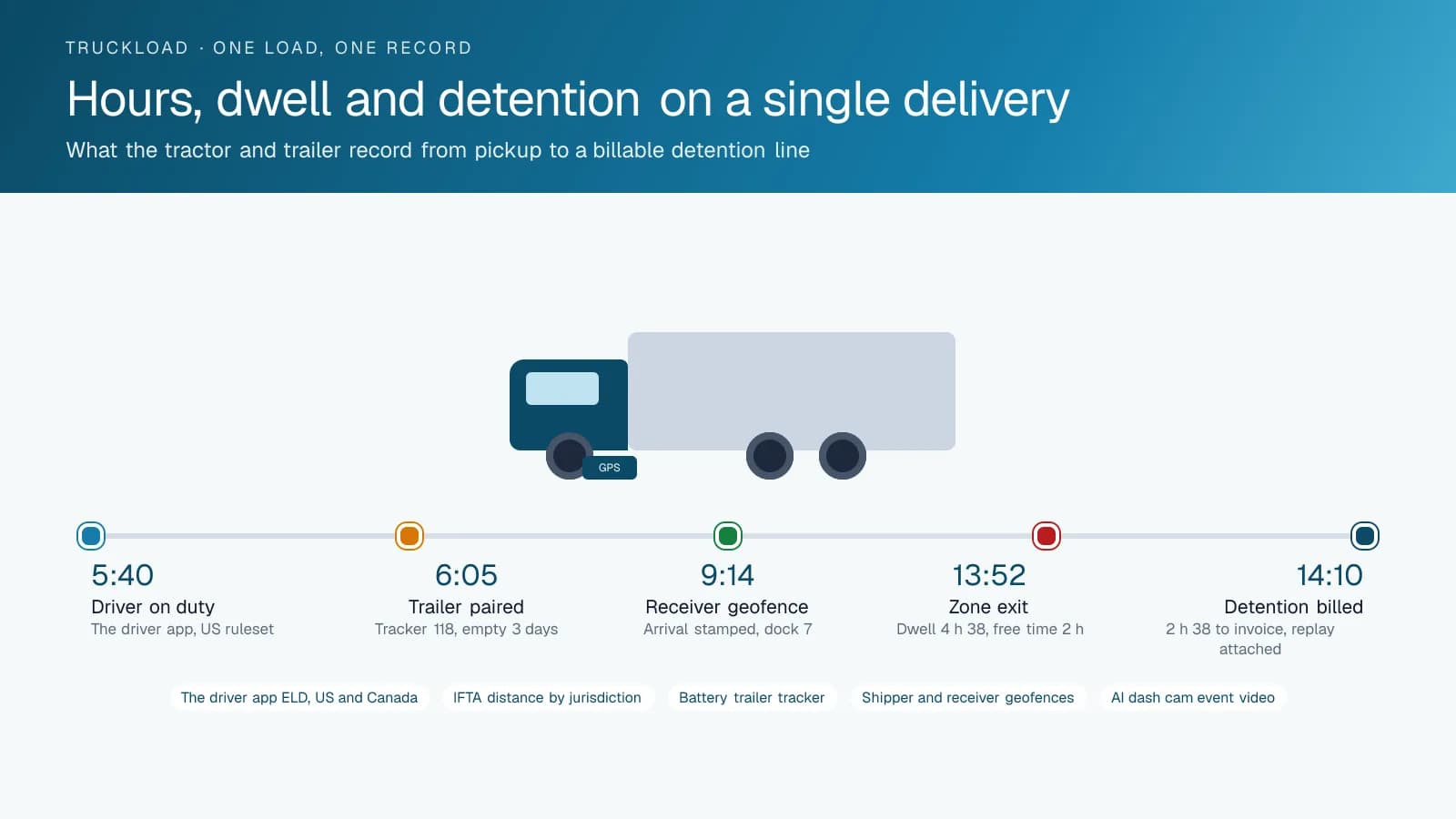
Detention is lost money when the only record is the driver's word. A geofence around every shipper and receiver stamps the time the tractor entered the yard and the time it left, and the difference minus the free time in the contract is the detention invoice. High Point GPS sets the geofences up from the customer list in the TMS and configures the report so that billing sees the dwell by stop each week. When a shipper disputes the charge, the trip replay shows the truck at the dock from 9:14 to 13:52. The same dwell data shows which customers cost the carrier the most time, which is the argument for a rate increase or for declining the freight.
Driver retention is the truckload carrier's hardest problem, and telematics can make it worse or better depending on how it is used. High Point GPS configures scoring so the driver sees their own scorecard on speed, harsh events, idling and fuel economy, compared to the fleet rather than to a target no one explained. A supervisor's coaching conversation starts from a specific event on a specific day, with the dash cam clip if there is one, and the drivers with the best scores are as visible as the ones with the worst. Carriers that pay a safety or fuel bonus draw it from the same record, and a driver who can see the number they are being paid on trusts it more.
Claims, fuel and the rest of the operation
A collision claim without video is settled on the other party's account. An AI dash cam in every tractor records the road ahead and, when the carrier chooses, the driver, and it uploads the clip around a harsh-braking or collision event on its own. The safety manager has the video before the driver has finished the phone call, and the claims adjuster has it the same day. Cargo claims use the same record: the trip replay shows whether the trailer was opened at an unplanned stop, and a door sensor through an IOX-AUXM input adds the time the doors moved. Event-based retrieval means a review is a few clips, not a day of footage.
Fuel is the largest controllable cost, and the platform reports it by driver, by lane and by tractor. Idling at the receiver, speed above the carrier's set limit and hard acceleration each show up as litres, and the fuel-card integration flags a purchase that does not match the tractor's location or tank size. Engine fault codes reach the shop as the tractor logs them, maintenance reminders run on engine hours and kilometres, and electronic DVIR in the driver app puts the pre-trip defect in front of the shop before the truck leaves the yard. The open API carries all of it into the TMS, the payroll system and the carrier's own dashboards.
Frequently asked questions
Does the ELD cover both US and Canadian hours-of-service rules?
Yes. The driver app is a certified ELD for both mandates, and it switches rulesets when a driver crosses the border. The driver sees remaining drive time and the next required break, and the safety manager sees every driver's hours, violations and unassigned driving segments from the office the next morning.
How does it produce the IFTA return?
The GPS tracking device records every kilometre with the jurisdiction it was driven in, and the High Point GPS platform totals distance by state and province per tractor for the quarter. A fuel-card integration matches purchases to trips. The quarterly report gives the distance and fuel figures the return needs, and the record stands up to an audit.
Can we track trailers that are not connected to a tractor?
Yes. Battery-powered trackers report each trailer's position on a schedule and more often when moving, without any connection to the tractor. The platform shows the tractor it is paired with, the location and the days it has sat, and a geofence records when it arrived at a customer yard and how long it has been there.
How does it help bill detention?
A geofence around every shipper and receiver stamps the arrival and departure of the tractor, and the dwell minus the contract's free time is the detention charge. The report gives billing the dwell by stop each week, and the trip replay is the evidence when a shipper disputes the invoice.
Will drivers accept dash cams and scoring?
Most do when the carrier is clear about how it is used. High Point GPS configures a driver-facing scorecard that compares each driver to the fleet, event-based video that is retrieved for incidents and coaching rather than watched continuously, and the option to run a road-facing camera only. The same record backs a safety bonus.
Related solutions
Related guides
- Hours of Service Rules Explained: The 11 and 14 Hour Limits →
- High Point GPS IFTA Reporting: How Automated Fuel Tax Reports Save Fleets Hours →
- Trailer GPS Tracking: How to Track Trailers With and Without a Truck Attached →
- Detention Time: What It Is, What It Costs, and How to Bill It With GPS Evidence →
- Dash Cam Footage and Insurance Claims →
- Driver Shortage 2026: Why Retention Matters More →
Get a free quote
What are you looking for?