
Industry
GPS Fleet Tracking for Vending & Micro-Market Route Service
GPS fleet tracking for vending operators: a service-visit record per location that proves an SLA, a time-and-place trail around cash handling, and routes measured across dozens of small stops.
Updated September 28, 2026
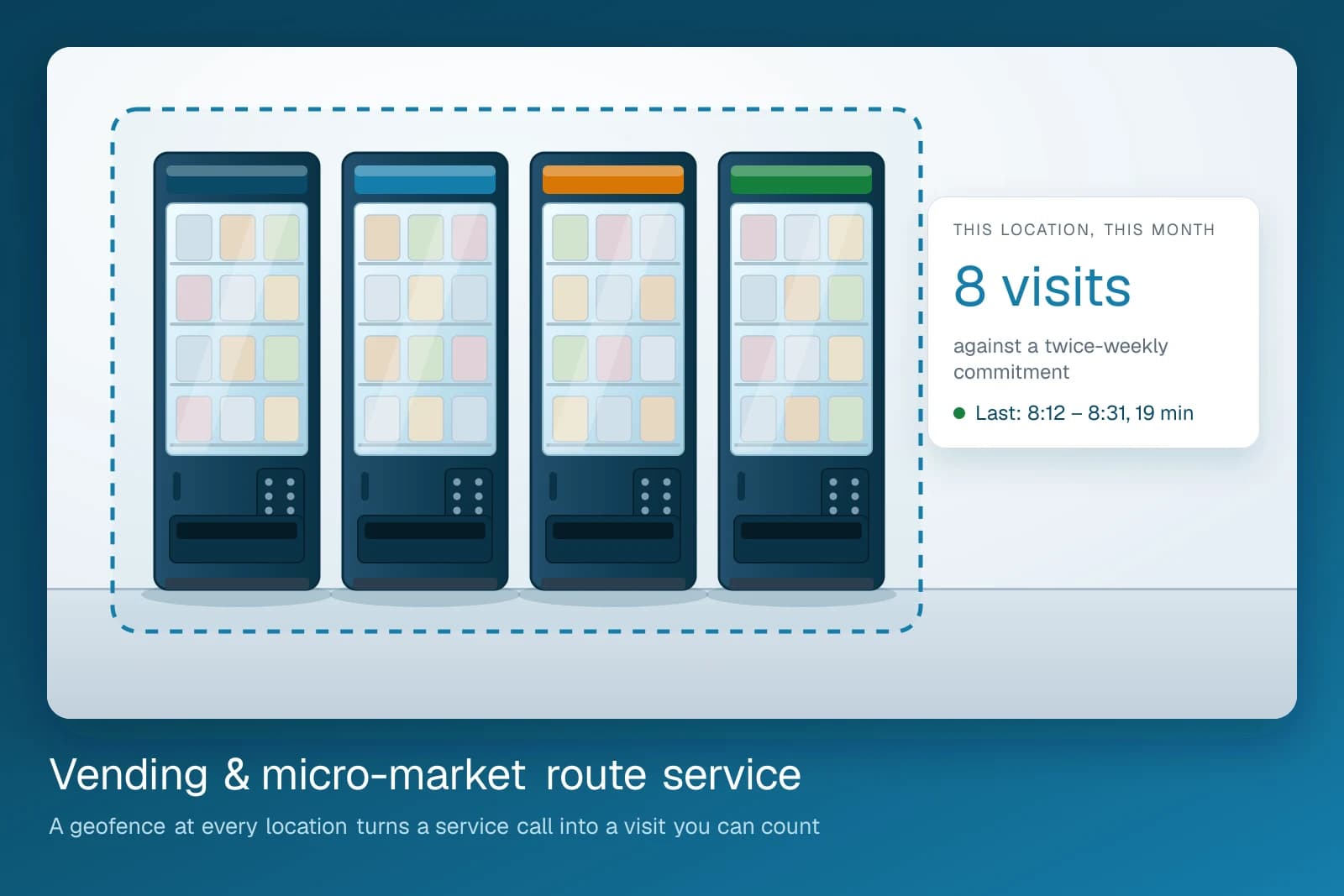
A vending operator's whole business is scattered across other people's buildings. The machines sit in factory break rooms, hospital corridors, school foyers and highway rest areas, and the entire service relationship with each of those locations rests on one question: did somebody come, and how often. GPS fleet tracking for vending route service answers it from the vehicle. A geofence around each location records the van arriving and leaving, which turns a contract that promises twice-weekly service into a countable record instead of an argument. The same data makes the route itself legible: thirty or forty small stops a day, most of them under fifteen minutes, spread across a service area that grew by acquisition and has never been rationalised. The High Point GPS platform reports stops per day, time on site per location and kilometres between them, so an operations manager can see which parts of the territory are being served economically and which are costing more to reach than the machines return. Driver ID through an NFC reader attributes each route to the person who ran it, which matters in a business where route drivers handle both product and, still in many operations, cash. The GPS tracking device plugs into the diagnostic port of a cargo van or box truck and reports on its own, and High Point GPS sets it up around the location list you already service.
Common challenges
- Location contacts who claim a machine sat empty for a week, with no record of when the route driver was actually there
- Service-level commitments in location contracts that nobody can evidence at renewal time
- Route drivers handling product and cash with no independent record of where the van was and for how long
- Territories assembled by acquisition, where nobody has measured which clusters of machines justify the drive to reach them
- Service calls for a jammed or dark machine that get promised same-day and dispatched to whoever answers the phone rather than whoever is closest
- Refrigerated and frozen product in the van on a long summer route, with no record of how long the doors were open or the van sat
How High Point GPS helps
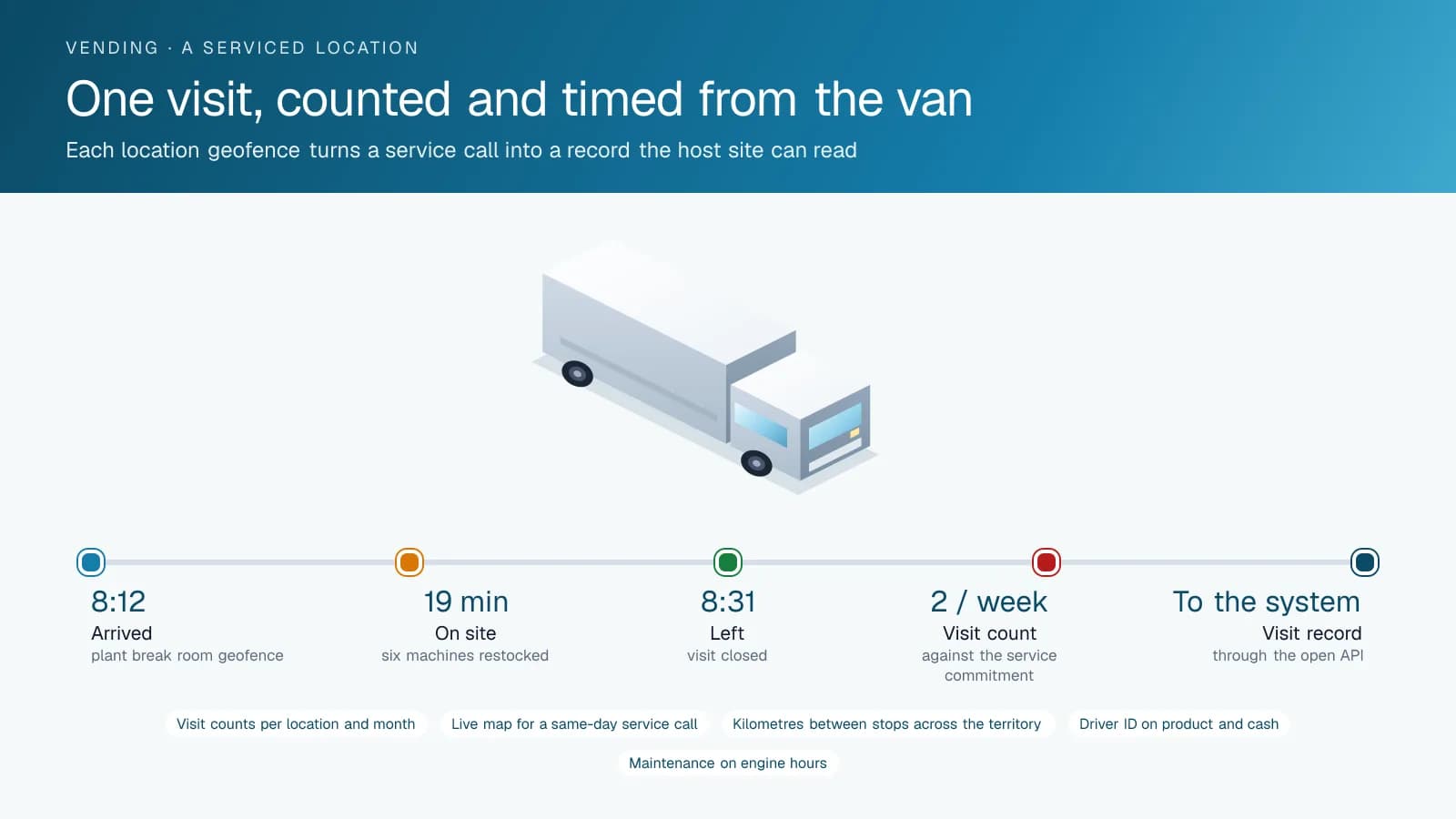
- A geofence per location that records every service visit with arrival time, departure time and duration
- Visit-count reports by location and date range, which is what a service-level commitment needs to be evidenced
- Live position of every van, so a same-day service call goes to the driver who can actually get there first
- Stops per day, time on site and kilometres between stops, by route, making territory economics visible
- Driver ID through an IOX-NFCREADERA reader, attributing each route and stop to the driver who ran it
- Trip replay for the stop-level questions that come up weeks later, from a shortage to a damaged machine
- Maintenance reminders on engine hours and mileage for vans doing many short stops, with fault codes to the shop
- Visit and stop data available through the open API, so the service record can reach your vending management system
Proving the visit to the location that hosts the machines
The relationship between a vending operator and a location is unusually fragile, because the location's whole experience of the service is whether the machine had what people wanted. A plant manager whose staff found the drink machine empty on Monday morning remembers that for months, and the operator's defence is usually a route driver's recollection. With a geofence around each location, every visit has an arrival time, a departure time and a duration, recorded from the van without the driver doing anything. A month's visits to a site are a number that can be put in front of the contact, and a commitment to service a location twice a week is either met or not on a record both parties can read.
That record is worth the most at renewal and at the point of a complaint. A location that believes it is being under-serviced, and an operator who believes the machines are being emptied faster than anyone predicted, are usually both partly right, and a visit history moves the conversation from impressions to a schedule that can be adjusted. Time on site adds a second dimension: a three-minute visit to a bank of six machines is a different event from a twenty-five minute one, and a run of very short visits at one location is worth understanding before the contact raises it. High Point GPS builds the geofences from your location list rather than asking someone to place them one at a time, and keeps them current as sites are added and lost.
Cash, product and the driver who handles both
Vending has been moving toward cashless for years and is still not there, and in most operations a route driver spends the day alone with saleable product and a bag of coin and small notes. Nobody wants a system that treats drivers as suspects, and the practical value of a vehicle record is nearly the opposite: it is the thing that clears a driver when a shortage at one location has to be explained. Driver ID through an IOX-NFCREADERA reader ties every route, stop and event to the person who ran it, so a discrepancy can be placed against a specific visit with a specific duration rather than against a week and a vague memory.
The same trail answers questions that have nothing to do with suspicion. A machine damaged in a lobby, a delivery door left open, a complaint about a van parked across a fire lane: each is a time and a place, and the trip record has both. Where an operator runs a cashless and telemetry-equipped estate, machine telemetry says what needs loading and the vehicle data says who went and when, and the two together describe a route far better than either alone. High Point GPS agrees the privacy settings and the reporting scope with the operator before any device is installed, and configures who in the business sees what.
Territory economics on thirty stops a day
Vending territories are rarely designed. They accumulate, usually through acquisition, and the result is a service area with dense clusters and long thin arms reaching out to a handful of machines somebody bought a decade ago. Because each stop is small, the cost of the driving is easy to lose: a route that makes thirty-five stops looks productive until you notice that eleven of them were reached by a sixty-kilometre round trip. The High Point GPS platform reports kilometres driven, kilometres between stops, stops per day and time on site per route, which is the data that tells you which end of the territory is paying for itself.
Once that is visible, the decisions available are concrete: re-sequence a route, move a cluster to a different day, change a service frequency at a distant site, or price a renewal to reflect what reaching it actually costs. The timeline map replays a driver's day, which frequently shows the cheapest improvement first, a route run in the order the location list was printed rather than the order the map suggests. For same-day service calls the live map does simpler work: a jammed machine at a hospital goes to the van that is fifteen minutes away rather than to the driver who happened to answer the phone. Where the operator runs vending management software, the visit and stop records are available through the open API so the two systems agree on what happened.
Vans, product and short-stop wear
A vending route van is loaded heavy, opened constantly, and driven in short bursts between stops, which is a duty cycle that wears a vehicle on hours rather than kilometres. The GPS tracking device reads engine hours, odometer and fault codes from the vehicle itself, and the High Point GPS platform schedules maintenance on whichever interval comes first. Brakes and driveline on a van that makes thirty-five stop-start cycles a day are not on the same clock as its mileage suggests, and the reminders can be set to reflect the way the vehicle is actually used.
Fault codes reach whoever handles the shop the day they appear, which on a route fleet with no spare van usually decides whether a repair is booked for the weekend or discovered on a Tuesday with a full load aboard. Electronic inspections in the driver app give a short pre-trip list built for this equipment, including the lift gate and the load restraints that keep product from shifting. Idling is worth watching in this work for a specific reason: a driver servicing a bank of machines in a hot loading bay often leaves the van running, and on a refrigerated route that is sometimes justified and sometimes simply habit. The report shows it per van and per driver, which is the only way to tell the two apart.
Frequently asked questions
Can we prove to a location that we serviced it as often as the contract says?
Yes. A geofence around each location records every arrival, departure and duration from the van automatically, and the platform reports visit counts per location for any date range. That is what turns a twice-weekly service commitment into something you can evidence at renewal or when a contact disputes it.
Does this work for routes with thirty or forty small stops a day?
It is built for exactly that. Stops are detected from the vehicle, so a fifteen-minute visit registers the same way a long one does, and the reports that matter on this kind of route are stops per day, time on site and kilometres between stops rather than total distance.
Our drivers handle cash. Is this about watching them?
In practice it more often clears a driver than implicates one, because a shortage can be placed against a specific visit of a specific duration instead of a vague week. Driver ID through an NFC reader attributes each route to a person. High Point GPS agrees the privacy settings and who sees which reports with you before anything is installed.
Can it help us decide which parts of the territory to keep?
That is one of its more useful outputs. The platform reports kilometres between stops and time on site per route, which exposes the long thin arms of a territory that were absorbed by acquisition and never reviewed. From there you can re-sequence, change a service frequency, or price the renewal to match what reaching the site costs.
Will it connect to our vending management system?
Trips, stops and geofence visits are available through the open API, so the visit record from the vehicle can reach the system that manages your machines and planograms. High Point GPS scopes that work with your software vendor.
Related solutions
Related guides
- How Geofencing Works for Fleet Tracking →
- Route Optimization Software Explained →
- IOX-NFCREADERA: Driver ID by NFC Tap, So Every Trip Has a Name on It →
- Timeline Map: Replaying a Trip Minute by Minute to Settle a Dispute →
- GPS Fleet Tracking for Small Business: What a 3 to 20 Vehicle Fleet Needs →
- Fleet Maintenance: Engine Hours vs. the Calendar →
Get a free quote
What are you looking for?