
Industries
Cold Chain Monitoring and Compliance for Food Fleets
Cold chain monitoring with GPS reports reefer temperature and location as you drive and alerts dispatch before a load is lost, for food fleet compliance.
What Does Cold Chain Compliance Ask of a Fleet?
For cold chain compliance, GPS cold chain monitoring puts a sensor in the reefer or cargo area that reports temperature continuously, ties each reading to a location and timestamp, and alerts dispatch as soon as a reading drifts out of the safe range. A failing compressor or a door left open too long becomes something you catch mid-route. Without it, you find out at delivery, which is where a cold chain tends to break quietly.
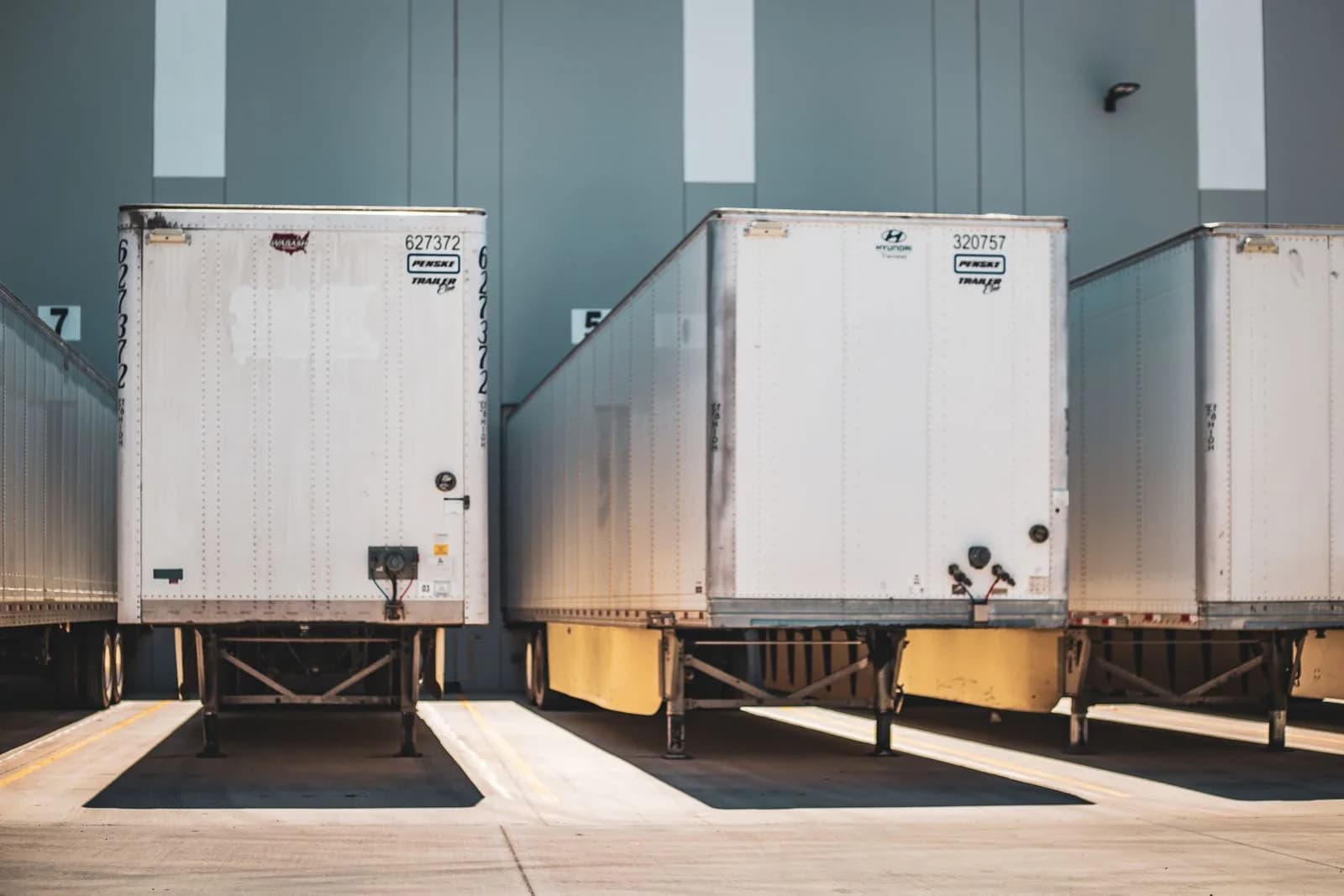
The cold chain is the unbroken run of proper temperature control a perishable product needs from origin to final destination. One weak link, such as a warehouse dock, a reefer trailer or a delivery stop where a door stays open too long, can compromise a load even when every other step went right. That single-point exposure makes cold chain management harder than ordinary logistics.
The distribution leg is usually the hardest part to control, because it gets the least direct human oversight. A warehouse has staff walking the floor and fixed refrigeration monitoring. A trailer on the highway between stops relies, for hours at a time, on equipment working with nobody watching.
Where Does the Cold Chain Break Down Most Often?
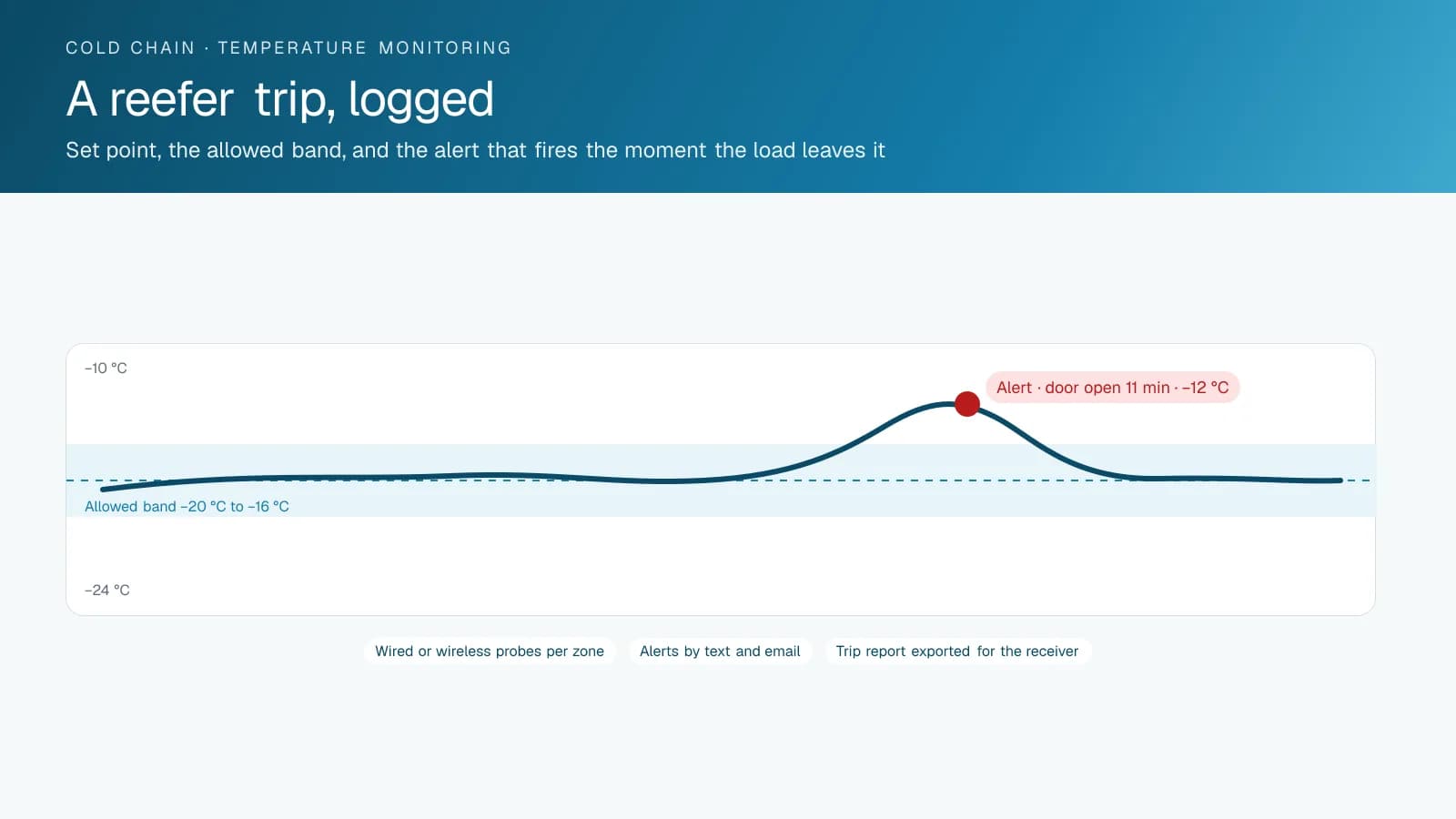
Three failures come up most. A reefer unit malfunctions mid-route and nobody notices until delivery. A trailer door stays open too long on a multi-stop route while crews load or unload. Or product goes on board without proper pre-cooling, so the reefer unit starts behind and spends the trip fighting to catch up. A manual temperature check at pickup and another at drop-off can miss all of these, because the failure can happen and reverse itself between checks, or start right after the last one.
Multi-stop routes need extra attention. Each stop is another door-open event and another chance for outside air to reach the load. A route with eight delivery stops carries far more cumulative door-open risk than a single direct run, even when both cover a similar distance and time.
What Does GPS Cold Chain Monitoring Track?
A temperature sensor paired with a GPS platform reports reefer or cargo-area temperature continuously, instead of at two checkpoints, and ties each reading to a location and timestamp. You set an alert threshold, and dispatch gets notified the moment a reading leaves the safe range. A problem you would have found at delivery becomes one you can react to mid-route, sometimes in time to save the load.
That reaction window is worth more than it looks. A dispatcher who hears within minutes that a reefer unit failed can reroute to a closer drop point, warn the receiving customer, or get a technician out before the product is a total loss. A dispatcher who finds out at delivery, when the driver opens the doors and the temperature log shows a problem from hours earlier, has no options left.
What Do Food Safety Regulations Require?
In the US, the FDA's Sanitary Transportation of Human and Animal Food rule, issued under the Food Safety Modernization Act, requires that food needing temperature control for safety travel at temperatures that keep it from becoming unsafe. If there is an indication that temperature control may have failed, the food can't be sold or distributed until a qualified individual determines it is still safe. The rule doesn't name electronic monitoring as the only compliant method. It does require you to know when temperature control has failed and to act on it, and continuous, alertable monitoring closes that gap far better than a manual spot-check schedule.
The rule also covers contamination risks beyond temperature, such as keeping ready-to-eat food from contacting raw food or non-food items in the same load. Temperature monitoring handles one major piece of sanitary transportation compliance and leaves the rest to you. Treat it as one part of a broader food safety practice. In Canada, the Safe Food for Canadians Regulations, administered by the CFIA, require the temperature in a conveyance where food is stored to be kept at levels appropriate for the food.
How Do You Build an Audit-Ready Temperature Record?
Larger buyers and retail customers can add their own pressure: some ask for documented proof of cold chain handling as a condition of doing business. A continuous, time-stamped temperature and location record for every trip lets you produce that proof on demand, instead of scrambling to reconstruct events after a buyer or auditor asks.
The same record protects your side of a dispute. If a customer claims a delivery arrived out of range and the data shows the load stayed in range for the whole route, you settle the disagreement fast and on objective evidence. Without the record, it comes down to the customer's word against the driver's.
Where Should a Mixed Fleet Start?
Most food and beverage distribution fleets run a mix of refrigerated and dry vehicles. Start by putting temperature sensors on the refrigerated side, where the compliance and spoilage exposure sits, and keep dry vehicles on standard GPS tracking on the same platform. You get fleet-wide visibility without paying for temperature monitoring on vehicles that carry nothing temperature-sensitive.
Within the refrigerated side, rank trailers by product risk instead of treating every reefer the same. A trailer that regularly hauls dairy or fresh proteins, with a tighter safe range and a shorter spoilage window, needs monitoring sooner than one that occasionally carries more temperature-tolerant packaged goods.
Temperature Bands and Alerts by Product
These are example starting configurations for common products. The alert delay stops a door opening from paging the dispatcher while still catching a compressor failure. Product specifications and the customer's contract set the real numbers.
| Product | Set point | Alert band | Delay before alert | Escalation |
|---|---|---|---|---|
| Frozen foods | −18 °C | −23 °C to −15 °C | 10 minutes | Driver, then dispatch |
| Fresh meat and poultry | 1 °C | −2 °C to 4 °C | 5 minutes | Driver and dispatch together |
| Seafood | 0 °C | −2 °C to 3 °C | 5 minutes | Driver and dispatch together |
| Dairy | 3 °C | 1 °C to 5 °C | 10 minutes | Driver, then dispatch |
| Produce | 4 °C | 1 °C to 7 °C | 15 minutes | Driver, then dispatch |
| Pharmaceuticals, cold chain | 5 °C | 2 °C to 8 °C | 2 minutes | Dispatch and quality lead immediately |
| Bakery and confectionery | 15 °C | 12 °C to 18 °C | 15 minutes | Driver |
Frequently asked questions
What temperature should a reefer trailer maintain?
It depends on the product. Frozen goods, fresh produce and dairy each have different safe ranges, so no single number works for every load. Set your monitoring system's alert range to match the specific product in the trailer, and use the product specification or customer contract where it calls for a tighter band.
Does FSMA require electronic temperature monitoring?
Not by name. The FDA's Sanitary Transportation Rule requires that temperature-sensitive food travel safely and that you act if temperature control fails, but the rule is risk-based and does not mandate one technology. Continuous electronic monitoring is a practical way to meet that requirement, because it tells you when control fails.
Can GPS tracking and temperature monitoring run on the same platform?
Yes. Temperature sensors connect to the same GPS device and dashboard you use for location tracking. A fleet running both refrigerated and dry vehicles sees all of it in one place, with temperature and location on the same record, and avoids running two separate systems.
Which vehicles should get temperature sensors first in a mixed fleet?
Prioritize by product risk, not only by which vehicles are refrigerated. Trailers that regularly haul products with tight safe ranges and short spoilage windows, such as dairy or fresh proteins, come before reefer units that mostly carry more temperature-tolerant goods. Dry vehicles can stay on standard GPS tracking.
Related solutions & products
Related terms
Continue reading
- Industries overview →
- GPS Fleet Tracking for Food and Beverage Distributors: Routes, Temperature and Delivery Windows →
- Bluetooth Temperature Sensor Puck: A Ten-Year Wireless Thermometer for Reefers and Coolers →
- Wired Reefer Temperature Monitoring for Multi-Compartment Refrigerated Trucks →
- One Bluetooth Gateway for Thirty Sensors on a Truck or Trailer →
- More in Industries →
Get a free quote
- Over 500 fleets
- Since 2013
- 4.9 on Google (19 reviews)
What are you looking for?
Prefer to talk?Call 1-800-613-6323[email protected]