
GPS Fleet Tracking & Telematics
Driver Safety Scorecard: How Driver Scoring Works for Fleets
A driver safety scorecard turns speeding, harsh braking and other telematics events into one score per driver. How driver scoring works and who to coach.

What Is a Driver Safety Scorecard?
A driver safety scorecard is driver scoring built on the risky-driving events your telematics already detects (speeding, harsh braking, hard acceleration, sharp cornering and, on some systems, seat-belt use), rolled into one comparable score per driver. In place of a pile of raw event counts, you get a ranked, like-for-like view of who drives safely and who doesn't. Most systems normalize the score by distance driven, so a high-mileage driver isn't penalized against a low-mileage one. That normalization makes the ranking fair, and drivers trust a ranking they see as fair.
The payoff is focus. You can't watch every vehicle all day, and most drivers are fine most of the time. A scorecard points you to the drivers and behaviours generating the most risk, so coaching time goes where it changes outcomes and isn't spread evenly across people who don't need it.
How Is a Driver Safety Score Calculated?
Each detected event carries a weight based on how strongly it correlates with real risk, and the system tallies events against distance or engine hours to produce the score. Speeding usually weighs heavily, since FMCSA's Large Truck Crash Causation Study found trucks travelling too fast for conditions in about a quarter of the crashes it examined. Many systems weigh harsh braking heavily too, and a good system lets you tune those weights for your operation. On camera-equipped vehicles, AI dash cams add context that motion data can't see, such as distraction and following distance. A scorecard built on telematics and video together catches risk that either source would miss alone.
Watch the trend more than any single day. A scorecard shows whether a driver is improving after coaching, holding steady or sliding, and whether the fleet as a whole is getting safer over time. One bad reading might be a legitimate emergency manoeuvre, so look at patterns across weeks before you react to an isolated event. Pairing scores with video also keeps you from coaching someone for a swerve that avoided a crash.
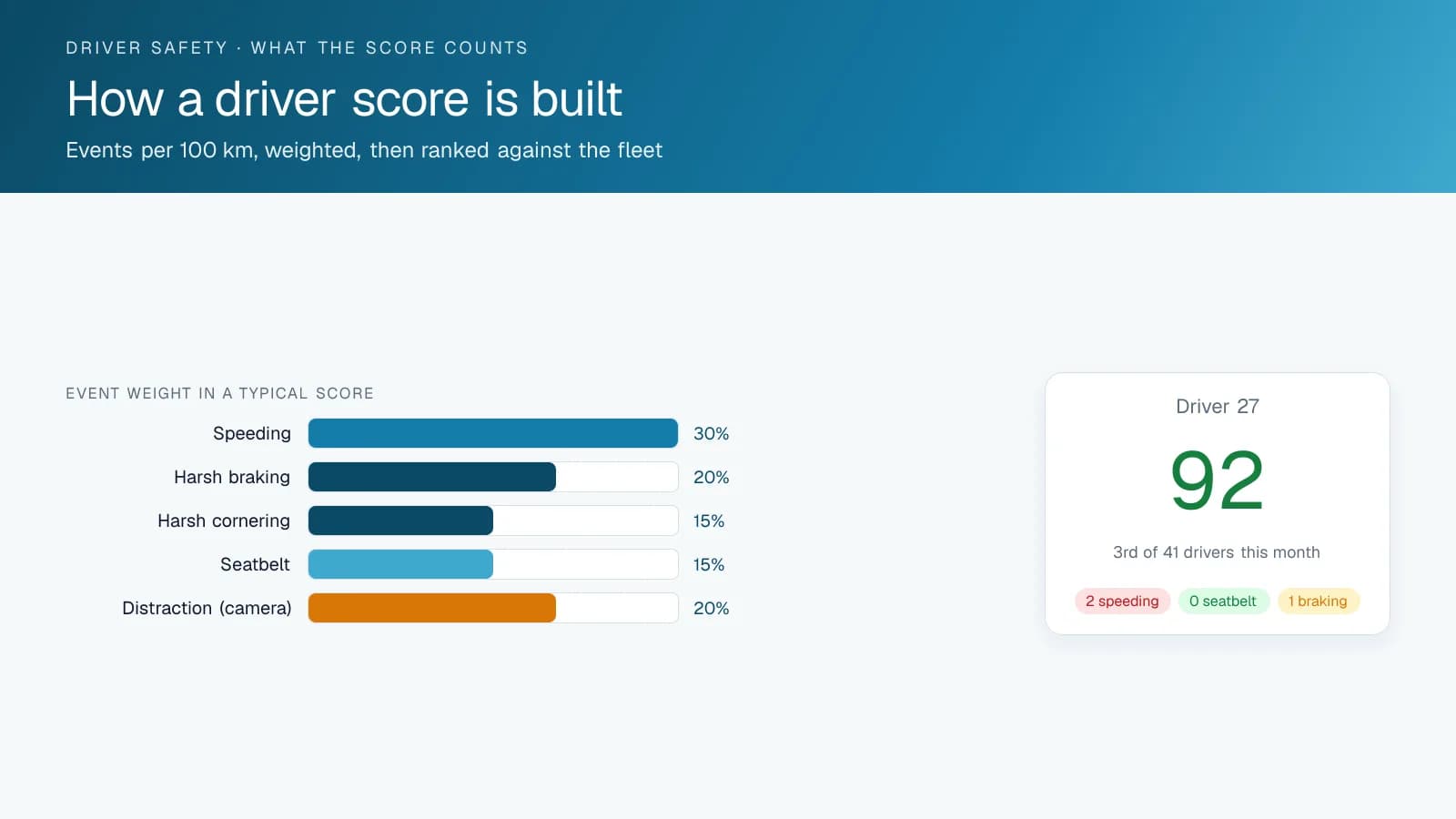
How Do You Use Driver Scoring Fairly?
The way you roll out a scorecard decides whether it helps or backfires. Run it as pure surveillance, ranked, punished and never explained, and it breeds resentment until drivers stop trusting the system. Run it in the open, where drivers see their own numbers, understand how the score is calculated and get coaching aimed at improvement, and they engage with it. Being explicit about what you measure and how you make coaching decisions separates a scorecard that raises safety from one that raises turnover.
The strongest programs pair scorecards with the safeguard drivers care about most: using the same data and video to defend them. A driver who has seen the system clear them of a false claim treats their scorecard very differently from one who has only seen it used against them. Recognize top scorers as well as correcting low ones. That keeps the focus on safer driving for everyone, which over time also protects your carrier safety record (the Unsafe Driving BASIC under the US CSA program, or in Canada your provincial carrier profile under the National Safety Code, such as the CVOR record in Ontario) and your insurance standing.
How to Read a Driver Scorecard
The table shows one driver's month on a scorecard, with the columns in the order a manager reads them.
| Measure | This month | Fleet average | Trend |
|---|---|---|---|
| Distance driven | 6,400 km | 5,900 km | |
| Speeding events per 100 km | 0.4 | 0.9 | Down from 1.1 |
| Harsh braking per 100 km | 0.6 | 0.5 | Flat |
| Harsh cornering per 100 km | 0.2 | 0.3 | Down |
| Seat belt events | 0 | 0.1 | Flat |
| Distraction events (camera) | 2 | 1.4 | Up from 0 |
| Following-distance events (camera) | 3 | 4.2 | Down |
| Score | 91 | 84 | Up from 86 |
| Rank | 4th of 32 | Up from 9th | |
| This month's conversation | The two distraction events, with clips; recognition for the speeding trend |
Frequently asked questions
What goes into a driver safety scorecard?
A scorecard combines telematics events such as speeding, harsh braking, hard acceleration and sharp cornering, usually normalized by distance driven so high-mileage drivers aren't penalized. On camera-equipped vehicles, AI dash cams add distraction and following-distance context that motion data alone can't capture, which gives the score a fuller picture of risk.
How is a driver safety score calculated?
The system weights each detected event by how strongly it correlates with real risk, then totals the events against distance or engine hours to produce a comparable score. Harsh braking and speeding usually weigh heavily, and good systems let you tune the weights to your operation.
Can driver scorecards hurt morale?
They can, if you use them purely as surveillance, ranking and punishing drivers without explanation. Used openly, with drivers seeing their own numbers, understanding the calculation, getting coaching aimed at improvement and seeing the data defend them against false claims, scorecards tend to build trust instead of resentment.
How do scorecards relate to my CSA score?
CSA is the US FMCSA program. A scorecard tracks the behaviours, such as speeding and unsafe driving, behind the roadside violations that feed your Unsafe Driving BASIC, so coaching flagged drivers protects your CSA percentile and insurance standing. In Canada, the same convictions and inspections feed your provincial carrier profile, such as Ontario's CVOR record.
Related solutions & products
Continue reading
- GPS Fleet Tracking & Management Software overview →
- What Is a Driver Safety Program? How Fleets Build One That Works →
- Driver Safety Course for Fleets: What It Costs and Which Kind Changes Behaviour →
- Driver Training Software vs Telematics Coaching: Which Changes Behaviour? →
- 4G Fleet Dash Cams as Driver Monitoring Cameras: How Behaviour Events Reach the Manager →
- More in GPS Fleet Tracking & Telematics →
Get a free quote
- Over 500 fleets
- Since 2013
- 4.9 on Google (19 reviews)
What are you looking for?
Prefer to talk?Call 1-800-613-6323[email protected]