
Video Safety & Dash Cams
4G Fleet Dash Cams With Driver Behaviour Monitoring: How the Events Reach the Manager
A 4G dash cam uploads a driver behaviour event within seconds of it happening, which is what turns a camera from a recorder into a coaching tool. Here's what a shift looks like through the camera and the telematics device together, how the events become a driver score, and what changes when the manager sees them the same day.
Why 4G Matters
Earlier fleet cameras recorded to a card, and the fleet saw the footage when someone pulled the card or the truck came within Wi-Fi range of the yard, days after the event. A 4G camera has its own LTE modem, or shares the GO device's, and uploads each event clip within seconds. The difference is not the video quality; it is that the manager sees a tailgating event from the morning run at lunchtime, and can talk to the driver that afternoon while the moment is still real to both of them. That immediacy is what makes behaviour monitoring a coaching program rather than an archive.
What a Shift Looks Like
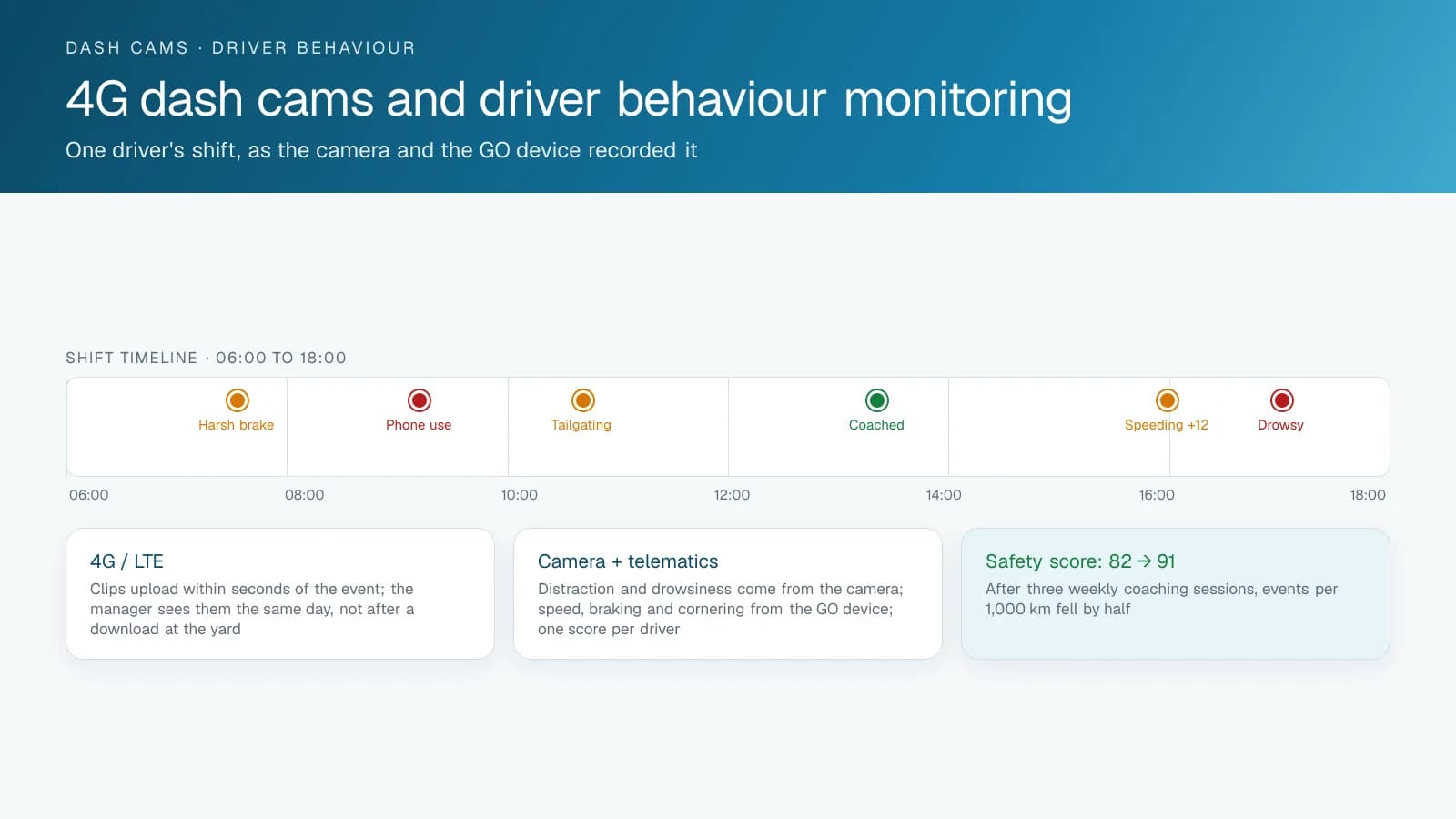
Take a twelve-hour delivery shift. At 7:12 the accelerometer in the GO device records a harsh brake, with the road camera clip showing the car that cut in — the driver did nothing wrong, and the clip says so. At 8:54 the driver-facing camera detects a phone in hand at a light and sounds an in-cab alert. At 10:24 the road camera flags following distance under a second on the highway. At 13:06 the manager reviews the morning's events and calls the driver; the phone and the tailgating get a two-minute conversation. At 15:36 the GO device records 12 km/h over the posted limit on a rural road. At 16:48 the camera's drowsiness detection fires near the end of the shift, and the driver takes a break. Six events, three from the camera and three from the vehicle's own data, on one timeline.
From Events to a Score
The platform weights each event type, normalizes by distance driven, and produces a safety score per driver, per week, comparable across the fleet. Camera events and telematics events count on the same score, which is why a camera that shares the GO device's data beats one that keeps its own: the score sees the whole picture. A driver at 82 with three coaching sessions over three weeks typically moves into the 90s, and the fleet's events per thousand kilometres fall by a third to a half over a quarter, which is the number the insurer asks for.
Running It Without Losing Drivers
The camera works when the policy is written down before it goes in, drivers know which events are reviewed and how, the clips that clear them are shown as readily as the ones that do not, and the best scores are recognized. Weekly review of a short list, not daily surveillance, is the routine that lasts. High Point GPS deploys 4G AI cameras integrated with MyGeotab for fleets in Quebec, Ontario and the northeastern US, and sets up the scoring and review with the fleet's safety lead.
Frequently asked questions
What does a 4G fleet dash cam do differently?
It uploads event clips over LTE within seconds, so a manager sees a driver behaviour event the same day and can coach on it while it is fresh, instead of after a card is pulled at the yard.
What driver behaviours does the camera monitor?
Distraction, phone use, drowsiness, seat belt and smoking from the driver-facing lens; following distance, forward collision risk, lane departure and rolled stops from the road-facing lens.
How does the driver score work?
Camera events and telematics events such as speeding and harsh braking are weighted, normalized by distance, and combined into one score per driver per week.
Does driver behaviour monitoring reduce collisions?
Fleets that review events weekly and coach typically see events per thousand kilometres fall by a third to a half within a quarter, with collision and claim rates following.
Will drivers accept the camera?
Usually, when the policy is clear, footage defends them as often as it coaches them, and the program recognizes good driving rather than only catching bad.
Related solutions & products
Continue reading
- Dash Cams & AI Video Safety overview →
- Best Dash Cam for Fleets: What to Look for Beyond Consumer Models →
- What Is a Driver Safety Program? How Fleets Build One That Works →
- Do Dash Cams Actually Lower Fleet Insurance Premiums? →
- What a Driver Safety Course Costs a Fleet, and Which Kind Changes Behaviour →
- More in Video Safety & Dash Cams →
Get a free quote
What are you looking for?