
GPS Fleet Tracking & Telematics
Geotab GO7 vs GO9: Why the GO7 Was Retired and What the GO9 Added
The GO7 was Geotab's workhorse for most of a decade, and the 3G shutdown ended it. Here's what a GO7 was, how the GO9 differs in network, positioning, processing and vehicle support, what a fleet still running GO7s should do, and where the GO9+ fits.
What a GO7 Was
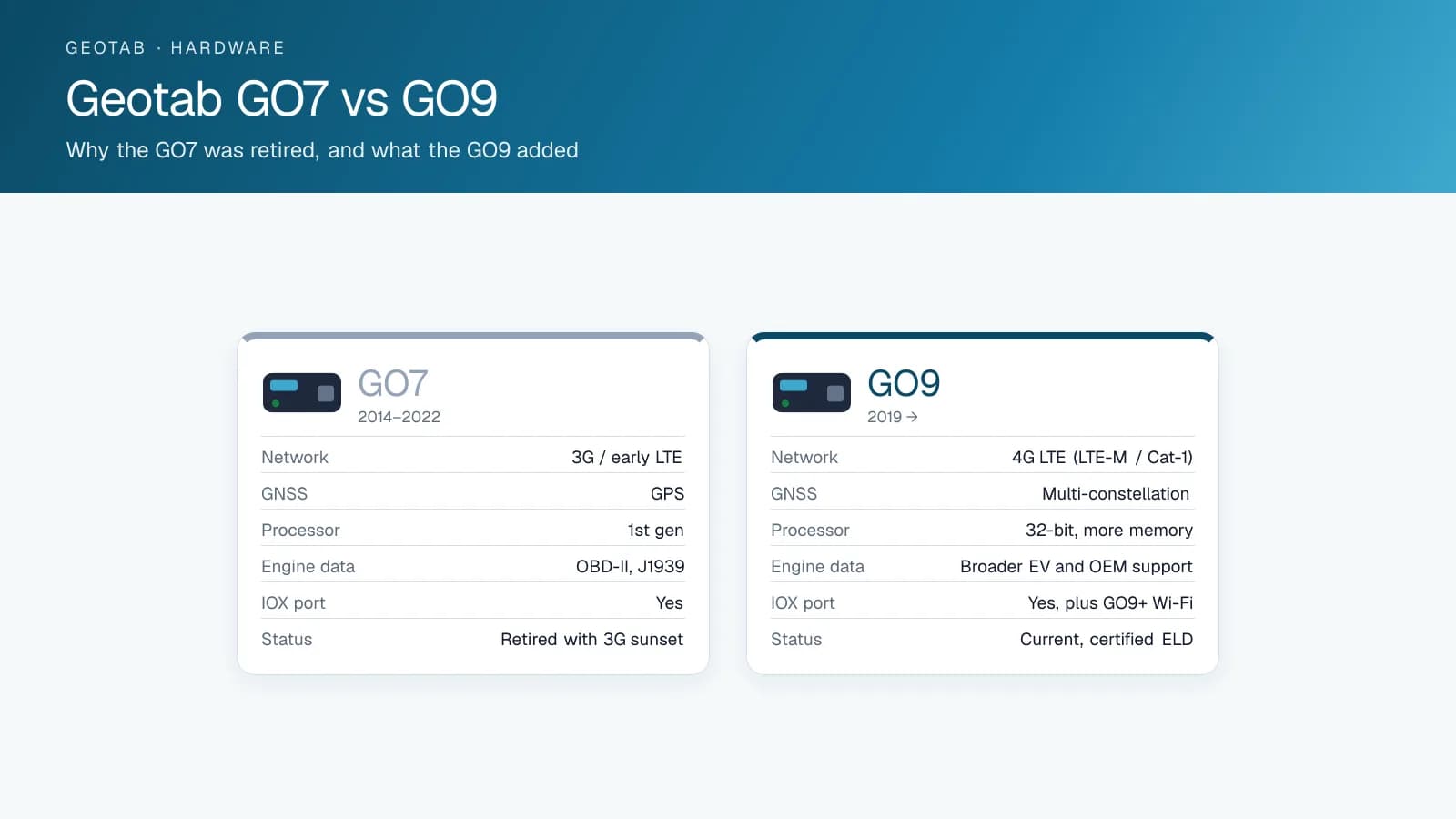
The GO7, introduced in the mid-2010s, was the device most fleets first met Geotab on: a plug-in telematics unit for the OBD-II or J1939 port with GPS, an accelerometer, engine data support and the IOX expansion port that later devices kept. Most GO7s used 3G cellular networks, with LTE variants arriving late in the model's life. It did the job well enough that many fleets ran the same units for seven or eight years.
Why It Was Retired
Carriers shut down their 3G networks — in the US through 2022 and in Canada by 2025 — and a 3G GO7 with no network is a device that logs but cannot report. Geotab ended support for the GO7 as the sunset arrived, and fleets replaced them under swap programs. A GO7 still in a vehicle today is either an LTE variant near the end of its supported life or a device that has not reported in a long time; either way it is not a device to build a compliance program on.
What the GO9 Added
The GO9, current since 2019, moved to 4G LTE with LTE-M and Cat-1 variants that will outlast the 3G sunset by many years. Its GNSS receiver uses multiple satellite constellations rather than GPS alone, which fixes position faster and more accurately in cities and under tree cover. A faster 32-bit processor with more memory runs the curve-logging algorithm and firmware features the GO7 could not, and the engine data support is broader, including electric vehicle state of charge and more OEM protocols. The IOX port is unchanged, so add-ons carry over. The GO9 is certified as a Canadian ELD with the Drive app; the GO7 never received that certification because the Canadian mandate arrived as it was being retired. The GO9+ adds built-in Wi-Fi hotspot capability and more processing for camera and add-in workloads.
What to Do With a GO7 Fleet
Replace them. The swap is a plug-out, plug-in on most vehicles, the MyGeotab database and rules carry over, and the vehicles' history stays attached to the units. A reseller does the swap at the yard and confirms each new device is reporting and, where it matters, on the certified ELD version. High Point GPS runs GO7-to-GO9 swaps for fleets in Quebec, Ontario and the northeastern US.
Frequently asked questions
What is a Geotab GO7?
Geotab's previous-generation plug-in telematics device, mostly on 3G networks, retired as carriers shut 3G down. It had GPS, an accelerometer, engine data and the IOX port.
What is the difference between GO7 and GO9?
The GO9 uses 4G LTE, multi-constellation GNSS, a faster processor with more memory, broader engine and EV support, and is certified as a Canadian ELD. The IOX port is the same.
Does the GO7 still work?
3G units cannot report on networks that have shut down. LTE variants may still report but are at the end of support. Fleets should replace them.
Is the GO7-to-GO9 swap hard?
No. It is a plug-out, plug-in on most vehicles, the database carries over, and a reseller does it at the yard.
What is the GO9+?
A GO9 variant with a built-in Wi-Fi hotspot and more processing for cameras and add-ins.
Related solutions & products
Continue reading
- GPS Fleet Tracking & Management Software overview →
- How Does the Geotab GO Device Work? From the Diagnostic Port to the Dashboard →
- What Is a Telematics Control Unit (TCU) in a Commercial Vehicle? →
- Telematics vs GPS Tracking: What's the Difference? →
- What Does the Geotab GO Device Actually Track? →
- More in GPS Fleet Tracking & Telematics →
Get a free quote
What are you looking for?