
Video Safety & Dash Cams
Side Cameras for Trucks: How Fleets Cover the Blind Spots Mirrors Miss
Side cameras for trucks cover the blind spots mirrors miss in lane changes, right turns and backing. What the research shows and how to plan the cameras.
What Do Side Cameras for Trucks Do?
Side cameras for trucks record, and can show the driver, the areas beside the cab and trailer that mirrors leave uncovered, which is where lane-change, right-turn and backing incidents happen. Paired with a road-facing dash cam and a rear camera, they give a fleet video of the whole vehicle, the setup vendors call a 360° view.
The problem they address is well documented. FMCSA says large trucks and buses have huge blind spots, or No Zones, around the front, back and sides, and tells other drivers that if they cannot see the truck driver in the side mirror, the driver cannot see them. In its guidance for truck drivers, FMCSA adds that one-third of all crashes between large trucks and cars take place in the No-Zone.
Where Are a Truck's Blind Spots?
Quebec's SAAQ describes three zones on a straight truck. At the front, the longer the hood, the bigger the blind spot, and a small car can hide in it. On the sides, the driver has to rely on the mirrors alone. At the rear, the blind spot is very long, which is why the SAAQ tells road users to stay alert when a truck backs up. The windshield pillars and the mirrors themselves create more blind spots.
The right side causes the most harm in cities. The SAAQ says most crashes involving a pedestrian or cyclist happen at urban intersections, and that the front and right-side blind spots are particularly problematic. A Transport Canada review of truck collisions with vulnerable road users, presented in 2018, reached a similar finding: the incidents typically involved a low-speed turning manoeuvre, and the first point of contact was commonly the front or right side of the truck. It also noted that almost every truck had mirrors exceeding the CMVSS 111 requirements, yet blind spots still existed.
Which Incidents Happen in a Truck's Blind Spots?
Three kinds of incident come up again and again. The first is the side-swipe during a lane change or merge. FMCSA cites the Large Truck Crash Causation Study, which found that 14 percent of large-truck crashes were due to the truck driver's inadequate surveillance. FMCSA also reports that seventy-five percent of lane change and merge crashes involve a recognition failure by the driver who changed lanes, and that over 90 percent of those drivers were in passenger vehicles. Side camera video is often what shows who moved into whom.
The second is the right turn. A truck swings wide to make a right turn, and the SAAQ warns that a cyclist or car that pulls up on its right ends up in the blind spot, where the driver can no longer see it. The third is backing: FMCSA reminds pedestrians that truck drivers often cannot see directly behind their vehicle. Rear cameras and blind spot cameras along the trailer cover these last two cases.
Do Blind Spot Cameras Reduce Crashes?
The strongest peer-reviewed numbers come from passenger vehicles. An IIHS study published in 2017 found that rearview cameras reduced backing crash involvement rates by 17%. A 2018 IIHS study of blind spot monitoring found lane-change crash rates 14% lower in equipped vehicles. We found no peer-reviewed study that puts a crash-reduction figure on camera systems in heavy trucks, so treat any vendor percentage you hear with care.
Regulators have accepted cameras as a substitute for mirrors in one case. In 2019, FMCSA granted Stoneridge an exemption that lets motor carriers run its MirrorEye camera monitor system in place of the two rear-vision mirrors required by 49 CFR 393.80. FMCSA found that the system eliminates the blind spots on both sides created by the mirrors and expands the field of view by an estimated 25 percent. The exemption covers only that product, and FMCSA renewed it to February 12, 2029. Recording cameras do a different job: they keep the evidence when an incident happens anyway.
Mirrors, Side Cameras or a Full Truck Camera System?
Each option below covers a different part of the problem. Most fleets end up combining well-adjusted mirrors with recording cameras, and the right number of cameras depends on where your incidents and claims actually happen.
| Option | What it covers | What it leaves out | Often suits |
|---|---|---|---|
| Mirrors only, kept clean and adjusted | The view required by law; New York City requires crossover mirrors on conventional-cab trucks over 26,000 lbs. | Blind spots remain, and nothing is recorded | Every vehicle, as the baseline |
| Road-facing and driver-facing dash cam | The road ahead and the cab | The sides and rear of the vehicle | Vans and pickups where most risk is in front |
| Dash cam plus a rear camera | Backing and the road behind | The sides of the cab and trailer | Delivery vans and straight trucks that back into docks |
| Full truck camera system with side cameras | Front, cab, both sides and rear, for a 360° view | Areas outside each camera's field of view | Tractor-trailers, city trucks with frequent right turns, buses |
Where Should You Put Side and Rear Cameras?
Start with the right side, then the rear, then the driver's side. In Canada and the US, the right side is where turning trucks meet cyclists and pedestrians, the rear is where backing incidents happen, and the driver's side matters most for lane changes on highways. Check that each camera sees the full length of the trailer: in an FMCSA field test of a truck blind spot warning system, the detectors did not cover the rear two-thirds of the trailer.
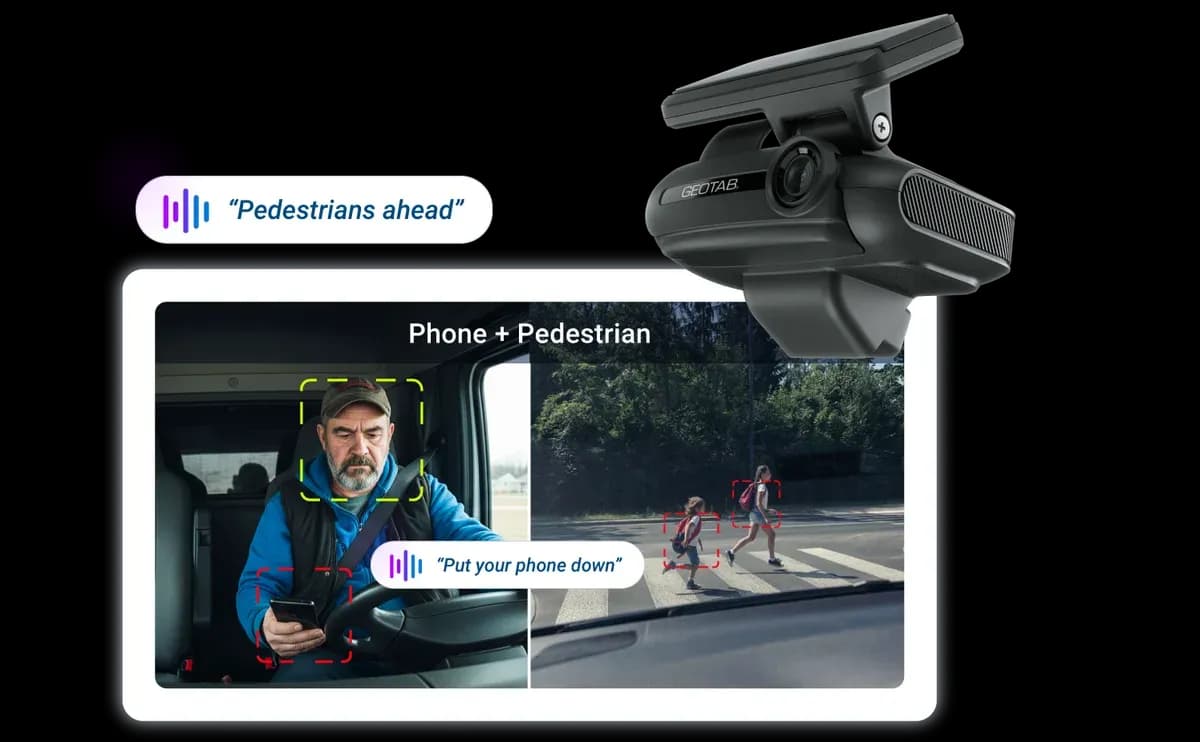
The GO Focus Pro takes up to 4 side or external rear cameras for a 360° view, plus 1 additional rear camera, on top of its built-in road camera and, on the dual model, a cabin camera. Its side cameras come in small and large versions, and the rear camera comes in a standard version and an IP69K external version. A fleet can mount cameras itself, but we always recommend a professional installer, because a camera placed by habit can miss the angle that mattered on the day of the incident.
Adding Blind Spot Cameras With High Point GPS
For trucks, the GO Focus Pro is the camera system we install for side and rear coverage. Geotab lists pre-collision and forward collision warnings, pedestrian, motorcycle and traffic light detection, dual SD slots for up to 2 TB of video, and event video kept in the platform for 365 days by default. For vans and pickups that mainly need the road, the cab and a backing view, the GO Focus Plus dual dash cam takes an optional rear auxiliary camera.
High Point GPS is a Montreal fleet telematics company and Geotab partner, founded in 2013 and serving over 500 fleets in Canada and the United States, in English and French. We plan the camera layout for each vehicle type with you, install with professional installers across North America, and bring the video into the same platform as your GPS tracking. Plans are 3-year contracts with free equipment, bonuses, add-ons, custom plans and bundles. Use the free quote form on this page and tell us which vehicles you run.
Frequently asked questions
Where are the blind spots on a semi truck?
A semi truck has blind spots at the front, along both sides and behind the trailer. FMCSA calls them No Zones and says that if you cannot see the driver in the side mirror, the driver cannot see you. Quebec's SAAQ adds that the front and right-side blind spots cause the most trouble with pedestrians and cyclists at urban intersections.
Do side cameras replace mirrors on a truck?
Usually not. Federal rules in the US still require two rear-vision mirrors on trucks. FMCSA has granted one exemption, for the Stoneridge MirrorEye camera monitor system, which lets carriers use that specific system in place of mirrors until February 12, 2029. Other recording side cameras add coverage and evidence alongside the mirrors.
How many cameras does a truck need for a 360° view?
It depends on the vehicle, but a common layout is a road-facing camera, cameras on both sides and a rear camera. The GO Focus Pro accepts up to 4 side or external rear cameras for a 360° view, plus 1 additional rear camera, on top of its built-in road camera. Planning the layout per vehicle type matters more than the camera count.
Do blind spot cameras lower crash rates?
Research on passenger vehicles says they help. IIHS found that rearview cameras reduced backing crash involvement rates by 17% and that blind spot monitoring cut lane-change crash rates by 14%. No peer-reviewed study we found gives a crash-reduction figure for camera systems on heavy trucks, so rely on your own claims history to judge the benefit.
Sources
- FMCSA, Tips for Driving Safely Around Large Trucks or Buses (PDF)
- FMCSA, CMV Driving Tips: Inadequate Surveillance
- FMCSA, Tips for Bicyclists and Pedestrians
- Federal Register, FMCSA exemption for the Stoneridge MirrorEye camera monitor system (2019)
- Federal Register, Stoneridge MirrorEye exemption renewal (2024)
- FMCSA, Field study of a heavy-truck blind spot warning system (PDF)
- IIHS, Cicchino (2017), rearview cameras and backing crashes
- IIHS, Cicchino (2018), blind spot monitoring and lane-change crashes
- SAAQ, Visibilité en présence d'un véhicule lourd
- SAAQ, Angles morts et pratiques dangereuses
- SAAQ, Partage de la route avec les véhicules lourds (PDF)
- Transport Canada, truck safety and vulnerable road users (2018 presentation, PDF)
- US DOT Volpe Center, Truck Sideguards for Vision Zero (PDF)
- Geotab, GO Focus Pro
- Geotab, GO Focus Pro technical specifications
- Geotab, GO Focus Plus
Related solutions & products
Continue reading
- Dash Cams & AI Video Safety overview →
- Fleet Dash Cams Compared: Samsara, Motive, Lytx, Netradyne and Geotab GO Focus →
- Dual Dash Cam with AI: How the Dual Dash AI Camera Coaches in the Cab →
- Driver Safety Scorecard: How Driver Scoring Works for Fleets →
- Who Owns Your Fleet Telematics Data? →
- More in Video Safety & Dash Cams →
Get a free quote
What are you looking for?