
GPS Fleet Tracking & Telematics
What Does the GPS Tracking Device Actually Track?
Location, yes — but the GPS tracking device's value is in what it reads from the engine and what it infers from motion. Here is a plain list of what it records, what it does not, and what each data point is used for.
Three Sources of Data in One Box
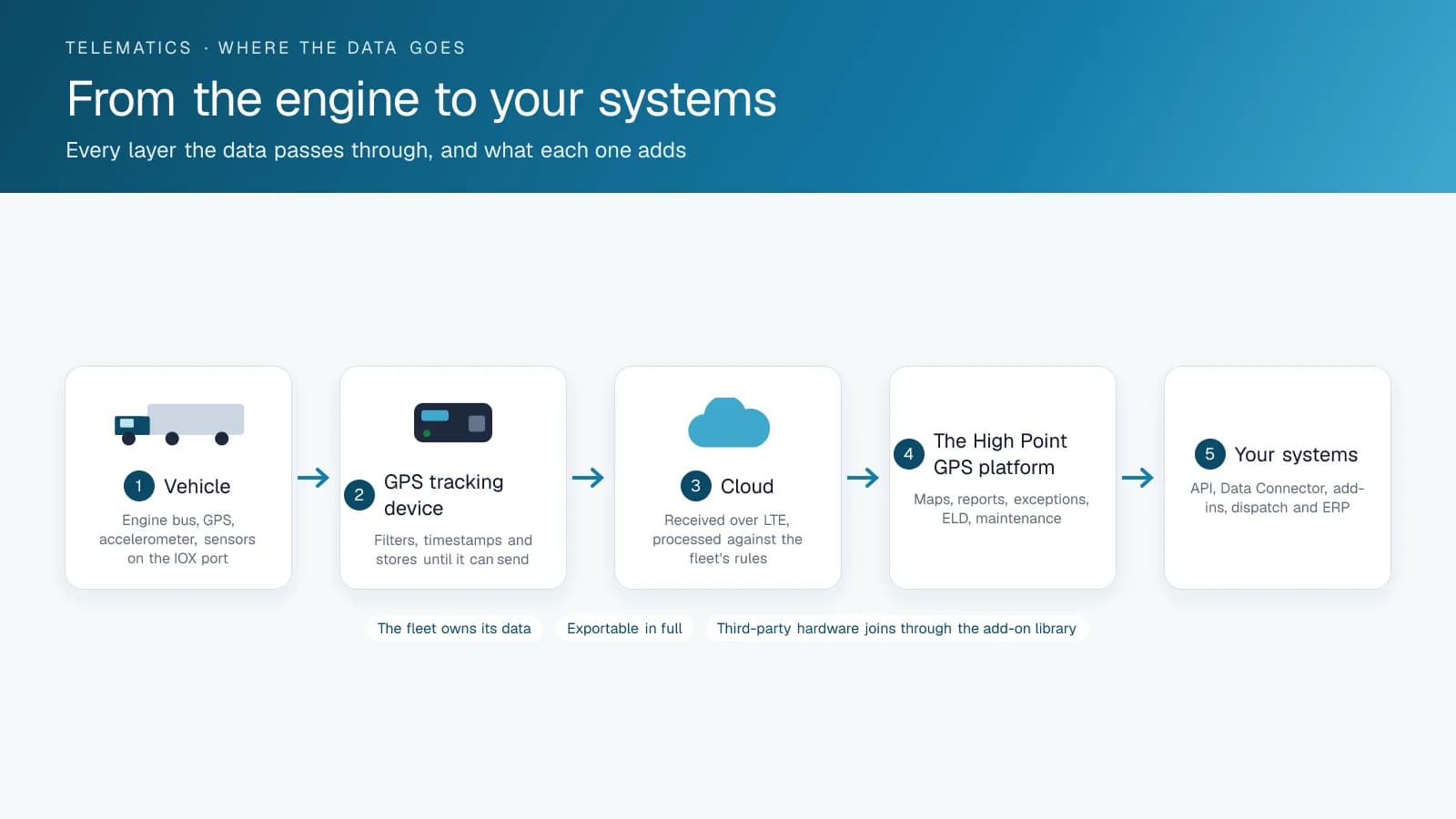
The GPS tracking device combines a GNSS receiver, an accelerometer, and a connection to the vehicle's onboard diagnostics. Each produces a different kind of data. The receiver gives position, speed and heading. The accelerometer gives motion — braking, acceleration, cornering, impacts — independent of the engine. The diagnostic connection gives what the vehicle itself knows: engine on and off, RPM, odometer, fuel, fault codes, and hundreds of other parameters depending on the make. Most of what a fleet uses is one of these three, or a rule combining them.
What It Records
The core data points, and the job each one does.
| Data | Source | Used for |
|---|---|---|
| Position, speed, heading | GNSS | Live map, trip history, geofences, speeding, IFTA distance |
| Ignition on/off, engine hours | Diagnostics | Trip boundaries, utilization, maintenance intervals |
| Odometer | Diagnostics | Service scheduling, IFTA, cost per km |
| Idling | Diagnostics + GNSS | Fuel programs; engine on, vehicle stationary |
| Fuel level and consumption | Diagnostics, where the vehicle reports it | Fuel reports, fuel-card reconciliation |
| Fault codes | Diagnostics | Maintenance alerts, roadside breakdown avoidance |
| Harsh braking, acceleration, cornering | Accelerometer | Driver scorecards, coaching |
| Collision detection | Accelerometer | Incident alerts, video request from a paired camera |
| Seat belt, where reported | Diagnostics | Safety rules |
| Battery voltage | Device | Vehicle and device health |
| Driver identity | IOX add-on (key fob or app) | Assigning trips and behaviour to a person |
| Temperature, PTO, auxiliary inputs | IOX add-ons | Reefers, equipment use, door sensors |
What It Does Not Record
The GPS tracking device has no microphone and no camera. It does not record audio, video or anything said in the cab; video comes only from a separate camera connected through the IOX port, and that camera's recording rules are configured by the fleet. It does not read the driver's phone. It does not track a person when they are not in the vehicle. And during personal conveyance, the ELD record stores location at reduced precision, though the fleet's own map still shows the vehicle.
It also only knows what the vehicle tells it. Fuel level, seat belt and some engine parameters depend on the make and model exposing them; an older or unusual vehicle may report fewer of them, which is worth checking for a specific vehicle before promising a specific report.
How Often, and How Accurately
The device does not log at a fixed interval. It records a point whenever the vehicle's motion changes enough for a straight line between points to misrepresent the path — the platform's curve-based logging — which keeps the trip shape accurate on corners without flooding the record with identical highway points. Position accuracy is the receiver's, typically within a few metres in open sky and worse in dense urban canyons or under cover. Data reaches the platform over cellular in near real time and is buffered on the device when there is no signal, then sent when it returns.
Why It Matters Which Data You Use
Two fleets with the same devices can get very different value from them, and the difference is which data they act on. Position alone answers 'where is it'. Engine hours and fault codes answer 'when will it break'. Idle time answers 'where is the fuel going'. Accelerometer events answer 'who needs coaching'. The device records all of it from the day it is installed; a fleet that starts with the map and never opens the rest is using a fraction of what it paid for.
How Each Data Point Gets Used
The device records dozens of parameters; a fleet acts on a handful. These are the ones that drive most reports and rules, and the decision each supports.
| Data point | Source | What fleets do with it |
|---|---|---|
| Position and speed | GNSS receiver | Live map, trip history, geofences, speeding rules, IFTA distance |
| Harsh braking, acceleration, cornering | Accelerometer | Driver scorecard, coaching, collision detection |
| Engine on and off | Diagnostic bus | Idle time, engine hours, utilization |
| Odometer | Diagnostic bus | Maintenance intervals, cost per kilometre |
| Fuel level and fuel used | Diagnostic bus | Fuel economy, fuel card reconciliation, theft |
| Fault codes | Diagnostic bus | Shop tickets, predictive maintenance |
| Seat belt | Diagnostic bus where exposed | Safety rules and in-cab alerts |
| State of charge and charging | Diagnostic bus on EVs | Range, charging schedules, EV suitability |
Frequently asked questions
Does the GPS tracking device record audio or video?
No. It has no microphone or camera. Video comes only from a separate camera connected through the IOX port, with recording rules the fleet configures.
Does the GPS tracking device track drivers when they are not driving?
It tracks the vehicle, not the person. When a driver leaves the vehicle it records nothing about them, and during personal conveyance the ELD record stores location at reduced precision.
How does the GPS tracking device know a vehicle is idling?
From the engine diagnostics (engine running) combined with GNSS (vehicle stationary). Idle time is one of the most used reports because it is measured directly and maps straight to fuel.
Does every vehicle report fuel level and seat belt?
No. Those depend on the make and model exposing them over diagnostics. Most modern vehicles do; older or unusual ones may not, so check a specific vehicle before relying on a specific report.
Related solutions & products
Related terms
Continue reading
- GPS Fleet Tracking & Management Software overview →
- How Does the GPS Tracking Device Work? From the Diagnostic Port to the Dashboard →
- Previous vs Current GPS Tracking Device: Why the Older Model Was Retired and What the New One Added →
- PTO On/Off Reader: Proving the Winch Ran, for Tow Billing and Hydraulic Maintenance →
- GPS Equipment Tracking: How It Works and Costs →
- More in GPS Fleet Tracking & Telematics →
Get a free quote
What are you looking for?