
Compliance
What Is IRP? Apportioned Registration and Apportioned Plates Explained
An apportioned plate means a truck is registered under IRP: one plate and cab card for 59 US and Canadian jurisdictions, with the fee split by distance.

What Is Apportioned Registration Under IRP?
IRP, the International Registration Plan, is apportioned registration: it lets a carrier register a truck once, in its base jurisdiction, and run it across North America on one apportioned plate and one cab card. The cab card lists every jurisdiction the vehicle may operate in. Before IRP, a truck that ran through six states needed six registrations, or a stack of trip permits bought at each border. Since the Full Reciprocity Plan took effect in 2015, the cab card covers all of them: every apportioned vehicle is registered for the 48 contiguous states, the District of Columbia and the ten Canadian provinces, whether or not it ever goes there.
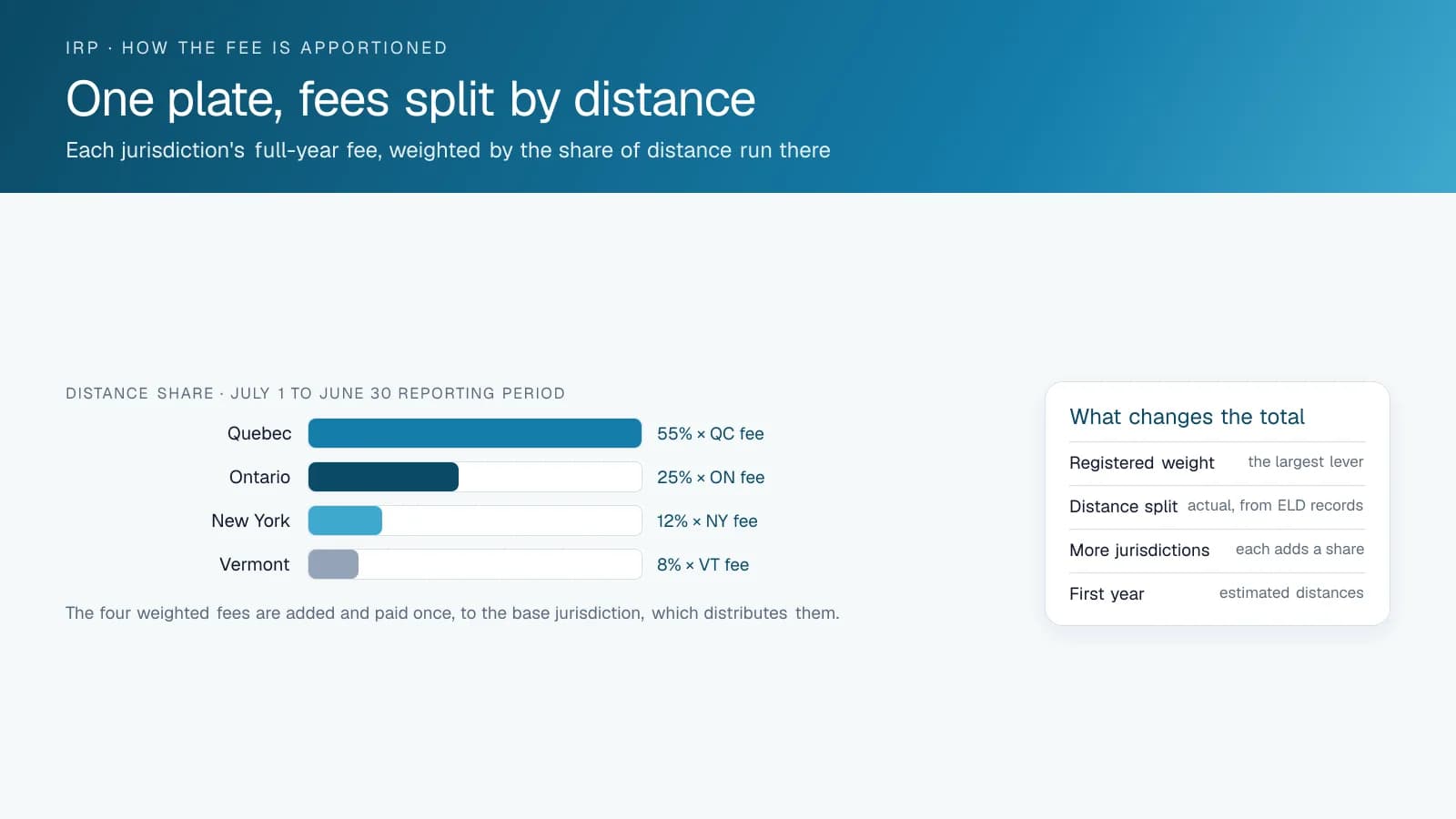
The fee is the apportioned part. Each member jurisdiction sets its own registration fee for a vehicle of a given weight. Your base jurisdiction works out your total by multiplying each jurisdiction's fee by the percentage of your fleet's distance travelled there, then passes the money on to the other members. A tractor that runs 60% of its miles in Ontario, 30% in Quebec and 10% in New York pays 60% of Ontario's fee, 30% of Quebec's and 10% of New York's, all on one invoice.
How Is IRP Different From IFTA?
IRP and IFTA are separate agreements run by separate agencies, and carriers hold both. IFTA covers fuel tax: it settles the per-litre or per-gallon tax owed to each jurisdiction, and you file it quarterly with a revenue or finance department. IRP covers registration: it apportions the annual plate fee, and you renew it once a year with a motor vehicle or transportation department. Both use the same threshold (over 26,000 pounds gross or registered weight, or three or more axles, operating in two or more member jurisdictions), and both need distance by jurisdiction. They read that distance differently. IFTA wants the quarter just ended, while IRP wants a twelve-month reporting period ending the June 30 before the registration year begins.
In Quebec, the SAAQ administers IRP and Revenu Québec administers IFTA. In Ontario, ServiceOntario has handled IRP since March 3, 2025, and the Ministry of Finance handles IFTA. In most US states the DMV runs IRP and the revenue department runs IFTA, although Florida, Virginia and Vermont run both out of the DMV. Miss your IFTA filings and your IRP renewal can be held, so in practice the two are linked even where the law keeps them apart.
Where Does IRP Distance Come From?
Your IRP renewal is built on a distance schedule: actual distance in each jurisdiction during the reporting period, for every vehicle in the fleet. A first-year registrant with no history uses the average per-vehicle distance chart published by IRP, Inc. instead. From then on, the fleet reports its own numbers, and the base jurisdiction can audit them for three years after the close of the registration year they support. Auditors look for individual vehicle distance records: trip-level distance by jurisdiction, tied to a unit, a date and a route.
IFTA audits ask for that same record, and telematics produces it as a report. A GPS tracking device logs each vehicle's position continuously, the platform assigns every stretch of travel to the province or state where it happened, and you pull the distance-by-jurisdiction report for any period, an IFTA quarter or the IRP reporting year, from the same data. Fleets that rebuild IRP distance from trip sheets once a year have a harder time showing an auditor the vehicle-level records behind their apportioned fees.
What Happens at the Roadside?
An apportioned vehicle carries its cab card, and a weigh station inspector checks it against the plate and the registered weight. Running over the registered weight in a jurisdiction gets a citation, and so does a non-apportioned vehicle operating across jurisdictions without a trip permit. Inspectors check the ELD, the IFTA decals and the IRP credential together, so a fleet that keeps all three current from one telematics dataset runs into fewer surprises at the roadside.
IRP and IFTA, Side by Side
Here are the two agreements a cross-border truck operates under, compared on the points carriers confuse most.
| Item | IRP | IFTA |
|---|---|---|
| What it settles | Annual registration fee, apportioned by distance | Fuel tax, netted by distance and fuel bought |
| Credential | Apportioned plate and cab card | Licence and two decals per vehicle |
| Filed | Once a year at renewal | Quarterly |
| Distance period | July 1 to June 30 before the registration year | The quarter just ended |
| Agency in Quebec | SAAQ | Revenu Québec |
| Agency in Ontario | ServiceOntario (since March 3, 2025) | Ministry of Finance |
| Threshold | Over 26,000 lb, or three or more axles, in two or more jurisdictions | The same |
| Audit window | Three years after the registration year | Four years of records |
| Link between them | Renewal can be held for unfiled IFTA quarters | Same distance data, different date range |
Frequently asked questions
What does IRP stand for?
IRP stands for the International Registration Plan. It is an agreement between the 48 contiguous US states, the District of Columbia and the ten Canadian provinces that apportions commercial vehicle registration fees by the distance travelled in each jurisdiction. A carrier registers once in its base jurisdiction and gets one plate and cab card for all of them.
What does an apportioned licence plate mean?
An apportioned plate is the single licence plate an IRP-registered vehicle carries. It is valid in every member jurisdiction, and the registration fee behind it is split among those jurisdictions according to the fleet's distance in each. The plate comes with a cab card, which the driver keeps in the vehicle for inspections.
Is IRP the same as IFTA?
No. IRP apportions the annual registration fee, while IFTA settles fuel tax every quarter. They share a weight threshold and both need distance by jurisdiction, but they are separate agreements filed with separate agencies. They are linked in practice, though: a jurisdiction can hold your IRP renewal if you have unfiled IFTA quarters.
What is a cab card?
A cab card is the registration document issued with an apportioned plate. It lists the vehicle, its registered weight and every jurisdiction it may operate in, and the driver must carry it in the vehicle. At a weigh station, the inspector checks the cab card against the plate and the truck's actual weight.
How long must IRP records be kept?
Keep IRP distance records for at least three years after the close of the registration year they support, because the base jurisdiction can audit them for that long. Auditors want trip-level distance by jurisdiction tied to a unit, a date and a route, which is the same record a GPS tracking platform produces for IFTA.
Sources
Related solutions & products
Related terms
Continue reading
- Compliance (ELD, DVIR, IFTA) overview →
- Who Needs IRP? Apportioned Registration Requirements and How to Apply →
- IRP Ontario: IRP Plates, Apportioned Registration, Fees and the Distance Schedule →
- Kentucky IRP: Apportioned Registration, Fees and the Distance Schedule →
- Nova Scotia IRP: Apportioned Registration, Plates, Fees and the Distance Schedule →
- More in Compliance →
Get a free quote
- Over 500 fleets
- Since 2013
- 4.9 on Google (19 reviews)
What are you looking for?
Prefer to talk?Call 1-800-613-6323[email protected]