
Compliance
Kentucky IRP: Apportioned Registration, Fees and the Distance Schedule
KY IRP registration goes through the Division of Motor Carriers, which also runs IFTA and the KYU tax. Who needs an apportioned plate, what sets the fee.
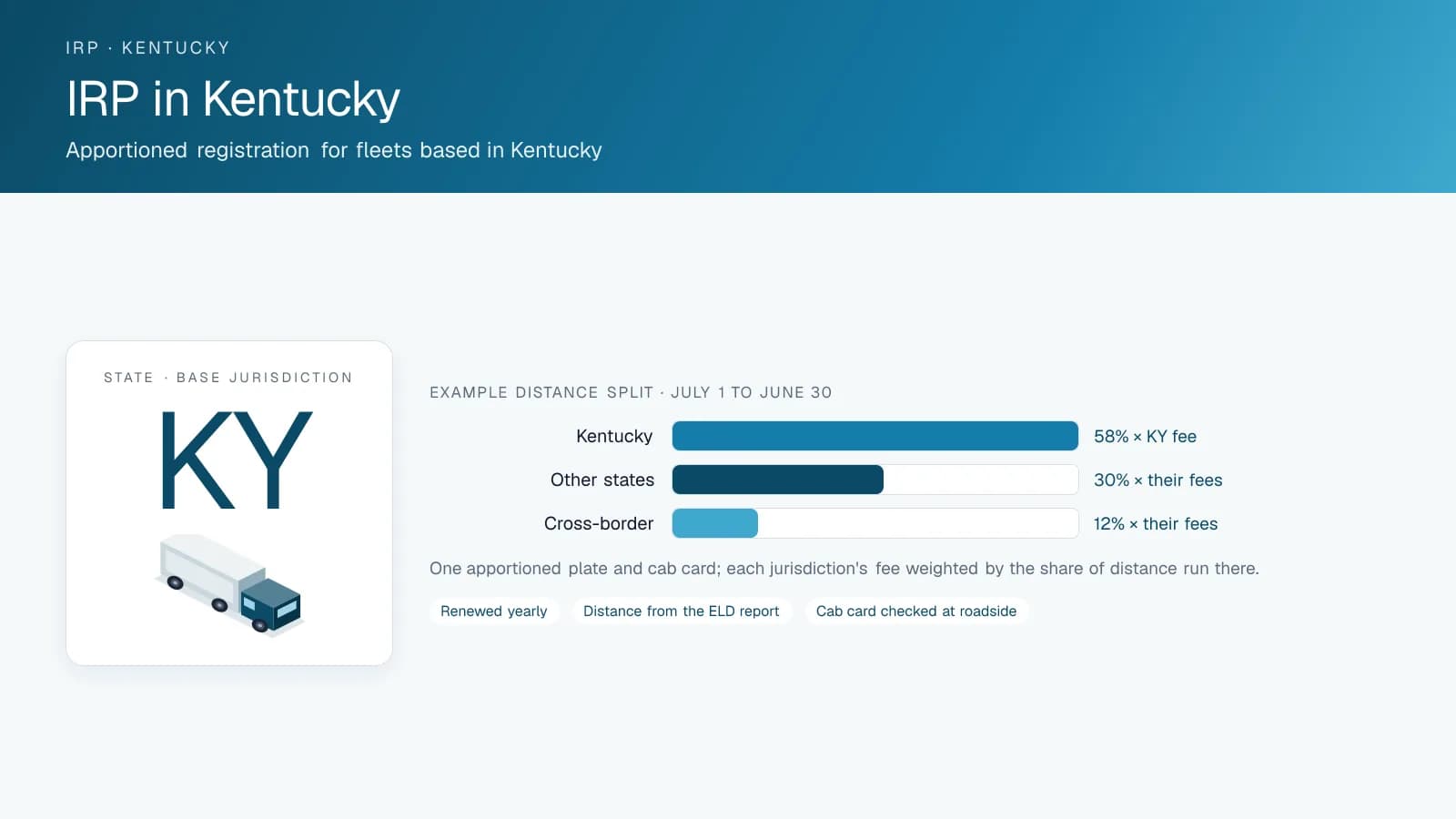
Where do you apply for Kentucky IRP registration?
Kentucky IRP registration goes through the Transportation Cabinet's Division of Motor Carriers: a carrier running qualified vehicles into other states or provinces applies there for apportioned plates, with Kentucky as its base jurisdiction. The same office runs the state's IFTA program and the KYU weight-distance tax, so you deal with one office for all three, which is unusual and convenient. A Louisville or Lexington carrier crosses jurisdictions on ordinary routes, with Indiana and Ohio across the river and Tennessee along the southern border.
What drives the Kentucky apportioned fee?
The obligation that sets Kentucky apart is the KYU, a weight-distance tax on Kentucky miles for vehicles over 59,999 pounds, filed quarterly and separate from both IRP and IFTA. A Kentucky carrier files all three from the same odometer, and an out-of-state carrier crossing Kentucky files KYU as well. A Kentucky fleet's IRP schedule typically covers Indiana, Ohio, Tennessee, Illinois and West Virginia, and the long I-65 and I-75 corridors add the Southeast and the Great Lakes. Telematics reporting of distance by jurisdiction, built from continuously logged position, gives you the July-to-June schedule, the IFTA quarter and the KYU miles from one dataset.
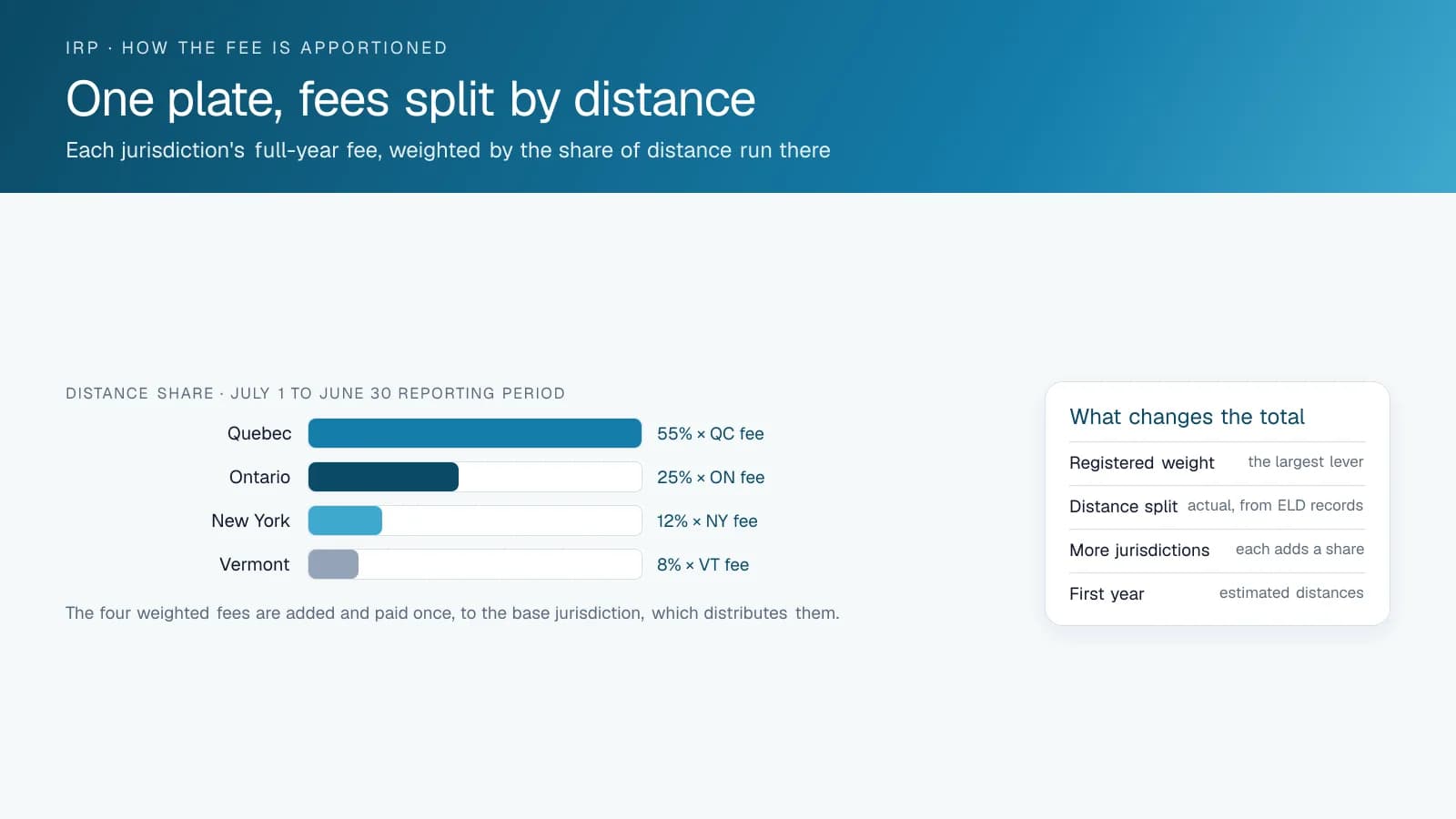
KY IRP roadside checks and audits
Kentucky State Police Commercial Vehicle Enforcement checks cab cards, KYU numbers and IFTA decals at the state's permanent weigh stations. Keeping all three current from one telematics record leaves fewer gaps to explain when a truck is pulled in.
Kentucky IRP at a glance
Here are the essentials for a fleet based in Kentucky. Confirm current procedures and fee schedules with the agency before you renew.
| Item | Kentucky |
|---|---|
| IRP administered by | Kentucky Transportation Cabinet's Division of Motor Carriers |
| Threshold | Power unit over 26,000 lb, or three or more axles, or a combination over 26,000 lb, in two or more jurisdictions |
| Credential | Apportioned plate and cab card per power unit; trailers not apportioned |
| Distance reporting period | July 1 to June 30 before the registration year |
| Fee basis | Each jurisdiction's fee at the registered weight, weighted by distance share |
| First-year fleet | Estimated distance chart until a full year of actual distance exists |
| Audit window | Three years after the registration year closes |
| Distance source | ELD or GPS jurisdiction report, per unit |
Frequently asked questions
Who handles IRP registration in Kentucky?
The Kentucky Transportation Cabinet's Division of Motor Carriers handles IRP registration. Applications, renewals and supplements for the apportioned plate and cab card all go through that office. The same division also runs Kentucky's IFTA program and the KYU weight-distance tax, so a Kentucky carrier deals with one office for all three credentials.
Does a truck based in Kentucky need IRP if it never leaves Kentucky?
No. A power unit that stays inside Kentucky gets an ordinary plate at the local County Clerk's office. IRP applies to qualified vehicles operating in two or more member jurisdictions, so the first regular run into Tennessee or Ohio triggers it. A one-off trip can run on a trip permit instead of a full apportioned plate.
Which reporting period does the Kentucky distance schedule cover?
The Kentucky distance schedule covers July 1 to June 30 of the year before the registration year. Your renewal with the Division of Motor Carriers asks for actual miles per jurisdiction for each power unit over that window. A new fleet without a full year on record uses the estimated distance chart instead.
Does an apportioned plate from the Kentucky Transportation Cabinet's Division of Motor Carriers replace the IFTA licence?
No. The apportioned plate and cab card cover registration, while the IFTA licence and decals cover fuel tax. A Kentucky fleet that crosses into Tennessee needs both, and letting either one lapse costs you a roadside stop. A fleet running heavy vehicles also needs a current KYU number on top of the two.
How long must IRP distance records be kept in Kentucky?
Keep IRP distance records for at least three years after the close of the registration year they support. The Kentucky Transportation Cabinet's Division of Motor Carriers can audit that window and asks for distance by jurisdiction tied to a unit and a date, which GPS trip logs supply directly.
Related solutions & products
Service areas
Related terms
Continue reading
- Compliance (ELD, DVIR, IFTA) overview →
- Kentucky IFTA Login and Filing: Motor Carrier Connect and KYU →
- How to Calculate Your IFTA Taxes: Formula and Worked Example →
- Who Needs IRP? Apportioned Registration Requirements and How to Apply →
- IRP in Vermont: Apportioned Plates, Registration Fees and the Distance Schedule →
- More in Compliance →
Get a free quote
- Over 500 fleets
- Since 2013
- 4.9 on Google (19 reviews)
What are you looking for?
Prefer to talk?Call 1-800-613-6323[email protected]