
Compliance
Kentucky IFTA Filing: Quarterly Returns, KYTC and KYU
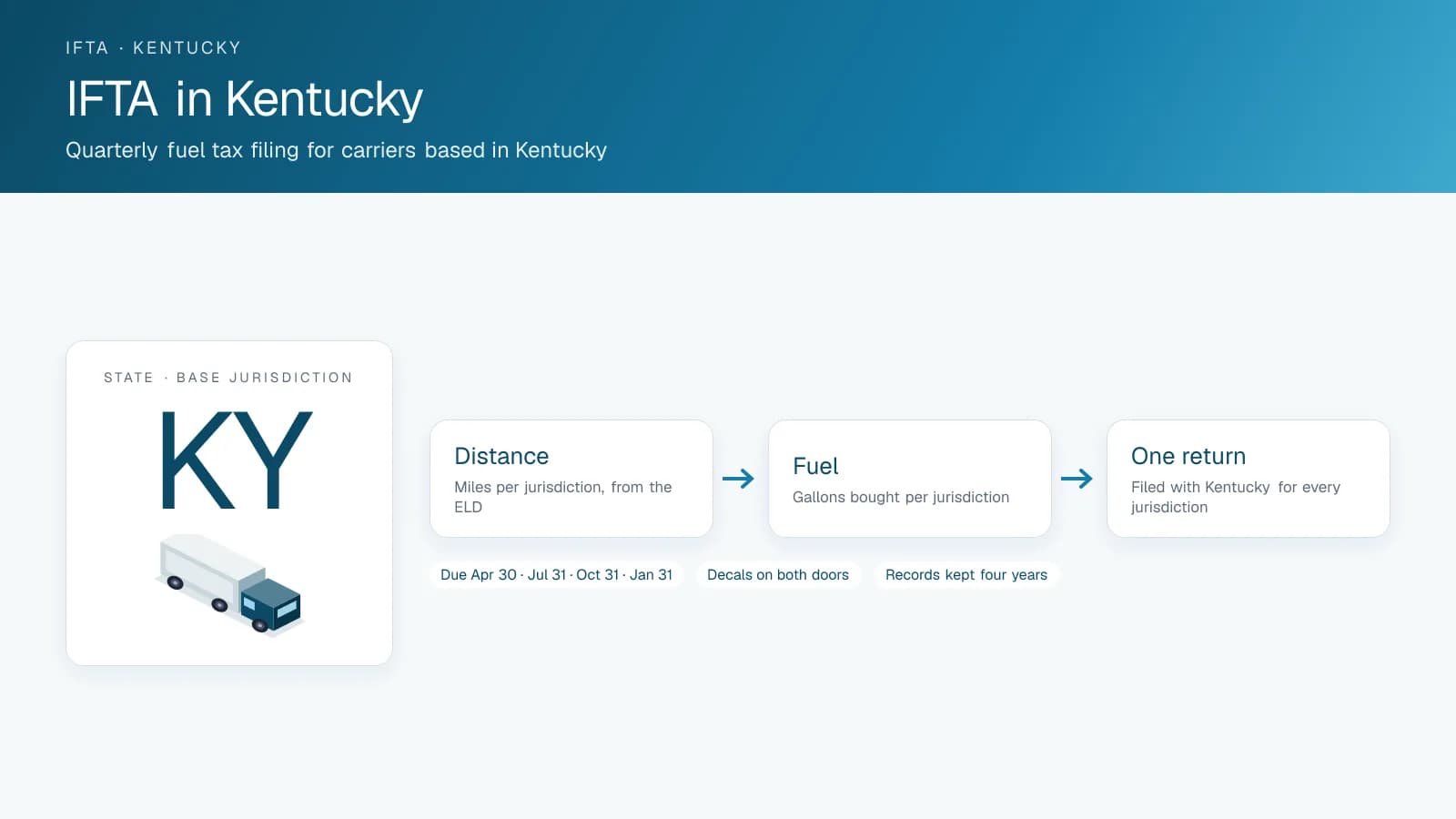
Kentucky IFTA filing goes through KYTC: register, then file quarterly returns online in Motor Carrier Connect. Heavy vehicles also owe KYU, a separate tax.
Who Administers Kentucky IFTA?
For Kentucky IFTA filing, a Kentucky-based carrier registers with the Kentucky Transportation Cabinet's Division of Motor Carriers (KYTC) and submits quarterly returns online through Motor Carrier Connect. The Department of Revenue plays no part, which catches out carriers used to a state revenue department handling fuel tax. Kentucky-based carriers that run qualified motor vehicles into other IFTA jurisdictions register and file with KYTC directly.
Know one Kentucky quirk before you register: if your fleet isn't based in Kentucky, you can't get a Kentucky IFTA licence; your IFTA licence comes from your own base jurisdiction. In Kentucky, those carriers deal with KYU (the state's weight-distance tax) if their vehicles meet its weight threshold, the same test Kentucky-based fleets face. KYU is a different filing from IFTA and doesn't replace it.
A Kentucky-based fleet registering for the first time applies to KYTC for the IFTA licence and, separately, checks whether its vehicles meet the KYU weight threshold and need that registration too. The most common early mistake is treating the two as one application. Approval for one says nothing about the other, or whether it even applies, and the two systems don't cross-reference each other for you.
How to File Kentucky IFTA Returns Through Motor Carrier Connect
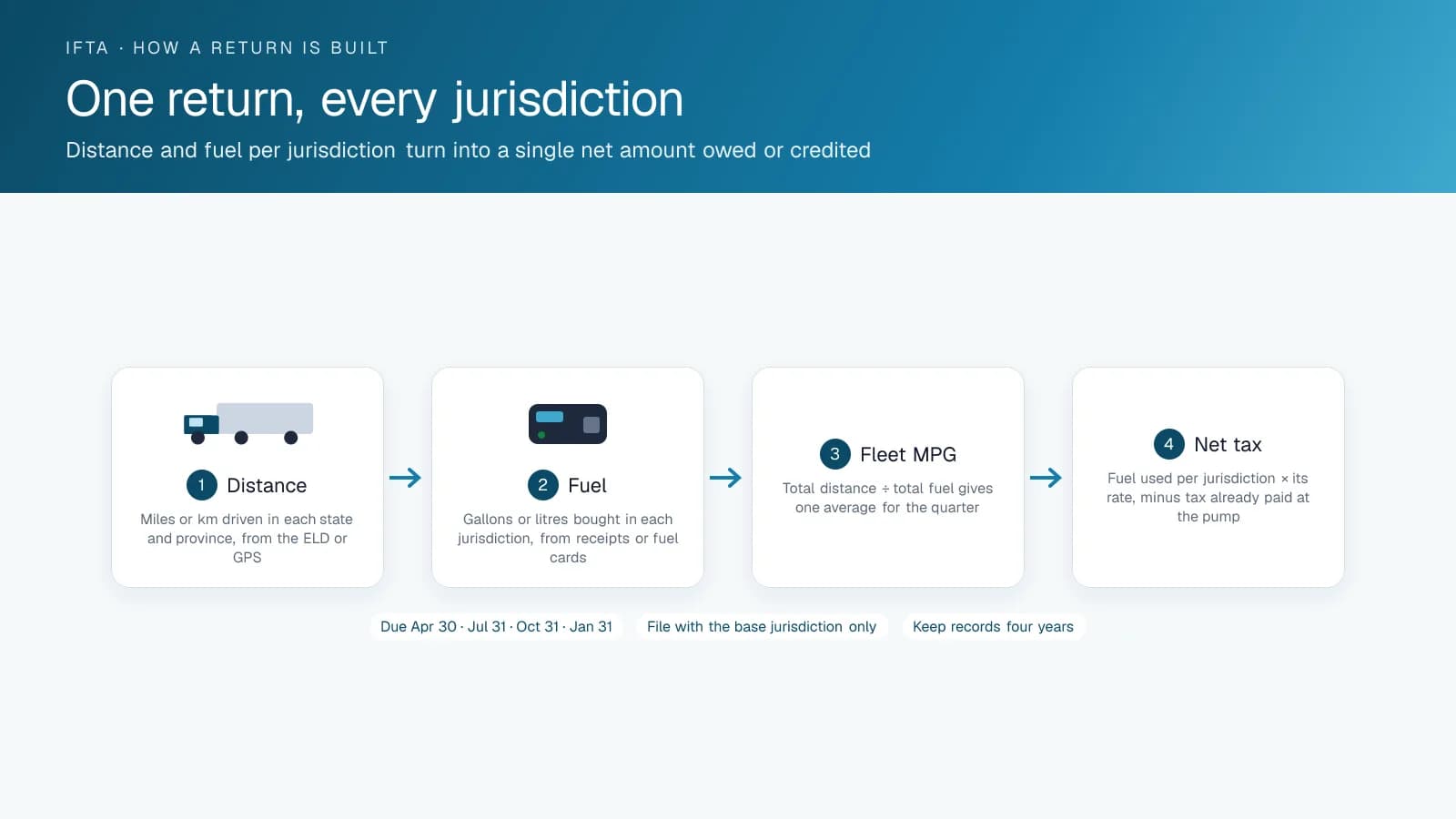
Kentucky requires carriers to file quarterly IFTA returns online through Motor Carrier Connect. KYTC sends a renewal notice each year asking carriers to renew online in Motor Carrier Connect, and the quarterly return goes through the same system. Due dates follow the standard schedule: April 30, July 31, October 31, and January 31.
Kentucky charges no fee for the IFTA licence or decals. The larger risk sits outside the IFTA filing: carriers assume IFTA covers everything and miss that KYU reporting is a separate obligation, tracked on its own, for heavy vehicles operating in the state.
You renew a Kentucky IFTA licence every year. KYTC handles the licence and any related KYU registration through different processes, so confirm each one is current on its own. A KYU renewal notice doesn't cover the IFTA side, and an IFTA renewal doesn't cover KYU.
IFTA and KYU Are Separate Filings in Kentucky
KYU applies to vehicles with a combined licensed weight over 59,999 pounds. It needs its own registration and its own quarterly reporting, tracked separately from IFTA mileage and fuel data, even though both filings draw on the same trip data underneath. A carrier that files IFTA correctly but never registers for KYU is still out of compliance in Kentucky if its vehicles meet that weight threshold.
Here GPS and engine data pays for itself twice. The jurisdiction-by-jurisdiction mileage that feeds an IFTA return is the same mileage a KYU filing needs, so a fleet already tracking mileage accurately for IFTA has most of the work done when it turns to KYU.
How Is Kentucky's KYU Tax Calculated and Filed?
KYU is charged by the mile. Under KRS 138.660, the rate is $0.0285 for each mile a vehicle with a combined licensed weight over 59,999 pounds travels on Kentucky roads, and every carrier running such a vehicle in the state needs KYU coverage, wherever it is based: a licence for regular operations or a temporary permit for an occasional trip. Vehicles on farm plates are exempt.
Returns are quarterly and are filed and paid online through KYU E-File, which needs a KYID account; payment is by credit card or ACH. Filing for a quarter opens the day after it ends, so the January to March return opens April 1. A KYU licence needs a return every quarter even with no travel: a quarter with no Kentucky miles still needs a zero-mile return, or the carrier faces a penalty, interest and a $500 revocation fee. Every qualified vehicle must also be listed in the KYU inventory in the Motor Carrier Portal, because unlisted vehicles can be cited.
A carrier that does not make regular trips through Kentucky can buy a one-time temporary KYU permit for each truck instead of holding a licence. A return can be amended in KYU E-File to add miles; lowering reported miles goes through the Division of Motor Carriers.
How Do You Apply for, Change or Close a Kentucky IFTA Licence?
A Kentucky-based carrier applies with the Kentucky Trucking Application, form TC 95-1, sent to the Division of Motor Carriers. Kentucky is your base jurisdiction when you have an established place of business in the state from which the operation runs, keep operational control and records for your qualified vehicles there (or can make the records available to Kentucky), run qualified vehicles on Kentucky highways and operate in at least one other IFTA jurisdiction.
Once licensed, you order extra decals, maintain the licence and amend returns in Motor Carrier Connect. To cancel, bring every IFTA and KYU filing and payment up to date and make sure the IRP account is in good standing, then email the cancellation request to the Division of Motor Carriers at [email protected].
Recordkeeping That Survives an Audit
Kentucky carriers follow the same recordkeeping standard as every other IFTA jurisdiction: keep the mileage and fuel records behind each quarterly return for four years from the due date or the filing date, whichever is later. The IFTA Procedures Manual sets that rule for all members, KYTC doesn't set it alone, and it applies on top of any records KYU reporting requires.
Many heavy vehicles in Kentucky carry both obligations, and both draw on the same trip and mileage data, so a gap in one audit often shows up in the other. One GPS-verified source of mileage by jurisdiction lets you answer an IFTA audit or a KYU audit from the same records, instead of keeping two paper trails that may not agree.
Kentucky IFTA at a Glance
The essentials for a Kentucky-based carrier, plus the KYU obligation that comes with operating in the state. Confirm fees and procedures with the Division of Motor Carriers before each renewal.
| Item | Kentucky |
|---|---|
| IFTA administered by | Kentucky Transportation Cabinet, Division of Motor Carriers |
| Portal | Motor Carrier Connect |
| Licence and decal fee | None |
| Return due dates | April 30, July 31, October 31, January 31 |
| Renewal | Annual, renewed online in Motor Carrier Connect; quarterly returns online |
| KYU | Separate weight-distance tax for vehicles over 59,999 lb; own registration and quarterly return |
| Carriers based elsewhere | No Kentucky IFTA licence; KYU licence if the weight threshold is met |
| Record retention | Four years from the due date or filing date, whichever is later |
Frequently asked questions
Which Kentucky agency handles IFTA?
The Kentucky Transportation Cabinet's Division of Motor Carriers handles IFTA in Kentucky, not the Department of Revenue. Kentucky-based carriers register with KYTC, file quarterly returns online through Motor Carrier Connect and renew the licence there each year. The same agency also handles KYU, though as a separate registration and filing.
Is KYU the same thing as IFTA in Kentucky?
No. KYU is Kentucky's separate weight-distance tax for vehicles with a combined licensed weight over 59,999 pounds. It needs its own registration and its own quarterly reporting, and it doesn't substitute for IFTA. A carrier that files IFTA correctly but skips KYU is still out of compliance if its vehicles qualify.
Can an out-of-state carrier get a Kentucky IFTA licence?
No. Carriers that aren't based in Kentucky can't receive a Kentucky IFTA licence; they get IFTA from their own base jurisdiction. If their vehicles meet the KYU weight threshold, they also need a Kentucky KYU licence for the weight-distance tax, a separate filing from IFTA. Check that threshold before you run Kentucky lanes.
How are Kentucky IFTA returns filed?
Kentucky IFTA returns are filed online through Motor Carrier Connect, because Kentucky requires electronic filing for the quarterly return. The annual licence renewal is also done online in that same system, after KYTC sends its yearly renewal notice. Due dates follow the standard quarterly IFTA schedule.
How long do Kentucky carriers need to keep IFTA and KYU records?
Keep IFTA records for four years from the return's due date or filing date, whichever is later. That is the shared IFTA standard from the IFTA Procedures Manual, and it applies alongside whatever recordkeeping KYU reporting requires separately. One GPS-verified mileage source can support both audits.
What is the KYU tax rate in Kentucky?
Kentucky's weight-distance tax is $0.0285 per mile under KRS 138.660, charged on the Kentucky miles of vehicles with a combined licensed weight over 59,999 pounds. Returns are filed quarterly through KYU E-File, and a quarter with no travel still needs a zero-mile return to avoid a penalty, interest and a $500 revocation fee.
Do I need a KYU licence for an occasional trip through Kentucky?
Not necessarily. A carrier that does not make regular trips through Kentucky can buy a one-time temporary KYU permit for each truck instead of holding a KYU licence. Carriers that run Kentucky regularly need the licence, a return every quarter and an up-to-date vehicle inventory in the Motor Carrier Portal, since unlisted vehicles can be cited.
Sources
Related solutions & products
Service areas
Related terms
Continue reading
- Compliance (ELD, DVIR, IFTA) overview →
- Kentucky IRP: Apportioned Registration, Fees and the Distance Schedule →
- How to Calculate Your IFTA Taxes: Formula and Worked Example →
- Who Needs IFTA? The Qualified Motor Vehicle Definition, Axle by Axle →
- IFTA Nova Scotia: Licence, Decals and Quarterly Fuel Tax Returns →
- More in Compliance →
Get a free quote
- Over 500 fleets
- Since 2013
- 4.9 on Google (19 reviews)
What are you looking for?
Prefer to talk?Call 1-800-613-6323[email protected]