
Industry
GPS Fleet Tracking for Auto Transport & Car Haulers
GPS tracking for auto transport carriers and car haulers: live load location, stamped dealer and auction arrivals, and the ELD, DVIR and damage records.
Updated September 21, 2026
A car hauler moves other people's inventory, and every unit on the trailer has a buyer, a dealer or an auction waiting for it. Dispatch fields calls all day about where a load is, and a single dent found at delivery can cost more than the freight paid for the whole run. GPS tracking for auto transport carriers puts every truck on one live map with the load it is carrying, the stops it has made and an arrival estimate for the next one. Geofences around dealerships, auctions, ports and rail yards record the arrival and departure time at each, which is the record a carrier needs when a receiver disputes a delivery window or claims the truck never came. The GPS tracking device also carries the ELD. The driver app handles hours of service and the electronic inspection of a truck and a stinger or high-mount trailer whose hydraulics, ramps and tie-downs need a real walk-around. Road-facing and driver-facing AI dash cams add the view of a load through a low bridge or a tight auction lane, and engine-hours maintenance keeps a high-mileage tractor on the road between runs. High Point GPS configures the platform for the way a car hauler runs: multi-stop loads, owner-operators mixed with company trucks, IFTA across many states and provinces, and customers who want a link to the truck rather than a phone call.
Common challenges
- Dealers and auctions calling for an ETA on a load that dispatch can only locate by calling the driver
- Damage claims at delivery with no record of where the truck was, how it was driven or when the load was inspected
- Detention at auctions and ports that the carrier eats because the arrival and departure times were never written down
- Hours of service and IFTA records spread across paper logs, fuel receipts and a driver's memory across many states
- Owner-operators on the same loads as company trucks with no common record of who did what
- Low-clearance strikes and lane collisions on a loaded trailer that come down to the driver's word
How High Point GPS helps
- Live location of every truck and load on one map, with the stop list and an arrival estimate per stop for dispatch and the customer
- Geofences on dealerships, auctions, ports and rail yards that record every arrival and departure to the minute
- Trip replay with speed, braking and cornering on any run, for damage claims and route disputes
- Road-facing and driver-facing AI dash cams that capture clearance strikes, lane changes and yard incidents by event
- Certified ELD in the driver app for US and Canadian hours of service, with roadside inspection mode
- Electronic DVIR checklists written for the tractor and the car-carrier trailer: hydraulics, ramps, lights, tie-downs
- Automated IFTA mileage by jurisdiction from the GPS tracking device, with fuel-card transactions matched to each truck
- Maintenance reminders on engine hours and mileage, with fault codes sent to the shop as the tractor logs them
Where is my car? Answering the dealer and the auction
A car hauler's dispatcher spends the day answering the same question from different callers: a dealer waiting on three units, an auction with a lane about to close, a broker with a customer on hold. With every truck on the live map and its stop list beside it, the dispatcher sees which stop the truck is heading to and the estimated arrival, and can say so without radioing the driver. Customers who want to check for themselves get a shared tracking link for their load, so the dealer's lot manager sees the truck approaching instead of phoning twice an hour.
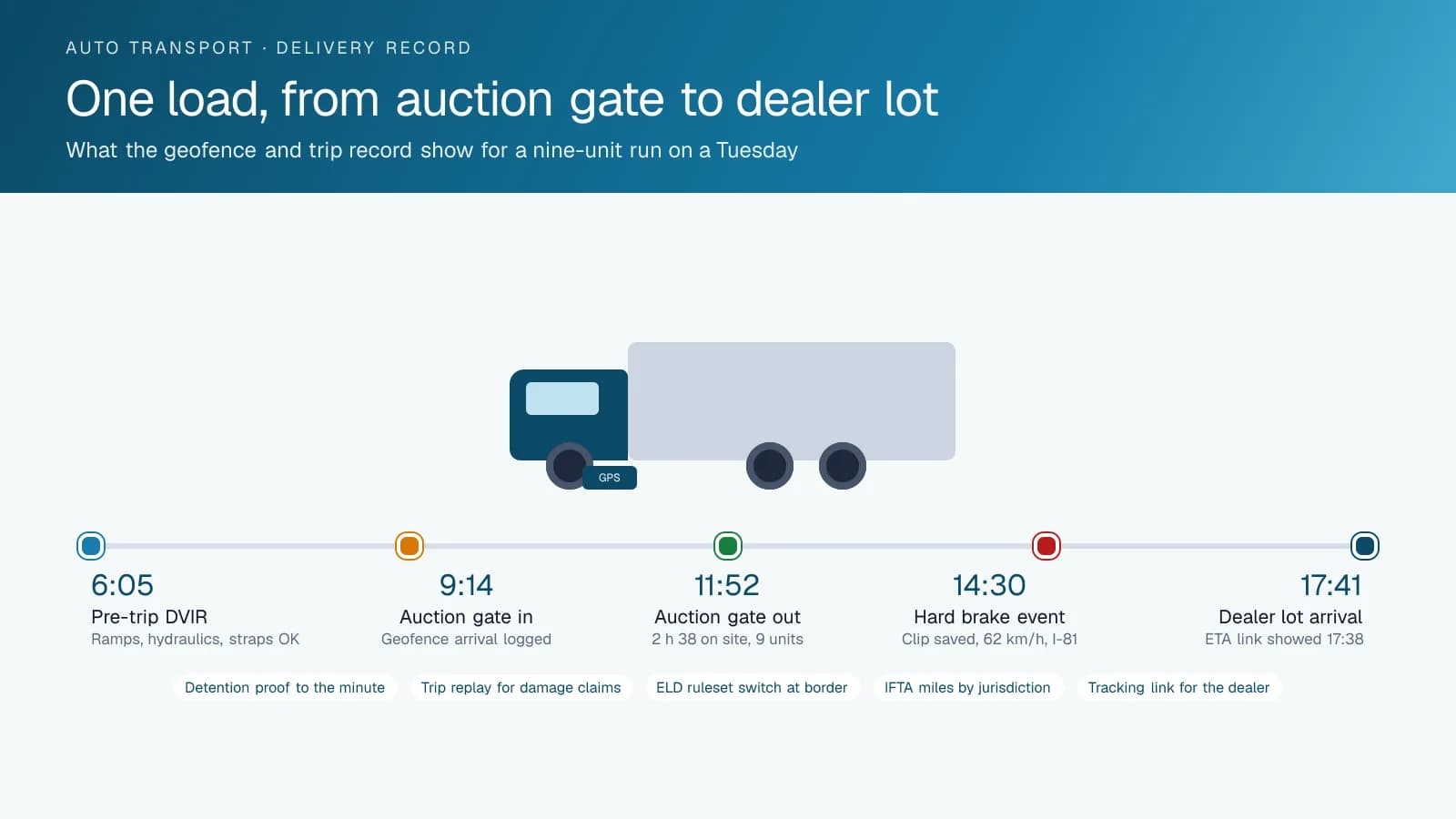
The arrival record matters as much as the arrival itself. High Point GPS draws a geofence around each regular pickup and delivery point, and the platform logs when the truck entered and left. When an auction says the carrier missed its slot, the record shows the truck inside the gate at 9:14 and leaving at 11:52. When a dealer claims the driver came after hours and nobody was there to sign, the record shows the time on the lot. That is what backs a detention invoice or answers a chargeback.
The damage claim and what the record shows
Every car hauler has paid a claim it did not cause. The bill of lading is the paper defence, and telematics is the second one. The trip replay for a run shows the route, the speed on every segment, and every hard-braking or hard-cornering event with its time and place. A claim that a car was damaged by rough driving meets a record that shows a smooth run, and a claim that a unit shifted on the deck can be compared with the exact roads and speeds the truck travelled between pickup and delivery.
AI dash cams add the picture. A road-facing camera records the low bridge, the tight ramp at the port or the forklift that clipped the lower deck in a yard, and the driver-facing camera shows the driver was attentive. Video is saved by event, so the claims desk pulls the clip for the minute in question rather than a day of footage. Carriers that pair the camera with a driver's own pickup and delivery photos in the inspection app have a complete file before the first call from the claims adjuster.
Hours of service, inspections and IFTA on a multi-state run
Car haulers run long, irregular routes across many jurisdictions, which puts pressure on every compliance record at once. The driver app on the driver's tablet is a certified ELD for the US and Canadian mandates, records duty status from the GPS tracking device, and switches rulesets at the border. The electronic DVIR carries a checklist built for the equipment: hydraulic lines and cylinders, ramps and deck locks, lights on both units, tie-downs and wheel straps. A defect flagged at pre-trip reaches the shop before the truck leaves, and the record shows the inspection was done for a roadside officer who asks.
IFTA on a car-hauler route is a mileage-by-jurisdiction problem, and the GPS tracking device solves it by recording the miles driven in each state and province as they happen. Fuel-card transactions are matched to the truck and the driver, so the quarterly return comes from the platform rather than a box of receipts. High Point GPS sets up the IFTA report and the fuel integration during onboarding, and the report is ready on the first day of the quarter. A carrier that adds trucks or changes fuel-card providers mid-year keeps the same report, because the mileage comes from the trucks rather than from the paperwork.
Company trucks, owner-operators and the tractor that never stops
Most auto transport fleets mix company drivers with owner-operators, and the records need to work for both. The GPS tracking device installs the same way in a leased-on tractor, and driver ID through the IOX-NFCREADERA or the driver app login ties every trip, inspection and hours record to a person rather than a truck. Settlement reporting for an owner-operator comes from the same mileage and stop data as the customer invoice, which removes an argument at the end of every month. When an owner-operator leaves, the truck's history stays with the carrier and the device moves to the next tractor.
A car-hauler tractor runs more miles in a year than most fleet vehicles run in three, and the maintenance program has to keep up. Reminders based on engine hours and mileage schedule the service before the run rather than after the breakdown, and engine fault codes reach the shop as the tractor logs them, with the location of the truck. Driver scoring set for a loaded car carrier, with tighter thresholds for speed and cornering, gives the safety manager a weekly list of who to coach and a specific trip to coach from.
Frequently asked questions
Can my customers see where their vehicles are?
Yes. Dispatch can share a tracking link for a specific truck or load, and the dealer or auction sees the truck approaching with an arrival estimate. The carrier controls what is shared and for how long, and the full live map stays with dispatch. Through the open API, the same position can feed a broker's load board or a customer portal without anyone sending a link.
Does the ELD handle both the US and Canada?
Yes. The driver app is a certified ELD under both the FMCSA and the Canadian mandate, records duty status from the GPS tracking device, and switches rulesets when the truck crosses the border. Roadside inspection mode shows the officer the logs on the driver's tablet, and the same app carries the electronic DVIR for the tractor and the car-carrier trailer.
How does tracking help with a damage claim?
The trip replay shows the route, the speed and every hard-braking or cornering event between pickup and delivery, and the dash cam saves video by event. Combined with the driver's inspection photos, the carrier has a record of how the load was handled before the claim is even filed.
Will it work in owner-operators' trucks?
Yes. The GPS tracking device installs in a leased-on tractor the same way as a company truck, and driver ID ties each trip and each hours record to the driver. Settlement and IFTA reporting for the owner-operator come from the same data as the rest of the fleet.
Can it do IFTA across all the states we run?
Yes. The GPS tracking device records miles by jurisdiction as the truck drives, and fuel-card transactions are matched to each truck. The quarterly IFTA report is generated in the High Point GPS platform for every state and province the fleet ran in, ready to file, and a purchase that does not match the truck's location is flagged before the return goes out.
Related solutions
Related guides
- How Geofencing Works for Fleet Tracking →
- Detention Time: What It Is, What It Costs, and How to Bill It With GPS Evidence →
- Dash Cam Footage and Insurance Claims →
- High Point GPS IFTA Reporting: How Automated Fuel Tax Reports Save Fleets Hours →
- What Is an ELD? A Plain-English Guide for Fleets →
- High Point GPS DVIR: How Digital Vehicle Inspection Reports Work →
Get a free quote
What are you looking for?