
Industry
GPS Fleet Tracking for Beverage Distribution
GPS tracking for beverage distributors that records time at every account on a route sales run, reads liftgate and reefer inputs from the truck, scores drivers for the way a loaded bay truck should be driven, and keeps DVIR, returns and empties on one record.
Updated September 21, 2026
A beverage route is a long list of accounts with a short window at each, and the truck that runs it is heavy in the morning and heavy again with empties in the afternoon. GPS tracking for beverage distribution puts every bay truck, van and trailer on one live map with the route it was given and the accounts it has served. A geofence around each account records the arrival, the time at the door and the departure. The route supervisor sees which stops take fifteen minutes and which take fifty, and a chain account that complains about a missed delivery is answered with the time the truck was in its lot. The Geotab GO device reads the liftgate and the reefer through IOX-AUXM auxiliary inputs, and the record shows the gate cycling at each stop and the cooler running on the loads that need it. Driver scoring is tuned to a loaded beverage truck: hard braking and fast cornering with a full bay of kegs are weighted the way the risk deserves, and idling at the account is separated from idling on the road. Electronic DVIR in the Geotab Drive app puts the pre-trip on record with the liftgate and the bay doors on the checklist, and engine-hours maintenance with fault codes keeps trucks that run six days a week out of the shop on unplanned days. High Point GPS sets it up for route sales, pre-sell delivery and keg accounts alike.
Common challenges
- Route sales days that run long with no record of which accounts ate the time
- Chain accounts and bars claiming a missed or late delivery, with only the driver's word to answer them
- Liftgate cycles and reefer run time unknown, so maintenance is late and a warm load is discovered at the account
- Drivers handling a loaded bay truck like a pickup, with the cost showing up in brakes, tires and claims
- Pre-trip inspections signed without a walk-around, and the liftgate fault found at the first stop
- Kegs, pallets and empties that leave the warehouse and come back short, with no record of where they were dropped
How High Point GPS helps
- Live map of every bay truck, van and trailer with the route assigned and the accounts served so far
- Geofences around each account recording arrival, time at the door and departure for every stop
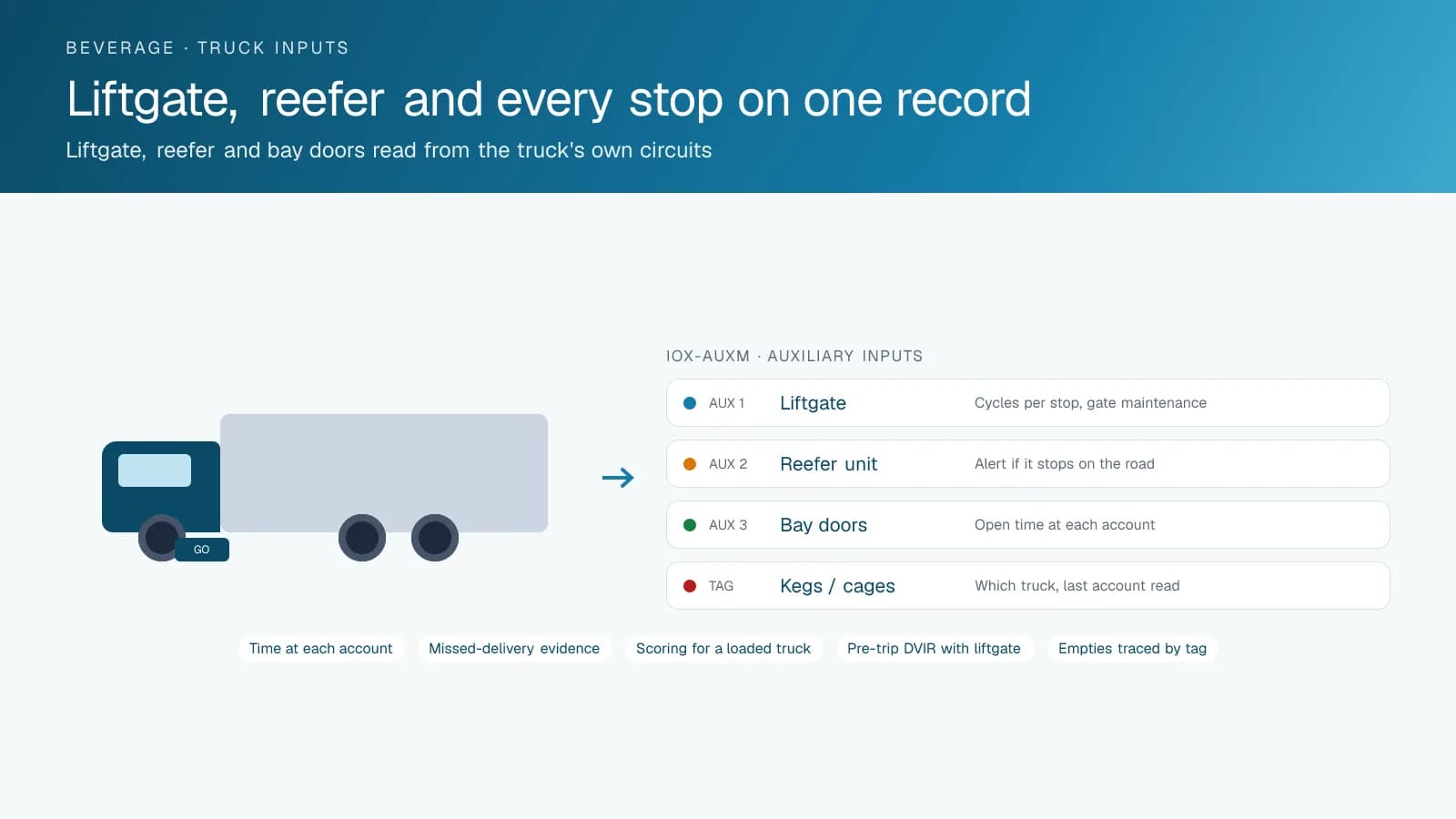
- Liftgate and reefer status read from the truck's own circuits through IOX-AUXM inputs
- Route reports by account and by driver that show where a route day goes long
- Driver scoring set for a loaded beverage truck, with braking, cornering and idling weighted for the load
- Electronic DVIR in the Geotab Drive app with the liftgate, bay doors and reefer on the checklist
- Bluetooth tags on kegs, cages and pallets that record which truck carried them and where they were dropped
- Maintenance reminders on engine hours and mileage, with fault codes sent to the shop as they appear
Time at Every Account
A beverage route lives or dies on time per stop. High Point GPS puts a geofence around each account, and the GO device records the truck entering, the time it sits there and the moment it leaves. The route report at the end of the day lists every account with its arrival, dwell and departure, and the supervisor sees which stops ran long. A convenience store that takes fifty minutes because the back room is a maze shows up beside one that takes twelve. That is the data behind a conversation with the account about its receiving, and behind a decision to move a stop to a different route.
The same records answer the account. A grocery chain's receiving desk claims the truck never came on Thursday; the geofence shows it in the lot from 10:04 to 10:31, and the trip replay shows it at the dock. A bar says the driver arrived after opening and blocked the entrance; the record shows the arrival time and where the truck parked. Trips are stored on the device when a truck is behind a building with no signal and uploaded when it moves on, so the stop is on the record either way.
Liftgate, Reefer and What the Truck Was Doing
A bay truck has two pieces of equipment that fail at the worst time: the liftgate and the reefer. An IOX-AUXM module on the GO device reads each one from the truck's own circuits, and the trip record then shows the liftgate cycling at every stop and the cooler running on the loads that need it. Liftgate cycles drive the maintenance interval on the gate's hydraulics and pump rather than a calendar guess, and a gate that cycled six hundred times last month gets serviced before the pump fails at a stop. Reefer run time does the same for the cooling unit.
The reefer input also protects the load. When the cooler shuts off on the road, the platform raises an alert before the driver has noticed the temperature climbing, and a supervisor decides whether the truck finishes the route or heads back. The record of the reefer running from the warehouse to the last cold account is what a customer asks for when a delivery is rejected as warm, and it is what settles whether the problem was the truck or the account's own cooler. High Point GPS maps the inputs at installation and documents which input reads what on each truck.
Driving a Loaded Truck the Right Way
A bay truck with a full load of kegs and cases handles nothing like the pickup the driver came to work in. High Point GPS sets the driver scoring for the vehicle and the load: hard braking and fast cornering are weighted more heavily than in a light fleet, because a shifting load damages product and a rollover risk rises with the centre of gravity. Speed limits by zone tighten in the residential streets around the accounts, and idling at the account is reported separately from idling on the road, because one is often unavoidable while a keg is going down the stairs and the other rarely is.
The score is the start of a conversation, not the end of one. A supervisor sees which drivers are braking hard on the same downhill approach every week and which routes produce the most events, and the coaching starts from a specific trip on a specific street. AI dash cams add the road view when the distributor wants it, with clips retrieved by event; a near-miss with a cyclist at an urban account is reviewed from footage. The fleet's insurer sees the scoring and the cameras at renewal, and the brakes and tires last longer in the meantime.
Inspections, Returns and the Empties That Come Back
The pre-trip inspection on a beverage truck should cover the liftgate, the bay doors and the reefer, because those are the items that end a route early. Electronic DVIR in the Geotab Drive app walks the driver through the checklist, time-stamps each item and routes a defect to the shop before the truck leaves the yard. The post-trip catches the damage that happened at the accounts. Maintenance reminders on engine hours and mileage keep the six-day trucks serviced on schedule, and fault codes from the engine reach the shop the day they appear, which is how a charging problem gets fixed before it strands a truck at the far end of a route.
Kegs, cages and pallets are the beverage fleet's other inventory. Bluetooth tags on the higher-value ones are read by the GO device in whichever truck carries them, and the platform records which truck a keg left in and the last account where it was read. When the empties count comes back short, the tag history narrows the loss to a stop and a day. The same records show a driver dropping an extra cage at a bar and picking it up two weeks later, which is a conversation the route supervisor can now have with specifics.
Frequently asked questions
Can I see how long the driver spent at each account?
Yes. A geofence around each account records the truck's arrival, the time at the door and the departure, and the route report at the end of the day lists every stop with those times. The supervisor sees which accounts run long and answers a chain's missed-delivery claim with the time the truck was in its lot.
How does the system know when the liftgate is used?
An IOX-AUXM module on the GO device reads the liftgate's circuit from the truck's own wiring. Each cycle is recorded with the time and the stop it happened at, and the gate's hydraulics and pump are serviced on the cycle count rather than on a calendar guess. A gate that has not cycled at a stop where it should have is visible in the same record.
Will it alert me if the reefer shuts off on the road?
Yes. The reefer input on the GO device reports when the cooling unit is running, and a rule sends an alert when it stops between the warehouse and the last cold account. The run-time record is also what settles a rejected delivery, showing whether the truck or the account's cooler was the problem.
Is the driver scoring different for a loaded beverage truck?
It should be, and High Point GPS sets it that way. Hard braking and fast cornering with a full bay of kegs are weighted for the load and the centre of gravity, speed limits tighten in the streets around the accounts, and idling at the account is separated from idling on the road, so the score reflects the driving that matters.
Can I track kegs and pallets that go out with the truck?
Yes. A Bluetooth tag on a keg, cage or pallet is read by the GO device in the truck that carries it. The platform records which truck it left in, the time it was last read and the account where that happened. When the empties count comes back short, the tag history narrows the loss to a stop and a day.
Related solutions
Related guides
- GPS Fleet Tracking for Food and Beverage Distributors: Routes, Temperature and Delivery Windows →
- Cold Chain Compliance: What GPS Monitoring Does →
- How Geofencing Works for Fleet Tracking →
- What Is a Geotab IOX and What Does It Do? →
- Geotab DVIR: How Digital Vehicle Inspection Reports Work →
- Driver Safety Scorecards: How Fleet Behavior Scoring Works →
Get a free quote
What are you looking for?