
Industry
GPS Fleet Tracking for Garage Door Installers
GPS tracking for garage door installers: send the closest technician to a stuck door, log time on site for every job, and protect loaded trucks overnight.
Updated September 21, 2026
High Point GPS provides GPS tracking for garage door installers and repair companies that run emergency calls and scheduled installs from the same trucks. Dispatch sees every truck on one live map in the High Point GPS platform, with the logged-in technician and the day's jobs beside it, and sends the closest free truck with an arrival time it can keep. Both kinds of work are judged on whether the truck arrived when promised. To a homeowner, a door stuck open on a February night is an emergency. A commercial roll-up door that will not close is a security problem for the warehouse and a call that has to be answered within an hour. Geofences at each address record arrival and departure, which gives you the time on site for the invoice and an answer when a builder says the crew left early. The same GPS tracking device reports after-hours movement of a truck carrying door sections, openers and springs, and an auxiliary input on the crane or the ladder rack shows when the equipment was used. Bluetooth asset tags follow the winding bars, spring tools and impact drivers that move between trucks. New-construction work gets its own record: the builder's site visited, the day the door went in and the truck that delivered it. Engine-hours maintenance and fault codes keep the trucks on the road, and driver scoring keeps the drive to an emergency call out of the claims file. High Point GPS installs and supports the whole system.
Common challenges
- Emergency calls for a door stuck open or a commercial door that will not close, and no way to tell which truck is closest
- Builders disputing which day a door was installed on a new-construction site and how long the crew stayed
- Time-on-site arguments over repair invoices, with only the technician's notes as backup
- Trucks loaded with door sections, openers and springs parked at job sites or the yard overnight, with no record of movement
- Spring tools, winding bars and impact drivers that move between trucks and go missing
- Ladder-rack trucks that break down on the way to a job because maintenance was tracked from memory
How High Point GPS helps
- Every truck on one live map, with the logged-in technician and the day's installs and repairs beside it
- Closest-truck dispatch for stuck-open and will-not-close calls, with a realistic arrival estimate for the customer
- Geofence arrival and departure records at every address, giving time on site for repair invoices and builder disputes
- New-construction site visits logged by day and by truck, matching each door delivery to the builder's schedule
- After-hours movement alerts for trucks loaded with door sections, openers and springs
- Crane, liftgate or ladder-rack use read through the auxiliary inputs on the GPS tracking device, with time and location
- Bluetooth asset tags on spring tools, winding bars and drivers that show which truck each was last seen in
- Engine-hours maintenance reminders and engine fault codes sent to the office before a truck fails on the road
How does GPS tracking get the closest truck to a stuck garage door?
GPS tracking shows dispatch where every truck is and which technician is free, so the stuck-door call goes to the nearest one with an arrival time based on its real position. A residential door stuck open in winter, or a commercial door that will not close at closing time, is a call the customer expects answered within the hour. On the live map, dispatch can tell which trucks are on installs that will run all day and which technician is finishing a spring replacement three streets away. The arrival time given on the phone accounts for the traffic between the truck and the address. High Point GPS sets up the map with the day's scheduled jobs as geofences, so dispatch sees at a glance who is committed and who can move.
Emergency calls also tempt technicians to drive fast in a heavy truck. Driver scoring reports speeding, hard braking and sharp cornering by technician and by trip, so an owner who sees repeated events on evening calls has specific trips to discuss. A road-facing AI dash cam is an option for companies that have had a claim; the event video of the moments before a collision often ends the dispute.
Time on site, whether the customer is a homeowner or a builder
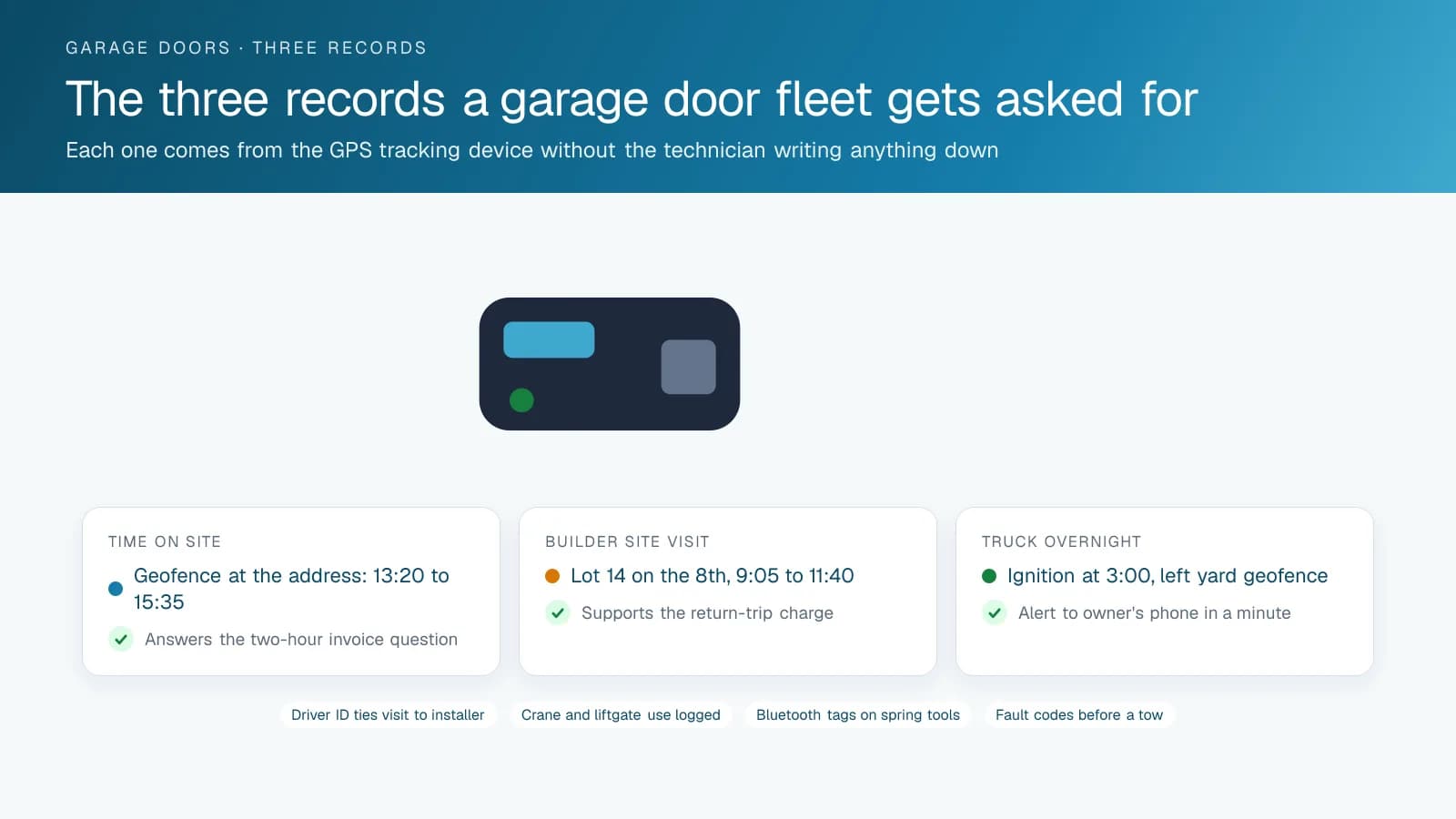
A repair invoice that bills two hours of labour invites the question of whether it was two hours. A geofence around the address records the truck's arrival at 13 h 20 and departure at 15 h 35, and the invoice can carry those times. A homeowner who says the technician was there forty minutes is answered with the record. A property manager for a warehouse with six roll-up doors sees a service history by door, with the date and the time on site for each visit.
New-construction work is where the record matters most. A builder with a dozen houses on a street schedules door installs and disputes them when the drywall crew says the garage was still open. The trip record shows the truck at lot 14 on the 8th from 9 h 05 to 11 h 40, and at lot 17 the next morning. When a site is visited three times because the opening was not ready, the record supports the return-trip charge. The IOX-NFCREADERA driver ID reader ties each visit to the installer who did it.
Protecting the truck and what is on it
A garage door truck at the end of a day carries door sections, openers, torsion springs and tools worth more than most people would guess, and it often sits in a driveway or a builder's lot overnight. A rule that fires on ignition outside working hours, or on any movement while the truck should be parked, sends an alert to the owner's phone. A geofence around the yard turns a truck leaving at 3 h 00 into a text message. If a truck is stolen, its live position keeps reporting and goes to police.
The GPS tracking device's auxiliary inputs through an IOX-AUXM module read the truck's own circuits. A crane or liftgate on a commercial door truck reports when it was used, and where, which matters when a section was damaged during unloading. A ladder-rack lock or a cargo-door sensor reports openings away from a job. Bluetooth asset tags on the spring tools, winding bars and impact drivers are read by whichever GPS tracking device is nearby, and a missing set is found in the other truck without a phone tree.
Keeping the fleet on the road
The trucks are heavy, they carry ladder racks and cranes, and they are driven hard between calls. Maintenance reminders on engine hours and mileage keep oil changes, brake inspections and tire rotations on schedule for each truck. Engine fault codes reach the office as they are logged, which is how a charging or cooling problem is fixed on a Tuesday instead of causing a tow with a door on board on a Saturday. The electronic DVIR in the driver app gives each technician a short pre-trip check on their phone, with the crane, the rack and the tie-downs on the list, and a defect goes to the shop that morning.
The office runs all of it from one High Point GPS platform database. Companies with a scheduling or field-service system connect it through the open API, and the arrival stamp lands in the job record without anyone typing it. Fuel-card integration matches each fill-up to a truck and a trip, and flags a purchase the truck was not there for. High Point GPS installs the GPS tracking devices, wires the auxiliary inputs, sets up the rules and reports, and trains the dispatch team, then stays available by phone from Montreal for fleets across Canada and the United States.
Frequently asked questions
Can dispatch see which truck is closest to an emergency call?
Yes. Every truck appears on a live map in the High Point GPS platform with the logged-in technician and the job they are on. Dispatch sees which truck is nearest to the address and whether it is free. The customer then gets an arrival estimate based on the truck's real position and the traffic between it and the address.
How does it settle a dispute with a builder about an install date?
A geofence around each lot or site records when the truck arrived and left on every visit, and the driver ID reader records which installer was there. A trip record showing the door delivered to lot 14 on the 8th from 9 h 05 to 11 h 40 settles the date and supports a return-trip charge when the opening was not ready.
Will it alert me if a truck moves overnight?
Yes. A rule on ignition or movement outside working hours, or on a truck leaving the yard geofence at night, sends an alert to a phone or email within a minute. A stolen truck keeps reporting its position, and you can share it with police while the door sections and openers are still on board.
Can it record when the crane or liftgate was used?
Yes. An IOX-AUXM module on the GPS tracking device reads the crane, liftgate, ladder-rack lock or cargo-door circuit and logs each use with the time and location. When a customer reports a damaged door section, that record shows whether it was unloaded at the site or somewhere else along the route.
What about the tools that move between trucks?
Bluetooth asset tags on spring tools, winding bars and impact drivers are read by any nearby GPS tracking device, and the High Point GPS platform shows which truck each item was last seen in and when. A missing set turns up in the other truck in a minute, without calling every technician.
Related solutions
Related guides
- What Is Geofencing? How It Works in Fleet Tracking →
- Heavy Equipment Theft Recovery: How GPS Gets Stolen Machines and Trailers Back →
- Asset Tracker Tags vs. Powered GPS Trackers for Equipment →
- IOX Meaning: What Is an IOX Port and What Does It Do? →
- Fleet Maintenance Schedule: Engine Hours vs Calendar and Mileage →
- GPS Fleet Tracking for Small Business: What a 3 to 20 Vehicle Fleet Needs →
Get a free quote
- Over 500 fleets
- Since 2013
- 4.9 on Google (19 reviews)
What are you looking for?
Prefer to talk?Call 1-800-613-6323[email protected]