
Industry
GPS Fleet Tracking for Generator Sales & Service
GPS tracking for generator sales and service fleets: every maintenance visit and outage call recorded by site, and the closest technician dispatched.
Updated September 21, 2026
High Point GPS provides GPS tracking for generator sales and service fleets, with every service truck on one live map showing the site it is at, the time it has been there and the calls waiting. A service department runs in two modes: a scheduled year of preventive maintenance visits, load-bank tests and warranty work across hundreds of standby units, and the night the grid goes down and every customer whose unit did not start calls at once. During an outage, the dispatcher sends the closest technician with the right parts to the hospital, the data centre or the farm that is dark, and gives the customer an arrival time that holds. Geofences around each customer site record every arrival, departure and time on site. That record supports the service contract invoice and answers the facility manager who asks whether the quarterly visit was done. The GPS tracking device also reports engine hours, mileage and fault codes for trucks that carry heavy parts inventories and tow load banks and trailer-mounted units. Bluetooth asset tags on load banks, analyzers, transfer-switch test kits and rental generators show which truck or site each is on. Driver scoring, AI dash cams and fuel-card integration cover the road side of a fleet that drives long distances between sites. High Point GPS installs the hardware, maps the customer sites to zones and sets up the reports a generator service manager reads.
Common challenges
- Outage nights when every customer calls at once and the dispatcher cannot see where the trucks are
- Facility managers asking for proof that the quarterly contract maintenance visit was done
- Load banks, analyzers and rental units left at a customer site and missed only when the next job needs them
- Long drives between rural and industrial sites with no view of speed, idling or where the fuel went
- Warranty and emergency call reports written from memory at the end of a sixteen-hour day
- Trailer-mounted rental generators that leave a site without the dealer knowing
How High Point GPS helps
- Live location of every service truck on one map, with the site it is at and the calls waiting beside it
- Nearest-technician dispatch for outage calls through the driver app, with the site details and the unit's history
- Geofence arrival and departure records, with minutes on site, for every contract visit at each customer site
- Bluetooth asset tags on load banks, analyzers and test kits, and battery trackers on rental and trailer-mounted units
- Trip replay showing the route, each site and the time on site for any truck on any day, including outage nights
- Driver scoring for speeding, hard braking and fatigue on long drives between sites, with AI dash cams as an option
- Engine-hours and mileage maintenance reminders for the trucks, with fault codes sent to the shop as they appear
- Open API to push visit records into the dealer's service management and contract billing software
How does GPS tracking help when the grid goes down?
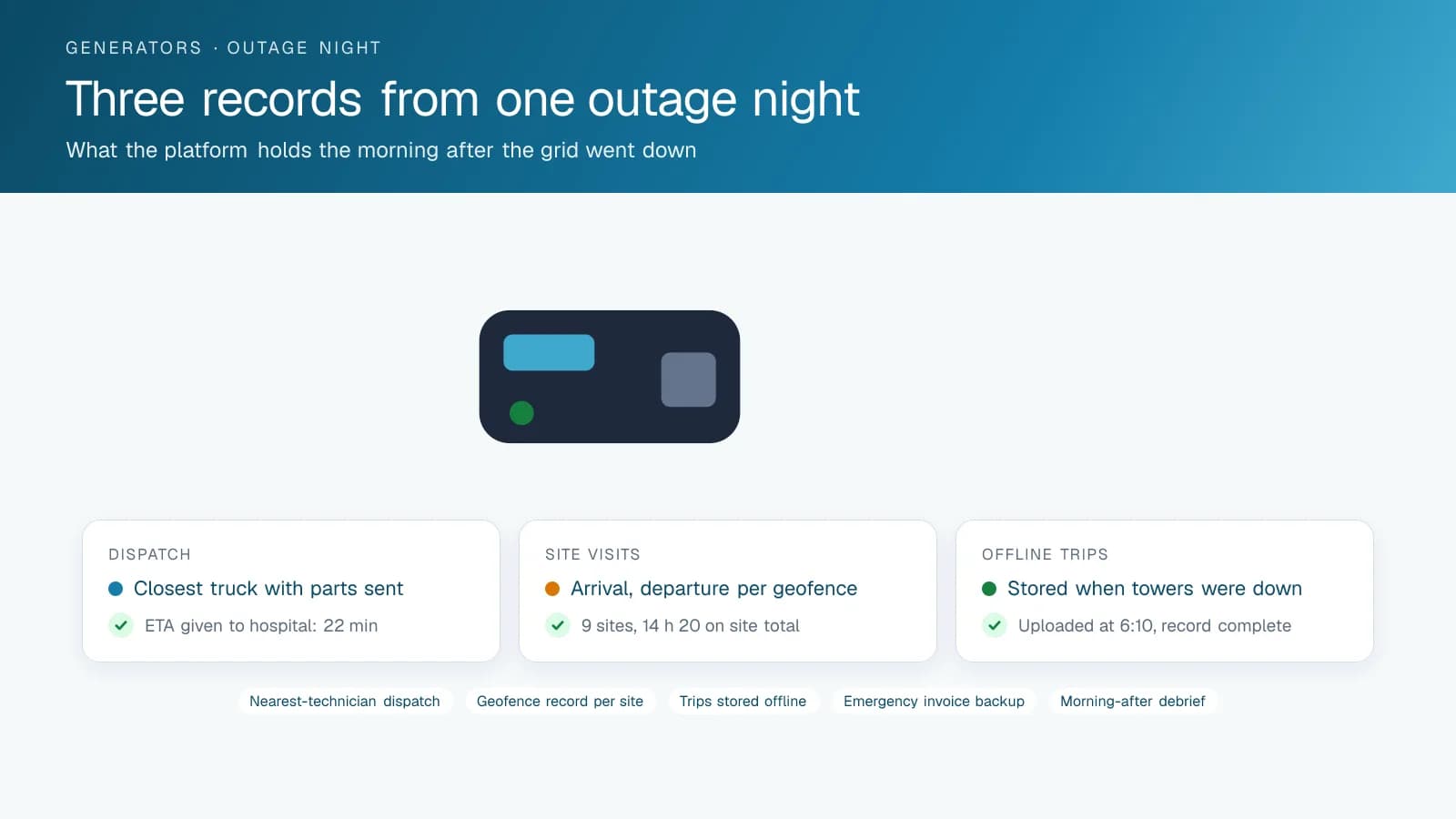
When the grid goes down, live GPS tracking lets the dispatcher see every truck, the site it is at and how long it has been there, and send the closest technician with the right parts to the next call. An ice storm or a summer heat wave fills the call board fast: units that passed their last test fail to start, transfer switches do not transfer, and the first callers are the ones whose business stops without power. The job goes to the technician's driver app with the site address, the unit's model and its service history, and the customer gets an arrival time the dispatcher can stand behind.
When cellular coverage drops, the GPS tracking device stores trips on board and uploads them once coverage returns, so the record of the night is complete even where the storm took the towers down. The next morning, the trip replay shows every site visited, the order the calls were run in and the time spent at each. The emergency invoices and the debrief on what the department could have done faster both start from that record. High Point GPS sets up the dispatch view and the outage reporting before the first storm of the season.
Proving the contract visit
A preventive maintenance contract promises a visit every quarter, an oil change on a schedule and a load-bank test once a year, and a facility manager who is audited on their own backup-power program asks for proof. A geofence around each customer site records the truck's arrival, the time on site and the departure without the technician logging anything, and the zone report lists every visit to that site for the contract period. When the facility manager asks whether the March visit was done, the office sends the arrival at 8:41, the ninety minutes on site and the departure, alongside the technician's service report.
The same record protects the dealer in a warranty dispute. A unit that failed after a documented visit has a service history the manufacturer can check, and a unit whose owner skipped the contract has a record of that too. Over a year, the zone data shows the average time per visit by unit type and by technician, which is the number that decides how many contracts a technician can carry. The open API lets the dealer push visit records into its service management software and its contract billing rather than typing them a second time.
Load banks, test gear and rental units
A generator service truck carries expensive, portable test equipment: a load bank, a power analyzer, a transfer-switch test kit, a fuel polishing rig and a battery load tester. Bluetooth asset tags on each piece report through the GPS tracking device on the truck carrying it, and a tag that stopped moving with the truck is flagged the moment the truck leaves a site. The analyzer left in a hospital's mechanical room is recovered the same day rather than discovered missing at the next load-bank test, and the inventory report shows where every tagged item was last seen.
Rental and trailer-mounted units are a different problem: they sit on a customer site for weeks, and the dealer needs to know where they are and whether they are running. A battery-powered tracker reports the unit's position on a schedule and wakes on movement, which is the alert that fires when a trailer leaves a site at night. A rugged GPS tracking device on a larger unit adds engine hours and fault codes. Rental billing then runs on real hours, and a unit that is about to fail gets a visit before the customer calls to say it did. High Point GPS tags the equipment at installation and adds trackers as the rental fleet grows.
Long drives, fuel and the trucks themselves
Generator sites are spread out: farms, cell towers, rural hospitals and industrial parks at the edge of the service area. Technicians drive long distances alone, often at the end of a long day, and the driver score reports speeding, hard braking and fast cornering per driver and per trip. AI dash cams add a driver-facing view with fatigue and distraction detection for the fleets that want it, and a road-facing view for the collision claim. Speed rules per geofence keep the trucks slow in the industrial parks and on the customer sites where a plant manager is watching.
The trucks carry heavy parts inventories and tow load banks and rental units, which wears brakes, cooling systems and transmissions faster than the odometer suggests. The GPS tracking device reports engine hours and mileage for each truck and sends engine fault codes to the shop as they appear, which is how a charging problem gets fixed before it strands a technician on an outage night. Fuel-card integration matches every fill-up to the truck, the driver and the odometer, and flags the fill-up that does not match the truck's location or exceeds its tank.
Frequently asked questions
How does it help during a major outage?
The dispatcher sees every truck's live location, the site it is at and how long it has been there, and sends each call to the closest technician with the right parts through the driver app, with the unit's history attached. When coverage drops, the device stores trips and uploads them later, so the record of the night is complete the next morning.
Can we prove a contract maintenance visit was done?
Yes. A geofence around each customer site records the truck's arrival, minutes on site and departure automatically, with no input from the technician. The zone report lists every visit to that site for the contract period, and when a facility manager or a manufacturer asks for proof, the office sends those times with the technician's service report.
Can it track rental and trailer-mounted generators?
Yes. A battery-powered tracker reports a rental unit's position on a schedule and alerts on movement, so you know when a trailer leaves a site at night. A rugged GPS tracking device on a larger unit adds engine hours and fault codes for hours-based billing and early failure warnings. Bluetooth tags cover the load banks and test equipment on the trucks.
Does it work in rural areas with poor cellular coverage?
Yes. The GPS tracking device stores trips and events when coverage drops and uploads them once the truck is back in coverage. The record of a visit to a remote site, with its arrival, time on site and departure, stays complete even if the live map lagged while the truck was there, and the office can build the invoice from it.
Can visit records feed our service management software?
Yes. Through the open API and custom add-ins, High Point GPS pushes arrival, departure and time-on-site records into the dealer's service management, contract billing or ERP system. A completed visit then updates the contract record with no second entry by the technician or the office, and the invoice draws on the same times.
Related solutions
Related guides
- What Is Geofencing? How It Works in Fleet Tracking →
- Asset Tracker Tags vs. Powered GPS Trackers for Equipment →
- Heavy Equipment Theft Recovery: How GPS Gets Stolen Machines and Trailers Back →
- Fleet API Explained: What You Can Build With High Point GPS →
- Fleet Maintenance Schedule: Engine Hours vs Calendar and Mileage →
- Rental Equipment GPS Tracking: Billing, Returns and Utilization →
Get a free quote
- Over 500 fleets
- Since 2013
- 4.9 on Google (19 reviews)
What are you looking for?
Prefer to talk?Call 1-800-613-6323[email protected]