
Industry
GPS Fleet Tracking for Government Motor Pools
GPS tracking for government motor pools: see who took each shared vehicle, measure utilization per unit and build department chargebacks from real trips.
Updated September 21, 2026
High Point GPS gives government motor pools GPS tracking with driver ID, so the fleet office knows who took each shared vehicle, how much each unit is used and what each department owes. A motor pool exists because departments cannot justify a vehicle each, and it fails for the same reason: nobody owns the car, so nobody accounts for it. The fleet manager hears the same questions every year. Which departments use the pool, and how much? Why does one branch have three sedans that move twice a week while another waits for a car? Who had the vehicle when the parking ticket arrived, or when a resident reported a government car outside a restaurant on a Saturday night? The answer comes from the GPS tracking device in every pool vehicle, driver ID at the ignition through an NFC reader, and a High Point GPS platform database organized by department. Each trip carries the driver and the department, and the utilization report shows days in use, kilometres and engine hours per unit, the evidence you need to right-size the pool and retire the units nobody drives. Geofences around the yard and the region of operations report after-hours and out-of-area movement against the personal-use policy. At month end, the chargeback report allocates kilometres and days to each department from the same trip data, and finance stops arguing over estimates. Reservations and key control integrate through Keyless or the open API, and electronic DVIR, engine-hours maintenance and fault codes keep the pool on the road with a small shop.
Common challenges
- No record of who drove a pool vehicle on a given day when a ticket, a complaint or a collision report arrives
- Departments holding vehicles they rarely use while others wait, with no utilization figures to support moving them
- A personal-use policy that exists on paper and is enforced by rumour
- Department chargebacks based on estimates that finance and department heads dispute every quarter
- Council, treasury board or audit requests for right-sizing evidence that take weeks to assemble from logbooks
- A shared fleet where nobody notices the warning light, because nobody drives the same car twice
How High Point GPS helps
- Driver ID at the ignition through an NFC reader, so every trip is attributed to a named employee and their department
- Utilization reports by unit and department (days in use, kilometres, engine hours and idle time) for right-sizing decisions
- Geofences around the yard, the service area and restricted locations, with after-hours and out-of-area movement alerts
- Per-department chargeback from actual trips, exported to the finance system on a schedule through the High Point GPS API
- Reservation and key-control integration through Keyless or the API, tying each booking to the trip that followed
- Driver-behaviour scoring for occasional drivers, with seat-belt, speeding and harsh-event reports
- Electronic DVIR in the driver app and engine fault codes sent to the shop, for a fleet with no regular driver
- Scoped logins, so a department head sees their own vehicles and trips without access to the whole government fleet
How do you know who had the pool car?
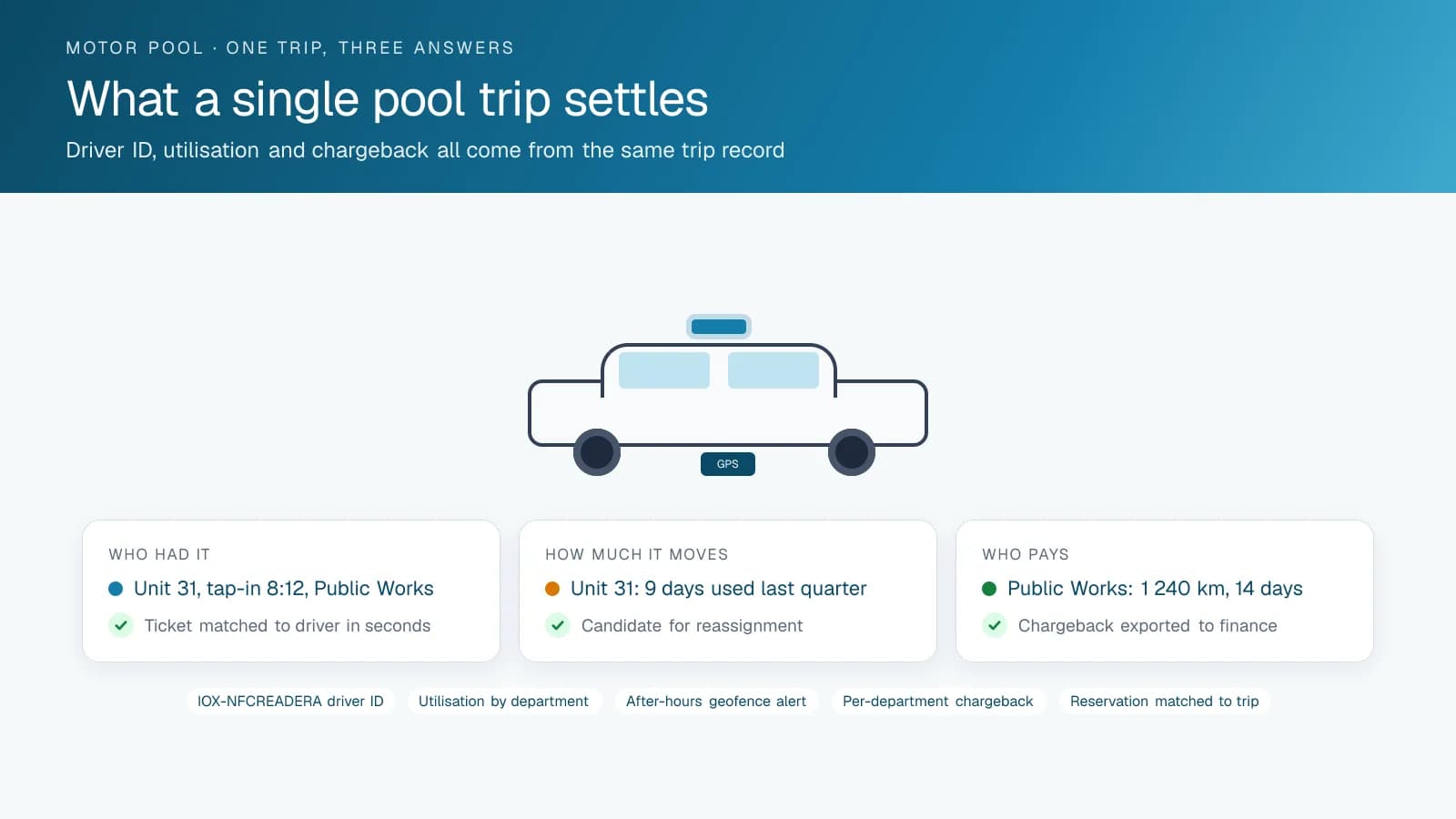
An IOX-NFCREADERA reader on the dash asks the employee to tap a card before the trip is attributed, and the trip record then carries the employee, the department, the route, the stops and the speed on every segment. Every question about a pool vehicle starts there. A photo-radar ticket arrives six weeks after the trip. A resident emails the mayor's office about a city car parked outside a bar. A department head wants to know why a sedan came back with a dented bumper. The platform can also alert the fleet office when a vehicle moves without an identified driver.
High Point GPS configures the database so a department head sees only their own vehicles and their own staff's trips, while the fleet office sees the whole pool. The ticket gets matched to the driver in seconds. The trip replay answers the Saturday-night complaint, showing either a legitimate after-hours call-out or a stop the policy does not allow. The dented bumper traces back to the trip where a harsh-event alert fired in a parking lot at 14:22. None of this depends on a logbook that employees fill in from memory at the end of the week.
Utilization and right-sizing the pool
The strongest argument for a smaller pool is a report that shows how little of it moves. The GPS tracking device records every trip, and the High Point GPS platform summarizes days in use, kilometres, engine hours and idle time by unit and by department over any period. A sedan that left the yard on nine days last quarter is a candidate for reassignment or disposal, and the department that has been holding it cannot argue from anecdote against the count. A branch that is short of vehicles has the same report as its case for an additional unit or for a shared booking arrangement with a neighbouring department.
The report also shows the shape of demand. If most trips are under 30 kilometres and return to the yard the same afternoon, a pool of smaller vehicles or electric vehicles fits the work. If a handful of units carry the long trips, those are the ones to specify differently. High Point GPS sets the utilization report up to run on a schedule and land with the fleet office and the finance team before the budget cycle. The same figures back the right-sizing recommendation that goes to council or to the treasury board.
Personal use and a policy you can enforce
A personal-use policy is only real when there is a record to enforce it against. Geofences around the yard, the service area and any locations the policy restricts produce an alert when a vehicle leaves the area or moves outside working hours, with the driver's identity attached. The fleet office reviews the alerts as they arrive rather than reconstructing them from a complaint. Where employees are allowed to take a vehicle home, the platform's personal-mode configuration lets the commute be recorded without the detail of private stops, and the policy is applied consistently to everyone rather than to whoever gets reported.
Driver behaviour matters more in a pool than in a dedicated fleet, because occasional drivers make occasional mistakes. Seat-belt use, speeding against posted limits and harsh braking are scored per driver, and a supervisor sees the trend for their staff without seeing anyone else's. Dash cams are optional in most pools. Where a government has a duty-of-care concern or a history of collision claims, an AI dash cam gives the incident review the view from the road and the cab, with clips retrieved by event rather than by hours of footage.
Chargeback, reservations and keeping the pool on the road
Finance wants each department to pay for what it used, and the pool manager wants to stop defending an allocation formula. The chargeback report takes the trips for the period, attributes each to a department from the driver ID, and totals kilometres, days and engine hours per department. High Point GPS exports it to the finance or ERP system on a schedule through the High Point GPS API, and a department head who questions the invoice can open their own scoped login and see the trips behind it. Reservations tie in the same way. A booking made in the government's reservation tool or through Keyless is matched to the trip that followed, and a vehicle that was reserved and never moved is as visible as one taken without a booking.
A shared fleet is hard on maintenance because no one driver notices the same warning light twice. Engine fault codes reach the shop as the vehicle logs them, and maintenance reminders run on kilometres and engine hours rather than on a calendar. The pre-trip inspection in the driver app takes the occasional driver through the checklist and sends a defect to the shop before the next booking. Trips are stored on the device when coverage drops in a parking structure and uploaded when it returns, so the record is never missing a day.
Frequently asked questions
How does the system know who took the vehicle?
An NFC reader on the dash requires an employee card tap before the trip is attributed, and each trip then carries the employee and their department. The fleet office can get an alert when a vehicle moves without an identified driver. A reservation system or the Keyless integration can also tie the booking to the trip that followed it.
Can we charge departments for their actual use?
Yes. The chargeback report attributes every trip to a department from the driver ID and totals kilometres, days and engine hours per department for the period. High Point GPS exports it to the finance system through the High Point GPS API, and department heads can open their own login to see the trips behind their invoice.
Will employees see it as surveillance?
Some may, so the setup limits what anyone can see. The platform records the vehicle's trips, which a government already has a duty to account for. A supervisor sees only their own staff, personal-mode settings can hide private stops on approved take-home use, and the same record applies the policy to everyone, not only to whoever gets reported.
What evidence does it give for reducing the fleet?
Utilization reports by unit and department show days in use, kilometres, engine hours and idle time over any period. Units that rarely leave the yard, departments that hold more than they use and the typical trip length all come from the same data, and a fleet office takes that case to council or to the treasury board.
Does it work with our reservation or key-control system?
Yes. Keyless provides app-based key control that ties a booking to the vehicle, and the High Point GPS API connects an existing reservation tool so each booking is matched to its trip. High Point GPS scopes the integration to the systems the government already uses and builds a custom add-in when the workflow needs one.
Related solutions
Related guides
- Municipal Fleet Tracking: A Buyer's Guide for Cities, Counties and Public Works →
- Public Sector Fleet Tracking and Dispatch for Government Fleets →
- IOX-NFCREADERA: Driver ID by NFC Tap, So Every Trip Has a Name on It →
- Keyless Monitor: The Command Centre for a Shared Vehicle Pool →
- Personal Conveyance Rules and MyGeotab Setup: Staying Compliant →
- Company Vehicle GPS Tracking Policy: Can My Employer Track Me? →
Get a free quote
- Over 500 fleets
- Since 2013
- 4.9 on Google (19 reviews)
What are you looking for?
Prefer to talk?Call 1-800-613-6323[email protected]