
Industry
GPS Fleet Tracking for Grocery Delivery
GPS tracking for grocery delivery fleets that keeps every van on its delivery window, logs chilled and frozen temperatures and records every stop.
Updated September 21, 2026
A grocery delivery fleet is judged one doorstep at a time. The customer chose a two-hour window, the produce and the frozen goods have to arrive at temperature, and the store or the online grocer hears about it within minutes when they do not. GPS tracking for grocery delivery puts every van and reefer truck on one live map with its stop list, its progress against the delivery windows and an estimated arrival for each remaining stop. Bluetooth temperature sensors in the chilled and frozen compartments report to the same GPS tracking device that reports position, so every delivery in the trip record carries the compartment temperature at the time the door opened. A door sensor on the auxiliary inputs shows how long the cargo area stood open at each stop, which is where most temperature excursions start. When a customer says the order came late or the ice cream was soft, customer service sees the stop, the arrival time, the door time and the temperature curve in one screen. Route planning fills the vans in stop order, driver scoring handles the residential streets where a van spends its day, and electronic inspections and engine-hours maintenance keep the fleet on the road through the weekend peak. High Point GPS configures it for a single store's vans or a regional grocer's hub-and-spoke network.
Common challenges
- Customers asking where their order is while dispatch can only see which van it was loaded on
- Missed delivery windows with no record of the stops that ran long or the traffic that caused them
- Cold-chain complaints about warm dairy or thawed frozen goods with no temperature record for the trip
- Cargo doors left open at each doorstep, letting the chilled compartment warm up with nobody noticing until the last stop
- Refunds and credits issued on the customer's word because there was no proof of when the order was delivered
- Vans running residential streets all day, with speeding near schools and hard braking that nobody sees until a claim
How High Point GPS helps
- Live location of every van on one map, with the stop list, progress against each delivery window and an ETA per stop
- Bluetooth temperature sensors in chilled and frozen compartments, logged with each stop and alerted when a threshold is crossed
- Cargo door open and close times through the GPS tracking device's auxiliary inputs, tied to each delivery
- Customer-facing ETA and proof-of-delivery options through add-on library apps and the open API, on the grocer's terms
- Trip replay that shows the route, each stop, the door time and the temperature curve for any van on any day
- Route planning that sequences stops by window and by compartment, with dispatch able to reassign a stop mid-route
- Driver scoring set for residential delivery: speed in school zones, hard braking, idling at the curb, seatbelt use
- Electronic DVIR in the driver app and maintenance reminders on engine hours, with fault codes sent to the shop
Keeping the window and proving you kept it
A grocery delivery window is a promise made at checkout and kept by a van in traffic. With every van on the live map and its stop list beside it, dispatch sees which stops are on time, which are at risk and how long the last three took. A van that is falling behind on a Saturday afternoon is visible an hour before the first missed window, and dispatch can move stops to a second van in the area. Customers who want to know where the order is can be given an ETA by text or in the grocer's own app through the open API.
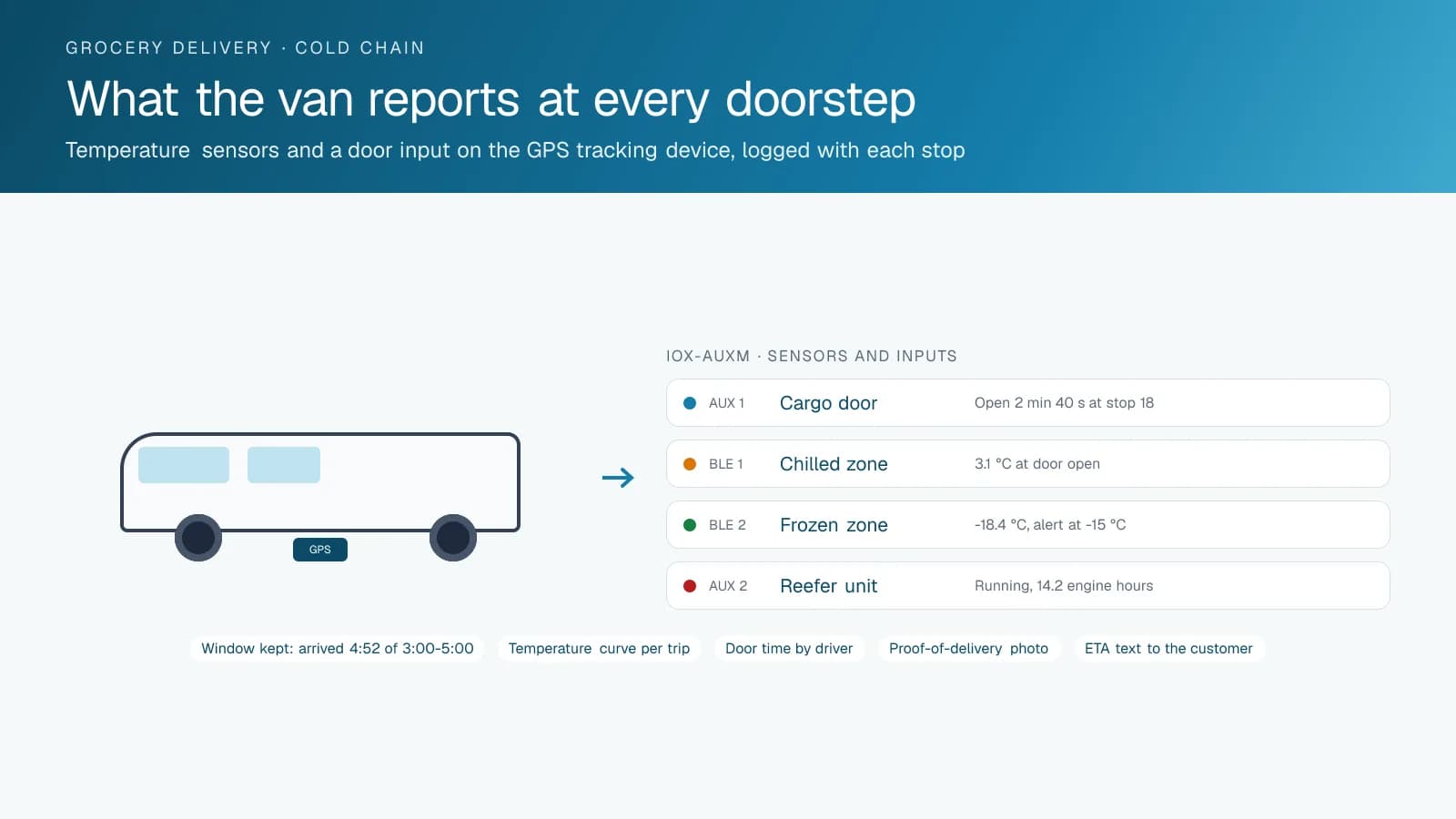
The record behind the map answers the complaint. A customer says the order came after the window closed; the geofence log shows the van at the address at 4:52, seven minutes before the end of the window, with the cargo door open for three minutes. A customer says the order never came; the replay shows the van at the door and the driver's proof-of-delivery photo beside it. High Point GPS sets these reports up so a customer service agent can pull the stop record while the customer is still on the chat.
The cold chain from the loading dock to the doorstep
A grocery van carries three temperatures at once: ambient, chilled and frozen. Bluetooth temperature sensors in each compartment report to the GPS tracking device every few minutes, and the trip record shows the temperature in each at every stop. A threshold alert reaches dispatch when the chilled compartment climbs past its limit, in time to reroute the van to the nearest store rather than deliver warm dairy to the next twelve customers. For a fleet with reefer trucks, a wired temperature connection to the reefer unit gives the same record from the unit's own sensor.
Most excursions start at the door. A door sensor on the IOX-AUXM auxiliary inputs records how long the cargo area stood open at each stop, and the report shows which drivers and which stops are letting the cold out. That is a coaching conversation and a route-planning decision rather than a refund. When a customer reports a thawed order, the temperature curve for the trip and the door time at their stop settle whether the fault was the van, the driver or the fifteen minutes the bag sat on a porch.
Routing the van and filling it in order
A grocery route has constraints a parcel route does not: every stop has a window, every van has three compartments of fixed size, and a frozen order cannot ride in the chilled space. Route planning in the platform sequences stops by window and by geography, and the stop order comes back to the picking team so the van is loaded last-stop-first. Dispatch sees the plan against the live position all day and moves a stop to another van when a customer changes the window or a van is delayed.
The same data shows which routes work and which do not. Stops per hour, time on site and kilometres between stops are reported by route, by driver and by day. The grocer sees where a zone is too large for one van or where a window has too many orders in it. Fuel and idling reports show a van that idles at every doorstep, which on a forty-stop route is an hour of engine time. High Point GPS builds these reports during onboarding and adjusts them as the delivery zones grow.
Driving on residential streets and keeping the van available
A grocery van spends its day on the streets where people live, and the driving standard has to match. Speed limits by zone tighten around schools and parks, hard braking and fast cornering are scored, and seatbelt use is reported from the vehicle. Driver scoring gives the delivery manager a short weekly list and a specific trip to coach from. AI dash cams add the view from the cab when the grocer wants it: a road-facing camera records the cyclist and the parked car, and a driver-facing camera flags phone use, with clips saved by event.
The weekend peak is when a van cannot be in the shop. Electronic DVIR in the driver app walks the driver through the van and the refrigeration unit before the first run, and a defect reaches the shop before the van is loaded. Maintenance reminders run on engine hours and mileage, and engine fault codes reach the shop as the van logs them. A charging fault on Thursday is fixed on Friday rather than stranding a full van of orders on Saturday morning, and the refrigeration unit's own hours are tracked for its service interval.
Frequently asked questions
Can customers see when their order will arrive?
Yes, if the grocer chooses to offer it. The platform's ETA for each stop can be sent by text or shown in the grocer's own app through the open API or an add-on library app. The grocer decides what the customer sees, and dispatch always has the full live map.
How does it record the temperature of the groceries?
Bluetooth temperature sensors in the chilled and frozen compartments report to the GPS tracking device every few minutes, and a wired connection to a reefer unit does the same for a truck. The trip record shows the temperature at each stop, and dispatch is alerted when a threshold is crossed.
Can it tell how long the cargo door was open?
Yes. A door sensor wired to the IOX-AUXM auxiliary inputs on the GPS tracking device records when the cargo door opened and closed at each stop. The report shows door time by stop and by driver, which is usually where a temperature excursion begins, and dispatch can be alerted when a door stays open past a set number of minutes.
Does it plan the delivery routes?
Yes. Route planning sequences stops by delivery window and geography, and the stop order goes back to the picking team so the van is loaded last-stop-first. Dispatch can move a stop to another van during the day when a window changes or a van runs late.
What does the driver have to do differently?
Run the pre-trip inspection in the driver app instead of on paper, follow the stop list on the tablet and take the proof-of-delivery photo at the door. Tracking, temperature logging and door recording work without any driver input, and a driver who logs in through the app or an NFC card has the day's stops attributed to them.
Related solutions
Related guides
- Delivery Fleet Management: How Last-Mile Companies Hit Delivery Windows →
- The Bluetooth Temperature Puck: A Ten-Year Wireless Thermometer for Reefers and Coolers →
- Wired Temperature Monitoring for Multi-Compartment Refrigerated Trucks →
- Cold Chain Compliance: What GPS Monitoring Does →
- Route Optimization Software for Last-Mile Delivery: Multi-Stop Planning Explained →
- How Geofencing Works for Fleet Tracking →
Get a free quote
What are you looking for?