
Industry
GPS Fleet Tracking for Hospitals & Healthcare Systems
GPS tracking for hospital and health-system fleets that puts couriers, facilities trucks, patient shuttles and security vehicles on one database, bills each department for what it actually drives, records the chain of custody for specimens and pharmacy runs, and shows who used a vehicle after hours.
Updated September 21, 2026
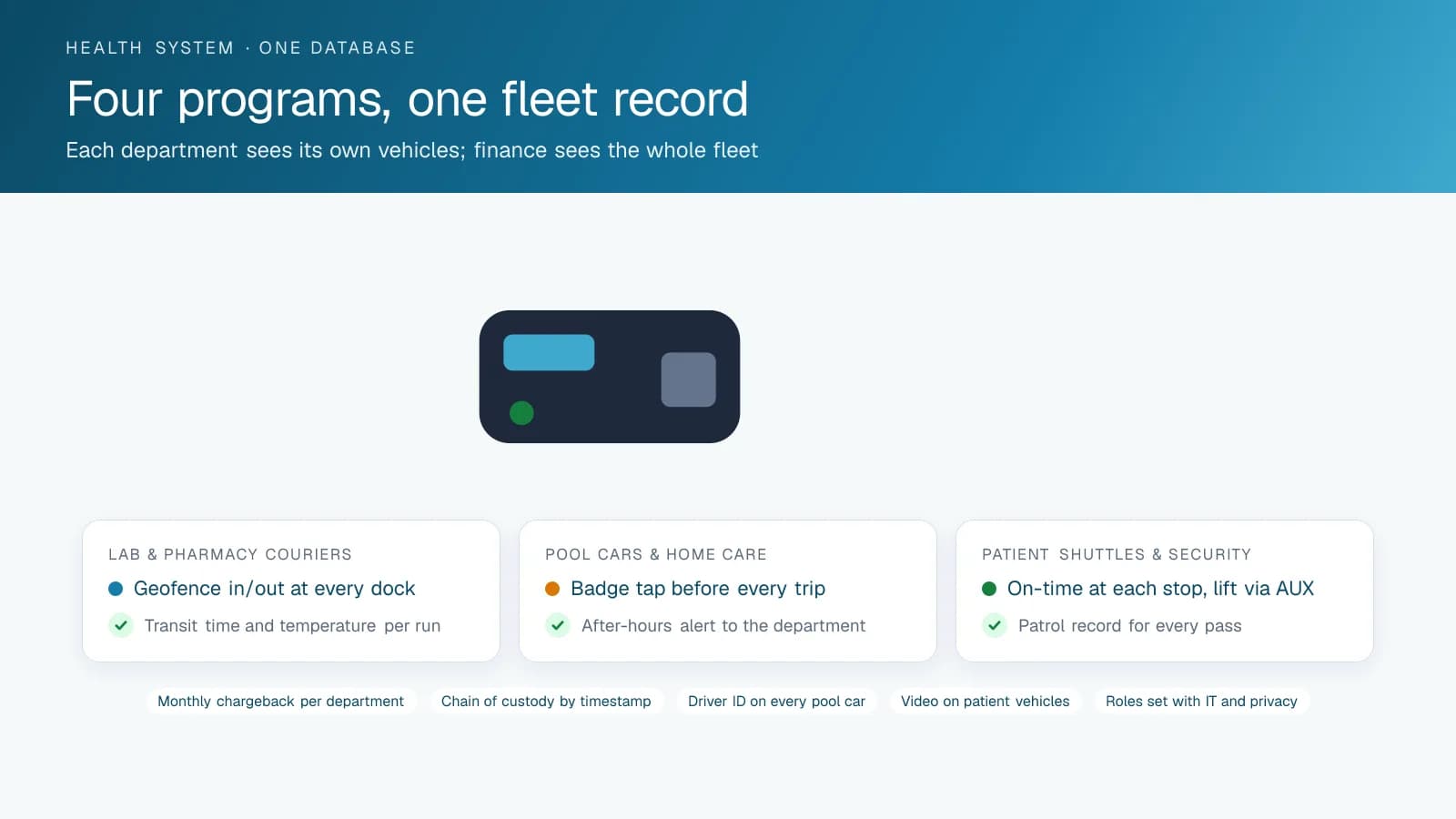
A health system's fleet is scattered across the org chart. Lab couriers run specimens between clinics and the central lab on a clock. Pharmacy vans deliver to satellite sites. Facilities trucks move between campuses. Patient shuttles connect the parking structure, the cancer centre and the dialysis unit. Security drives the perimeter all night. Home-care nurses drive pool cars to patients. Each program owns its vehicles, budgets them separately and answers a different regulator, and the fleet lives in a spreadsheet at facilities management that is six months out of date. High Point GPS puts every vehicle on one MyGeotab database with groups that match the departments. The health system sees the whole fleet and each program sees its own. Per-department reporting on kilometres, hours, fuel and idling feeds the monthly chargeback. Geofence records at every clinic, lab dock and pharmacy give the courier program a time-stamped chain of custody for each specimen run. Driver ID with an NFC reader ties each trip to a person, which answers the question of who took the pool car on Saturday night. Patient shuttles get on-time reporting and a map at the lobby desk. Security vehicles get a patrol record. Pre-trip inspections, driver scoring and AI dash cams give the risk office the driver safety program it has asked for. One vendor handles installation across every campus and stays on as support.
Common challenges
- Vehicles owned by a dozen programs, with no single view of the fleet and no consistent rules across it
- Specimen and pharmacy courier runs with no time-stamped record of pickup and delivery when a sample is questioned
- Department chargebacks estimated from a vehicle count rather than from what each program actually drove
- Pool cars driven after hours and on weekends with no record of who had the keys
- Patient shuttles that run a schedule nobody measures, while patients late for dialysis or chemotherapy complain to the lobby desk
- A risk and compliance office with no driver safety data and no inspection records for a fleet that carries patients
How High Point GPS helps
- One MyGeotab database with groups per program, so the health system sees the fleet and each department sees its own vehicles
- Geofence arrival and departure records at every clinic, lab dock, pharmacy and campus, for courier chain of custody
- Per-department monthly reporting on kilometres, hours, fuel and idling, exported for internal chargebacks
- Driver ID with an IOX-NFCREADERA reader on pool cars, with alerts for after-hours use and unidentified drivers
- Patient shuttle on-time reporting from geofenced stops, with a shuttle map for the lobby desk and patient app
- Security patrol records showing each pass of the perimeter, the parking structures and the off-site clinics
- Electronic pre-trip inspections in the Geotab Drive app for shuttles and wheelchair-accessible vans
- Driver scoring by department, AI dash cams on patient-carrying vehicles, and temperature monitoring on pharmacy and specimen vans
One Fleet Across Every Program
The health system's fleet office, if there is one, usually inherits a list of vehicles from facilities, another from the lab, another from security and a fourth from the foundation. High Point GPS builds the MyGeotab database so that each program has its own group with its own permissions, and the fleet office and finance see everything. Rules and alerts follow the groups: a speeding alert on a courier van reaches the lab logistics coordinator, an after-hours alert on a pool car reaches the department that owns it. When a new clinic opens or a program moves, the group changes and nothing else does.
Per-department reporting is what finance needs at month end. Each program's kilometres, engine hours, fuel purchases from the fuel-card integration and idling time come out of the same records, in a format the general ledger can load. A department that argues it is being charged for a van it barely uses gets a trip list. A department that has been quietly using a facilities truck for its own deliveries shows up in the report, and the conversation happens with data rather than suspicion. The same export supports the sustainability office's fuel and emissions reporting.
Chain of Custody for Couriers
Lab and pharmacy couriers are the most time-sensitive fleet in a health system. A specimen that sits in a van for two hours can be rejected; a chemotherapy dose that misses a delivery window is a patient rescheduled. Every clinic, lab dock, pharmacy and satellite site becomes a geofence, and the GO device records the arrival and departure at each on every run. The courier record for a run reads: left Clinic B at 10:04, arrived at the central lab dock at 10:41, thirty-seven minutes in transit. When a sample is questioned, the lab has the timeline without asking the driver.
A Bluetooth temperature sensor in the van adds the cold-chain record for pharmacy and refrigerated specimen runs, logged alongside the position. Route planning sequences the stops so that the time-critical pickups run first, and the dispatcher sees which courier can absorb a stat call without pushing a scheduled run past its window. Trips are stored on the device when coverage drops in a parking structure and uploaded when the van comes out. The courier coordinator sees a late run on the map before the lab calls about it.
Pool Cars, After Hours and Driver ID
A health system's pool cars are driven by home-care nurses, social workers, administrators and residents, and the vehicle that was in a collision on Saturday night is the one nobody remembers checking out. An IOX-NFCREADERA reader in each pool car requires a badge tap before the trip is attributed, and the platform alerts when a car moves without a driver identified or outside the hours the department allows. The trip record then carries the driver, the department and the route, and the reservation, if the health system's booking tool is connected through the open API, is attached as well.
The same driver ID serves the security fleet. Each pass of the perimeter, the parking structures and the off-site clinics is a geofence record, and the shift report shows which officer drove which vehicle where. A complaint that security never came by the north lot at 2 a.m. is answered from the record, and the security director sees which patrol routes are actually being driven. Officers log in with the same badge they use for the building, and the platform can alert when a patrol vehicle sits idling at a single point for longer than the shift allows.
Patient Shuttles, Inspections and Video
Patient shuttles carry people who are unwell, on a schedule that matters to their treatment. Each stop is a geofence, so the on-time report is built from actual arrivals, and a shuttle map at the lobby desk or in the patient app shows where the next one is. Wheelchair lifts and doors are read through IOX-AUXM inputs, so the record shows the lift cycled at the dialysis entrance at 7:52. Pre-trip inspections in the Geotab Drive app cover the lift, the securements and the doors, and a defect reaches the shop before the shuttle takes its first patient.
Driver scoring on hard braking, cornering and speed is set for vehicles with patients aboard, and reported by department for the risk office's monthly review. AI dash cams, road- and driver-facing, on the shuttles and the accessible vans provide the video for a passenger fall or a collision at a campus intersection. High Point GPS handles installation across every campus and clinic on the health system's schedule, and remains the support contact when vehicles or programs change. When a new clinic opens, its vehicles and geofences join the existing groups and the rules already apply.
Frequently asked questions
Can each department see only its own vehicles?
Yes. The MyGeotab database is built with a group per program and matching permissions. The fleet office and finance see the whole fleet; a department sees its vehicles, drivers and reports; alerts route to that department's coordinator. Groups change when programs reorganize. A user can belong to more than one group when a role spans programs.
How does it document courier chain of custody?
Every clinic, lab dock and pharmacy is a geofence, and the GO device records arrival and departure at each on every run. The timeline for a specimen or pharmacy run, including transit time and any temperature sensor readings, is available without asking the driver. The record is exported as a trip report if a sample is challenged.
Can it tell us who drove a pool car after hours?
Yes. An IOX-NFCREADERA reader requires a badge tap before a trip is attributed, and the platform alerts when a car moves with no driver identified or outside the department's allowed hours. The trip record carries the driver, the department and the route. The reservation attaches to the trip when the booking tool is connected through the API.
Does it support internal chargebacks?
Yes. A monthly report per department exports kilometres, engine hours, fuel purchases and idling time in a format the general ledger can load. Chargebacks come from what each program actually drove, with the trip list available if a department questions its charge. A department that disputes a charge gets a trip list rather than an estimate.
Is the data handled appropriately for a healthcare organization?
The platform records vehicle and driver data, not patient information. Access is controlled by MyGeotab user roles and groups, and High Point GPS sets them up with the health system's IT and privacy offices. Retention for video and trip data is configured to the organization's policy. Video and driver access can be limited to named supervisors.
Related solutions
Related guides
- Fleet Dispatch and Tracking for Public Sector →
- How Geofencing Works for Fleet Tracking →
- IOX-NFCREADERA: Driver ID by NFC Tap, So Every Trip Has a Name on It →
- The Bluetooth Temperature Puck: A Ten-Year Wireless Thermometer for Reefers and Coolers →
- Fleet Telematics Data Security: What to Know →
- NEMT Fleet Tracking: GPS for Non-Emergency Medical Transportation Vehicles →
Get a free quote
What are you looking for?